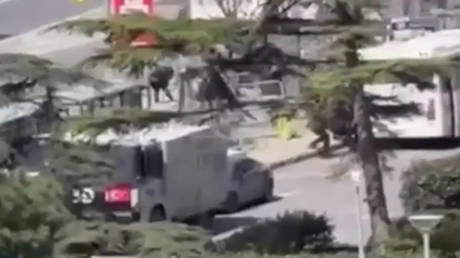
The discharge of kinetic force in the immediate vicinity of a high-value diplomatic mission—specifically the Israeli consulate in Istanbul—represents a critical failure in the established "de-escalation buffer" typically maintained by host-nation security apparatuses. When gunfire erupts in these high-density urban environments, the event functions as more than a localized crime; it serves as a stress test for the bilateral security protocols and the structural integrity of the Vienna Convention on Consular Relations. This incident exposes the widening gap between traditional state-level protection and the rise of decentralized, non-state kinetic actors operating within porous civilian sectors.
The Triad of Diplomatic Vulnerability
Urban diplomatic missions operate under a unique set of constraints that create inherent security bottlenecks. The Istanbul incident highlights three specific variables that determine the lethality and political fallout of such an event:
1. Spatial Constraints and Proximity Risk
Unlike remote embassies housed in fortified compounds, consulates in major metropolitan hubs like Istanbul are often integrated into commercial or residential high-rises. This proximity eliminates the "stand-off distance" required to neutralize a threat before it reaches the perimeter. The presence of civilian traffic creates a target-rich environment where collateral damage is almost certain, complicating the rules of engagement for both consular guards and local police forces.
2. Information Asymmetry in Urban Skirmishes
The immediate aftermath of a consulate shooting is characterized by an information vacuum. In the Istanbul case, initial reports often struggle to distinguish between organized terrorism, personal grievance, or state-sponsored signaling. This ambiguity is a tactical asset for the perpetrator, as it delays a coordinated response and allows for the rapid dissemination of unverified visual data—often captured by civilian bystanders—which can be weaponized for propaganda before official narratives are established.
3. The Sovereignty Friction Point
The sidewalk in front of a consulate is a legal grey zone. While the building itself is inviolable under international law, the immediate exterior is the jurisdiction of the host nation. Friction occurs when the response times or tactical methods of the Turkish security forces do not align with the internal threat assessments of the Israeli security detail. This mismatch creates a "response lag" that attackers exploit.
Structural Breakdown of Kinetic Escalation
The mechanics of an urban gunfight near a sensitive site follow a predictable, yet devastating, chain of causality. Understanding these links is essential for deconstructing why current preventative measures failed.
The first link is the Surveillance Phase. High-value targets like the Israeli consulate are under constant observation, not just by cameras, but by human intelligence. Any lapse in the "randomization" of security patrols or vehicle arrivals provides a window for a planned strike.
The second link is the Initiation of Force. In dense urban environments, the sound of gunfire triggers immediate chaos, which serves as a smokescreen. The "OODA Loop" (Observe, Orient, Decide, Act) of the security forces is compromised by the presence of non-combatants, leading to a defensive posture rather than an immediate neutralizing strike.
The third link is the Geopolitical Ripple. For a mission representing Israel, any kinetic event is immediately viewed through the lens of regional conflict. The event is not analyzed in a vacuum; it is processed as a data point in the ongoing tension between Ankara’s regional aspirations and Jerusalem’s security requirements.
The Cost of Perimeter Erosion
When a security perimeter is breached or even approached with lethal intent, the economic and political costs are quantifiable. We must categorize these impacts to understand the true scale of the Istanbul incident.
- Operational Hardening Costs: Following a shooting, the immediate requirement is a "security surge." This involves the deployment of armored assets and specialized tactical units. The long-term cost involves permanent changes to the urban fabric—installing bollards, closing streets, and increasing the frequency of identity checks, which degrades the local business environment.
- Intelligence Recalibration: A failure to prevent a shooting indicates a "blind spot" in the signals intelligence (SIGINT) or human intelligence (HUMINT) networks. The cost here is the resource-intensive process of auditing all current informants and digital surveillance tools to find the point of failure.
- Diplomatic Capital Depletion: Every incident of violence requires a diplomatic "cleanup." The host nation must reassure the foreign mission of its safety, while the foreign nation often issues travel advisories that damage the host's tourism and investment profile.
Analyzing the Actor Profile: Lone Wolf vs. Cell-Based Operations
The tactical execution of the gunfire near the Istanbul consulate suggests a specific operational profile. A high-precision, multi-shooter ambush indicates state or paramilitary involvement, whereas a chaotic, low-accuracy exchange often points to a radicalized individual or a small, poorly funded cell.
A "Lone Wolf" actor presents a higher difficulty for intelligence agencies because they lack the communication footprint of a larger organization. However, their lethality is usually capped by limited access to high-grade equipment. Conversely, a cell-based operation, while easier to detect via SIGINT, possesses the capability for a sustained siege or a multi-pronged attack. The Istanbul event appears to sit at the intersection of these two—likely a small group with enough technical proficiency to execute a strike but lacking the depth to hold a position or successfully exfiltrate.
The Failure of Deterrence Frameworks
Standard deterrence relies on the "Certainty of Retaliation." However, in the context of ideological or asymmetric warfare, the perpetrator often views death or capture as a successful outcome. This renders traditional deterrence models—based on rational actor theory—largely obsolete.
Instead, security must pivot toward Disruption-Based Defense. This involves:
- Kinetic Interception: Developing the capability to neutralize a threat within seconds of the first shot, utilizing automated detection systems and rapid-response units stationed within a 300-meter radius.
- Digital Perimeter Expansion: Monitoring localized social media and encrypted channels for "pre-attack chatter" that specifically references the geography of the consulate.
- Cross-Agency Interoperability: Eliminating the bureaucratic silos between the Turkish National Intelligence Organization (MİT) and foreign security attachés to ensure real-time data sharing.
Strategic Realignment and the Buffer Zone
The Istanbul incident serves as a definitive signal that the status quo of "passive protection" is insufficient for high-friction diplomatic missions. The move from passive to active defense requires a fundamental shift in how urban consular zones are managed.
The priority must be the establishment of a Technological Exclusion Zone. This is not a physical wall, but a dense layer of multi-spectral sensors capable of identifying weapons signatures and abnormal behavior patterns before a shot is fired. Furthermore, the legal frameworks governing the use of force by diplomatic security details on host-nation soil need to be renegotiated to allow for proactive defense in the face of imminent, verifiable threats.
The final strategic play for any mission operating in a high-risk urban environment is the "Hard Pivot to Decentralization." If a central consulate building becomes a magnet for violence, the physical concentration of diplomatic functions must be reduced. Distributing administrative tasks to smaller, non-descript satellite offices while maintaining the primary consulate as a fortified symbolic hub reduces the "all-or-nothing" risk of a single kinetic event. This hybrid model preserves diplomatic presence while significantly lowering the profile of the target for potential attackers.