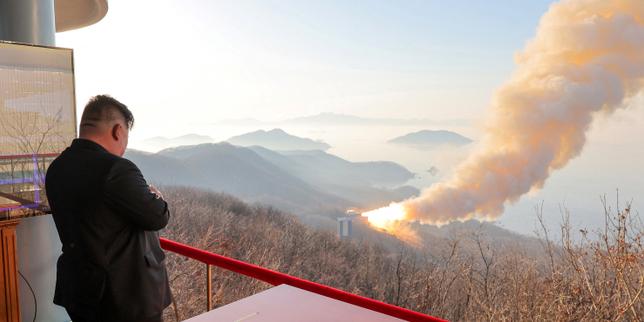
The launch of "unidentified projectiles" by North Korea is rarely a tactical failure of intelligence; rather, it is a deliberate exercise in ambiguity designed to test the detection thresholds and political cohesion of the ROK-US alliance. When the South Korean Joint Chiefs of Staff report such an event, the lack of immediate classification functions as a metric of the projectile’s novelty or its flight profile’s deviation from standard ballistic trajectories. To understand these launches, one must deconstruct the North Korean strategy into three operational layers: technical validation, diplomatic signaling, and the stress-testing of regional missile defense architectures.
The Taxonomy of Projectile Ambiguity
The term "unidentified projectile" serves as a placeholder for a spectrum of kinetic capabilities. In the North Korean context, this usually filters into four distinct technological categories, each carrying a different escalatory weight.
- Solid-Fuel Short-Range Ballistic Missiles (SRBMs): These represent the most frequent "unidentified" launches. Unlike older liquid-fueled variants, solid-fuel systems like the KN-23 or KN-24 can be deployed and fired within minutes, significantly reducing the "kill chain" window for preemptive strikes.
- Large-Caliber Multiple Rocket Launcher Systems (MRLS): Pyongyang often blurs the line between traditional artillery and ballistic missiles. High-caliber rockets (300mm to 600mm) often follow "quasi-ballistic" paths, making them difficult to categorize in the initial minutes of flight.
- Hypersonic Glide Vehicles (HGVs): These systems represent a tier-one threat because they detach from traditional parabolic arcs. An HGV maneuvers within the atmosphere, staying below the optimal radar horizons of systems like THAAD (Terminal High Altitude Area Defense).
- Submarine-Launched Ballistic Missiles (SLBMs): These introduce a second-strike capability that complicates the geographical focus of South Korean Aegis-equipped destroyers.
The ambiguity during the first 60 minutes of a launch is a feature of the weapon's design. By utilizing depressed trajectories—firing at a lower angle than optimal for distance—North Korea forces regional radar systems to interpolate data from a fragmented flight path.
The Strategic Cost Function of Provocation
Every launch incurs a significant opportunity cost for the North Korean regime. Given the scarcity of high-grade propellant and specialized telemetry equipment, these tests are not mere military exercises; they are capital-intensive diplomatic communications. The regime operates on a cost-benefit ratio where the "yield" is measured in political concessions or domestic consolidation.
The Internal Validation Loop
Military modernization is a primary pillar of Kim Jong Un’s legitimacy. Each launch serves as a physical proof of concept for the "Five-Year Plan for the Development of Defense Science and Weapon Systems." The engineering data gathered during a failed or partially successful flight is often more valuable than a "perfect" flight, as it identifies stress points in airframe integrity and propulsion efficiency.
The External Pressure Mechanism
The timing of these launches consistently correlates with specific external stimuli. The strategic logic follows a predictable sequence:
- The Reaction Phase: Testing occurs during ROK-US joint military exercises (such as Freedom Shield) to project a counter-offensive capability.
- The Decoupling Phase: Launches are often calibrated to drive a wedge between Washington’s denuclearization goals and Seoul’s desire for immediate de-escalation.
- The Normalization Phase: By conducting frequent launches, Pyongyang aims to "fatigue" the international community, eventually forcing the world to accept North Korea as a permanent nuclear weapons state.
Terminal Phase Dynamics and Defense Saturation
The technical challenge for South Korea and Japan lies in the "Terminal Phase"—the final moments before impact. North Korea has moved away from simple Scud-based technology toward systems capable of "pull-up" maneuvers.
In a standard ballistic flight, the trajectory is predictable via Newtonian physics. However, newer North Korean projectiles can change altitude and direction during their descent. This creates a computational bottleneck for interceptors. If a missile can maneuver, the interceptor must have a significantly higher G-load capability to adjust its course. This is the logic of saturation: by launching multiple "unidentified" projectiles simultaneously, North Korea aims to overwhelm the processing capacity of the Patriot (PAC-3) and M-SAM (Cheongung) batteries.
The Interceptor Paradox
Deploying an interceptor costs significantly more than the projectile it targets. If North Korea can produce ten low-cost MRLS rockets for every one high-cost interceptor, they achieve a favorable "economic exchange ratio." This allows them to deplete the defensive inventory of the South without ever needing to use their primary nuclear-tipped assets.
Geopolitical Friction Points
The classification of these projectiles by the South Korean military is a political act. Labeling a launch a "missile" triggers specific UN Security Council resolutions and necessitates a formal diplomatic response. Labeling it an "unidentified projectile" allows for a period of strategic silence, providing the government with room to calibrate its rhetoric.
- The Role of Beijing and Moscow: North Korea utilizes the current fractured state of the UN Security Council. Knowing that a veto from China or Russia is almost certain, the regime can test increasingly sophisticated technology with minimal risk of additional multilateral sanctions.
- The Intelligence Gap: Detecting a launch is easy; identifying the payload is difficult. The gap between "launch detected" and "classification" is where disinformation thrives. North Korea uses this window to gauge the speed and accuracy of South Korean intelligence, effectively "testing the testers."
Operational Risks and Systemic Fragility
The primary risk in this cycle is not an intentional strike, but a "procedural escalation." As North Korea tests more projectiles with unconventional flight paths, the margin for error for South Korean and Japanese automated defense systems narrows.
The reliance on "Launch on Warning" postures means that a projectile perceived to be on a trajectory toward a high-value target could trigger an automatic retaliatory strike. The lack of a direct communication "hotline" between Pyongyang and Seoul increases the probability that a technical malfunction or a miscalculated test flight could be interpreted as the opening salvo of a conflict.
Strategic Recommendation for Regional Stability
The current paradigm of "detect, condemn, and wait" has proven insufficient. To counter the North Korean projectile strategy, regional powers must pivot from a purely defensive posture to a "Resilience and Redundancy" framework.
- Integrated Sensor Fusion: South Korea and Japan must move beyond bilateral intelligence sharing (GSOMIA) toward a fully integrated, real-time sensor net that combines satellite infrared data with low-altitude radar. This eliminates the "unidentified" window and reduces the psychological impact of the launch.
- Asymmetric Economic Countermeasures: Instead of relying on stalled UN sanctions, the focus should shift toward "secondary targeting" of the specific supply chains providing the electronic components for guidance systems.
- Electronic Warfare (EW) Prioritization: The focus on kinetic interception (hitting a missile with a missile) is economically unsustainable. Investment should scale toward high-powered microwave and laser systems capable of disrupting the telemetry of projectiles during the mid-course phase.
The objective is to devalue the launch as a currency. When a launch no longer generates headlines, intelligence confusion, or diplomatic concessions, the cost-benefit ratio for the North Korean regime will finally invert.