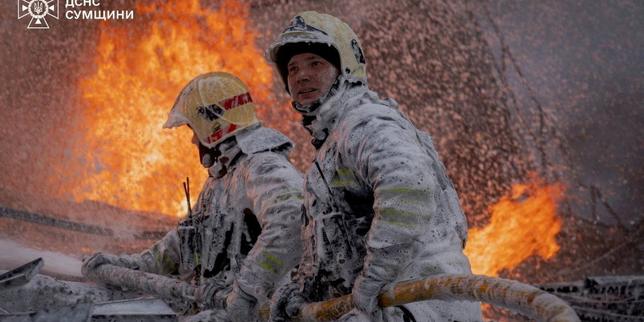
The deployment of 327 unmanned aerial vehicles (UAVs) in a single nocturnal window represents a shift from tactical harassment to a strategy of industrial-scale atmospheric saturation. This volume of fire is designed to solve a specific mathematical problem for the aggressor: forcing the exhaustion of high-cost interceptor inventories while simultaneously identifying the geometric gaps in the defender's radar coverage. By analyzing this offensive through the lens of cost-exchange ratios and kinetic density, the true objective reveals itself not as a series of individual strikes, but as a systematic stress test of the Ukrainian Integrated Air Defense System (IADS).
The Mechanics of Saturation and Integrated Defense
Saturation attacks operate on the principle of overwhelming the target's target-tracking capacity. Every air defense battery possesses a finite number of engagement channels—the maximum number of simultaneous threats its radar can track and its missiles can intercept. When the volume of incoming projectiles exceeds these channels, the system enters a state of "overflow," where additional threats pass through unmonitored. You might also find this similar story interesting: The Islamabad Illusion: Why Trump’s Second Round of Iran Talks is a Geopolitical Mirage.
The 327-drone offensive utilizes three distinct tiers of operational intent:
- Sensor Loading: The initial wave forces radar operators to activate active scanning modes, which reveals the location of mobile defense units to Electronic Intelligence (ELINT) aircraft or satellites.
- Kinetic Depletion: Low-cost, slow-moving loitering munitions (such as the Shahed-136 variants) act as "missile magnets." They are cheap enough to be produced at scale but dangerous enough that they cannot be ignored, forcing the defender to expend interceptors that cost ten to fifty times the price of the drone.
- Pathfinding for Precision Strikes: The survival rate of these 327 drones provides a live data map. Where drones are shot down, a "hard" defense node exists; where they penetrate, a "corridor" is identified for higher-value cruise or ballistic missile strikes.
The Cost Exchange Asymmetry
The fundamental metric governing this phase of the conflict is the Cost-Exchange Ratio (CER). In a sustainable defense, the cost of the interceptor ($C_i$) should ideally be lower than the cost of the target being destroyed ($C_t$) or the value of the asset protected ($V_a$). As discussed in recent coverage by NBC News, the implications are significant.
$$CER = \frac{C_i}{C_t}$$
In the case of the 327-drone attack, the CER is heavily skewed in favor of the attacker. Shahed-class drones, estimated at $20,000 to $50,000 per unit, are frequently engaged by IRIS-T, NASAMS, or Patriot missiles costing between $500,000 and $4,000,000 per shot. Even when man-portable air-defense systems (MANPADS) or Gepard anti-aircraft guns are used, the logistics of distributing these assets across a nation the size of Ukraine creates "defense deserts."
This creates a Logistical Bottleneck. The bottleneck is not necessarily the financial cost—often covered by international aid—but the industrial throughput of interceptor production. If Russia can manufacture or procure 1,000 drones per month while the collective West produces only 100 high-end interceptors, the defense will eventually reach a point of "kinetic bankruptcy," regardless of financial backing.
Architectural Vulnerabilities in Urban Protection
Defending a fixed point, such as a power substation or a command center, requires a different geometric configuration than defending a mobile front line. The 327 drones were not aimed at a single point but were dispersed to force the fragmentation of defense assets.
The defense must solve for the Probability of Kill ($P_k$) across a 360-degree axis. By launching from multiple vectors—typically North from Kursk, East from the Sea of Azov, and South from Crimea—the attacker forces the defender to spread their radar "fans" thin.
- Radar Horizon Limitations: Low-altitude drones exploit the curvature of the earth and terrain masking. If a drone flies at 50 meters, a ground-based radar might only detect it at a range of 20-30 kilometers.
- Decoy Integration: Within the 327 units, a percentage likely consisted of "Gerbera" or other plywood-and-foam decoys without warheads. These carry Luneburg lenses—small devices that make a tiny drone appear as large as a fighter jet on radar—further complicating the prioritization matrix for air defense commanders.
Operational Responses: The Rise of the Mobile Fire Group
To counter the unfavorable CER, the Ukrainian defense has transitioned toward a decentralized, "low-tech" solution: Mobile Fire Groups (MFGs). These units, typically mounted on pickup trucks equipped with thermal imaging and heavy machine guns or twin-barreled cannons, represent a shift toward Asymmetric Deflation.
The MFG strategy works by:
- Decoupling from the Grid: Using acoustic sensors and visual spotters rather than active radar, making the units invisible to anti-radiation missiles.
- Economic Rebalancing: Shifting the intercept cost from a $2 million missile to a few hundred rounds of 14.5mm or 23mm ammunition.
- Geographic Elasticity: Moving units along the predicted flight paths of drones (often following highways or riverbeds) to create a "running gauntlet" rather than a static wall.
However, the 327-drone volume tests the saturation point of even these mobile groups. If a group can engage two drones in a five-minute window, but ten drones pass through their sector, eight remain unaddressed. This is the "Mass-over-Precision" doctrine in its purest form.
The Signal Intelligence Harvest
Beyond physical destruction, a mass launch serves as a massive data-collection exercise. Russian "A-50U" or equivalent airborne early warning and control (AEW&C) platforms, along with ground-based ELINT stations, monitor the electronic emissions triggered by the 327 drones.
When a Ukrainian radar pings a drone, its coordinates, frequency, and pulse repetition interval (PRI) are recorded. This allows the Russian General Staff to build a Dynamic Electronic Order of Battle (EOB). The 327-drone strike is essentially a "flashbulb" that illuminates the entire Ukrainian defense landscape for a brief period, allowing the attacker to see where the "shallows" and "deeps" of the defense are located before the next phase of the campaign.
Strategic Constraints and Attrition Realities
The primary limitation for the attacker is the exhaustion of their own stockpile and the degradation of launch platforms. However, the move toward 300+ drone salvos suggests that domestic Russian production lines, specifically in the Alabuga Special Economic Zone, have reached a level of maturity where they can sustain "surge" capacity.
The defender faces a three-fold pressure:
- Technical Fatigue: Continuous 24/7 alert status for crews leads to human error and mechanical failure of sensitive radar components.
- Inventory Displacement: Moving a Patriot battery to defend Kyiv from drones leaves a thermal power plant in Kharkiv or a bridge in Odesa vulnerable to ballistic missiles.
- Psychological Erosion: The "constant threat" environment is designed to degrade the civilian will and the perceived efficacy of the state's protection.
The 327-drone offensive signals that the war has entered a period of Industrialized Attrition. Victory is no longer determined by the "cleverness" of a single strike, but by the efficiency of the assembly line and the ability to maintain a favorable cost-per-kill ratio.
To maintain defensive integrity, the transition to automated, AI-augmented CIWS (Close-In Weapon Systems) and electronic warfare (EW) "domes" is a mandatory evolution. Reliance on traditional, missile-based air defense to counter $20,000 drones is an unsustainable strategy that leads to eventual systemic collapse. The defense must now prioritize the deployment of directed-energy weapons or high-frequency EW jamming to achieve a "zero-cost" intercept, effectively breaking the attacker's economic logic of saturation.
The strategic play is now a race between Russian production scaling and the Western integration of low-cost, high-volume counter-UAS (C-UAS) technologies. If the intercept cost is not brought down by an order of magnitude within the next two fiscal quarters, the defender will be forced to make impossible choices regarding which critical infrastructure to abandon to the next wave of saturation.