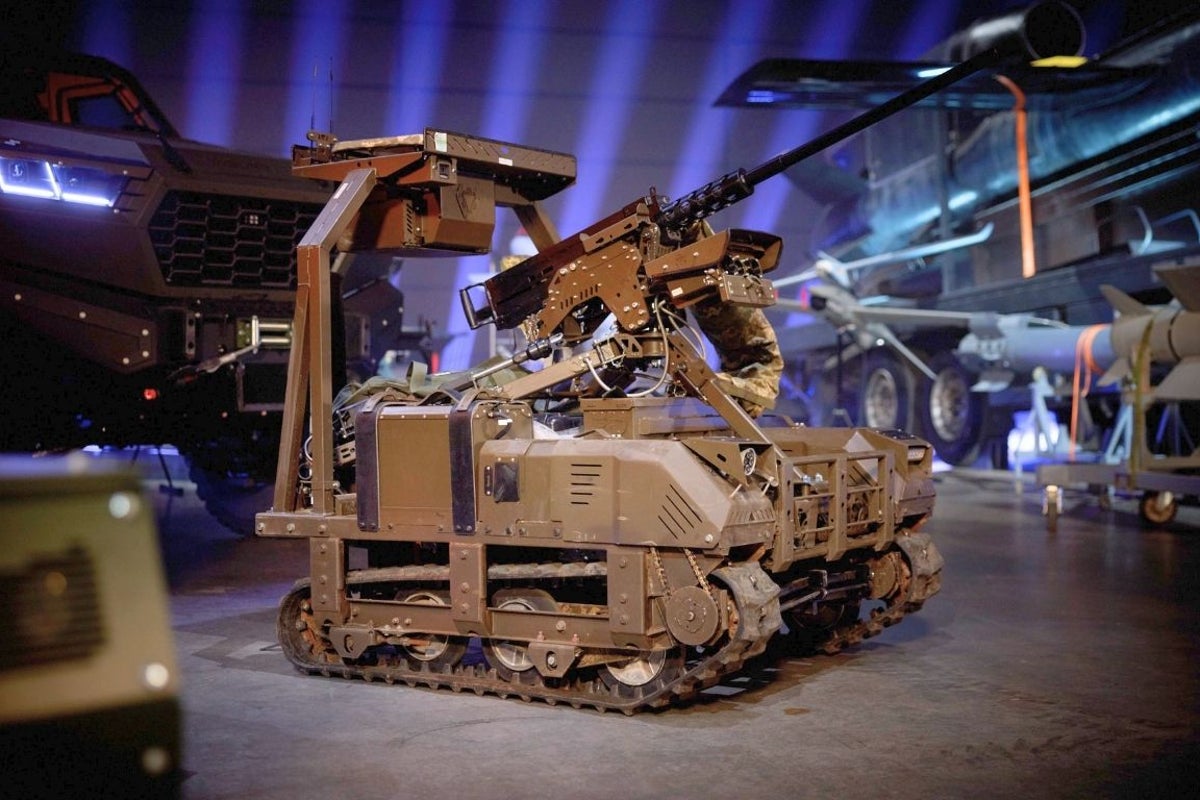
The transition from aerial dominance to terrestrial automation in the Russo-Ukrainian conflict represents a fundamental shift in the cost-of-attrition equation. While First-Person View (FPV) drones redefined the tactical deep, the emergence of Unmanned Ground Vehicles (UGVs) addresses the final 500 meters of combat—the zone where human casualty rates are highest and logistical friction is most acute. This is not merely an evolution of hardware; it is a structural reorganization of front-line risk management.
The Triad of UGV Operational Utility
The deployment of land-based robotics in Ukraine follows a functional taxonomy categorized by risk-transfer. By replacing high-value biological assets (soldiers) with low-cost mechanical assets, the Ukrainian military is attempting to solve for the scarcity of manpower against a numerically superior adversary.
1. Logistics and Last-Mile Resupply
The primary bottleneck in trench warfare is the "lethal corridor" between the nearest covered transport point and the forward edge of the battle area. Transport UGVs, often simple four-wheeled or tracked platforms, minimize the exposure of logistics teams.
- Payload Efficiency: Platforms capable of carrying 200–500kg of ammunition or water replace four to six human porters.
- Thermal Signature Management: Low-profile electric motors produce a negligible thermal footprint compared to internal combustion engines or groups of humans, reducing the probability of detection by Russian thermographic sensors.
- Casualty Evacuation (CASEVAC): The extraction of wounded personnel under fire is a high-risk activity that typically requires four able-bodied soldiers. A dedicated CASEVAC UGV frees those four soldiers to maintain defensive posture while the platform navigates back to a stabilization point.
2. Kinetic and Combat Platforms
Armed UGVs, or "robot tanks," serve as mobile sentries. These units are typically equipped with 7.62mm or 12.7mm machine guns, or in some cases, anti-tank guided missiles (ATGMs).
- Suppression Persistence: Unlike a human gunner who must retreat under heavy artillery fire, a UGV can remain in a fixed position to suppress advancing infantry until the hardware is physically destroyed.
- Static Defense Augmentation: Positioning UGVs in "grey zones" between trenches allows for an early warning system that can engage the enemy without risking immediate encirclement of human troops.
3. Mine Warfare and Engineering
The Ukrainian front is currently the most densely mined territory on earth. UGVs provide the only scalable solution for clearing paths or, conversely, seeding minefields in contested territory without high human cost.
- Remote Minelaying: Small, stealthy UGVs can deploy TM-62 anti-tank mines behind enemy lines during night operations, disrupting Russian supply routes.
- Demining Attrition: Using expendable robots to trigger or neutralize mines is a more sustainable economic trade than losing a Western-supplied Leopard 2 or a specialized Wisent demining vehicle.
The Economic Logic of Mechanical Attrition
The shift to UGVs is driven by an unavoidable mathematical reality: the rising cost of human capital versus the falling cost of mass-produced electronics.
$$C_{attrition} = \frac{Cost_{Platform} + Cost_{Training}}{Probability_{Survival}}$$
In this model, the $Cost_{Training}$ for a professional soldier is an investment spanning months or years, whereas the $Cost_{Training}$ for a UGV operator is centralized and scalable. When a UGV is destroyed, the loss is purely financial ($Cost_{Platform}$). When a soldier is lost, the cost includes the loss of specialized experience and the social burden of casualty.
The Feedback Loop of Electronic Warfare
The primary technical constraint on UGV effectiveness is the radio-frequency (RF) environment. Unlike aerial drones, which maintain a relatively clear line-of-sight (LOS) for signals, UGVs operate in the "clutter" of the earth's surface.
- Signal Masking: Terrain, vegetation, and buildings degrade control signals. This necessitates either high-powered transmitters—which act as beacons for Russian electronic intelligence (ELINT)—or higher levels of onboard autonomy.
- Frequency Agility: To survive in a dense Electronic Warfare (EW) environment, UGV controllers are migrating to "frequency hopping" and MESH networking, where multiple drones act as signal relays to maintain connectivity with a ground robot deep in a valley or trench.
Structural Limitations and Friction Points
Despite the strategic advantages, the "revolution" of land robots faces severe physical and technical hurdles that prevent them from fully replacing infantry.
Mobility and Terrain Complexity
Unlike the air, the ground is an obstacle-rich environment. A 10-centimeter-deep rut or a fallen tree limb can immobilize a wheeled UGV.
- The Tracked vs. Wheeled Dilemma: Tracked systems offer superior cross-country mobility but suffer from higher mechanical complexity and energy consumption. Wheeled systems are faster and cheaper but are limited to relatively flat or firm surfaces.
- Battery Density: Current lithium-ion technology limits operational endurance. A UGV performing high-torque maneuvers in mud will deplete its power source in hours, creating a new logistical burden: the need to recover and recharge the robots themselves.
The Autonomy Gap
True autonomy—the ability for a robot to navigate a chaotic battlefield without a human pilot—remains elusive.
- Target Discrimination: Distinguishing between a wounded comrade and an enemy combatant requires sophisticated Computer Vision (CV) that is susceptible to spoofing and environmental interference (smoke, rain, mud on lenses).
- Ethical and Command Latency: The requirement for a "human in the loop" for lethal decisions introduces latency. In a high-speed firefight, the time taken for a remote operator to confirm a target can be the difference between a successful defense and a breached line.
Integration into the Combined Arms Framework
UGVs do not function as a standalone "silver bullet." Their value is realized only when integrated into a multi-domain architecture. In a typical Ukrainian engagement, an aerial drone (UAV) provides the "eye in the sky," identifying targets and relaying coordinates to a ground-based UGV or a precision artillery unit.
Data-Centric Warfare
The UGV is increasingly a node in a broader sensor network. Modern Ukrainian platforms are being equipped with acoustic sensors to detect incoming mortar fire or the sound of approaching armor, feeding that data back into situational awareness software like "Delta." This transforms a simple transport robot into a mobile intelligence asset.
The Strategic Path Toward Mass-Scale Automation
To achieve a decisive advantage, the production of UGVs must move from "boutique" garage workshops to industrial-scale manufacturing. The current fragmentation of dozens of different UGV models creates a maintenance nightmare. Standardization of parts—specifically battery packs, control modules, and communication arrays—is the next critical phase for the Ukrainian defense industry.
The focus must shift toward "Expendable Autonomy." The goal is not to build a perfect, indestructible land robot, but to build 10,000 robots that are "good enough" to survive three missions. If a $5,000 UGV can successfully deliver 500kg of supplies before being destroyed, it has already paid for itself by preventing the loss of a multi-million dollar transport vehicle or the wounding of a soldier whose rehabilitation costs would exceed the robot's price tag tenfold.
The strategic priority is now the development of automated pathfinding that does not rely on GPS, which is heavily jammed across the frontline. Inertial Navigation Systems (INS) and visual odometry—where the robot "sees" its path and remembers it—represent the frontier of this terrestrial arms race. Operators who can deploy swarms of these semi-autonomous ground units will dictate the tempo of the war of attrition, effectively turning the front line into a zone where the enemy must expend expensive munitions to destroy cheap, persistent machines.