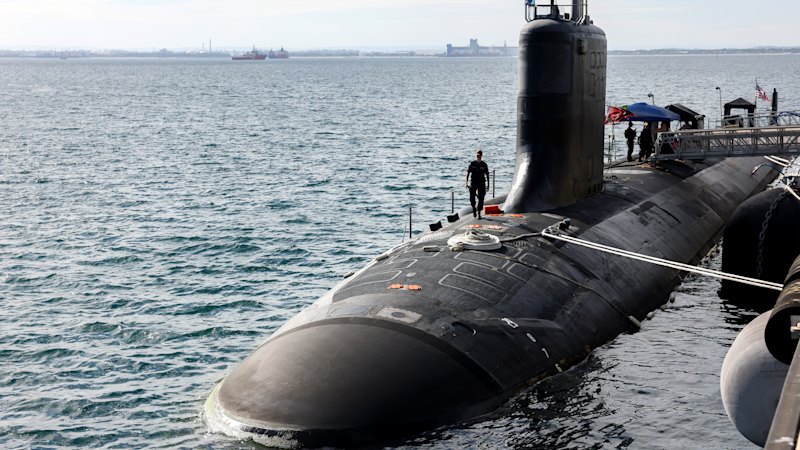
Australia is currently wagering its entire national security on a promise that the American industrial machine is physically unable to keep. For $368 billion, Canberra expects a fleet of Virginia-class nuclear submarines to bridge the gap between its aging Collins-class vessels and a distant, sovereign future. But the math in Washington simply doesn't work. While Australian politicians maintain there is no "Plan B," the United States is quietly grappling with a shipbuilding crisis that places its own domestic needs firmly above its export obligations.
The Math of National Survival
The bedrock of the AUKUS agreement is the transfer of three to five Virginia-class submarines to the Royal Australian Navy starting in the early 2030s. To make this happen without cannibalizing the US Navy’s own force structure, American shipyards must reach a production cadence of 2.33 boats per year. Currently, they are struggling to maintain a rate of 1.1.
This isn't a mere temporary bottleneck. It is a systemic failure of a hollowed-out industrial base. General Dynamics Electric Boat and Huntington Ingalls Industries—the only two yards capable of building these complex machines—are drowning under a backlog of Block V Virginia-class hulls and the existential priority of the Columbia-class ballistic missile program. In the zero-sum world of Pentagon procurement, the Columbia-class, which carries the US nuclear deterrent, will always receive the last welder and the last circuit board before an Australian export hull is even considered.
Australia’s Three Billion Dollar Donation
In an unprecedented move, Australia has already transferred $3 billion directly to the US industrial base to "grease the wheels" of production. Critics in Canberra are beginning to call this what it looks like: a high-priced subsidy for American infrastructure with no guaranteed return.
While this capital injection is intended to expand workforce training and facility upgrades in places like Groton and Newport News, it does nothing to solve the immediate manning crisis. The US Navy is currently facing a 40% maintenance backlog. Submarines like the USS Boise have sat idle for over a decade waiting for repairs that never come. If the US cannot fix the ships it already owns, the political appetite for handing over operational hulls to an ally—even one as close as Australia—is evaporating in a "US First" legislative climate.
The British Canary in the Coal Mine
While the Virginia-class transfer is the "Pillar 1" bridge, the long-term "SSN-AUKUS" design relies on British engineering. Here, the outlook is equally grim. The UK’s submarine industrial base at Barrow-in-Furness is similarly overextended, prioritized toward the Dreadnought-class ballistic program.
Retired naval officers are now sounding the alarm that the UK has "dropped below the minimal sustainable force." If London cannot meet its own replenishment schedules, the likelihood of a joint-designed Australian hull hitting the water in Adelaide by the 2040s is a fantasy. Australia is hitching its wagon to two partners whose industrial capacity is in a state of managed decline.
The Rotational Shell Game
Washington is already signaling a shift in the deal's terms. Instead of a clean transfer of ownership, there is growing talk of "Submarine Rotational Force-West." This would see US-owned and manned submarines based in Perth, providing a "presence" without giving Australia sovereign control over the assets.
For the US, this solves the inventory problem. For Australia, it destroys the concept of sovereign capability. A rotated US hull remains under the ultimate command of the White House. If a conflict breaks out where Australian and American interests don't perfectly align, Canberra could find itself with a front-row seat to a war it cannot influence, despite having paid the entry fee.
The Danger of No Plan B
The most chilling aspect of the current strategy is the Australian government’s refusal to entertain an alternative. Deputy Secretary for Strategy Hugh Jeffrey recently told a Canberra forum that the government is "not venturing into the space about Plan B."
This "all-in" mentality ignores the reality of the Collins-class lifecycle. These boats are old. They are becoming "creaking hulls" that require increasingly expensive life-extension programs just to remain safe for their crews. By the time the government realizes the Virginia-class transfer is stalled by US Congressional intervention or industrial paralysis, the Collins fleet may be beyond saving.
Australia is effectively sleepwalking into a "capability gap" where it could have no functioning submarine fleet for a decade or more. The assumption that the US will prioritize Australian security over its own domestic hull count is not just optimistic; it is a dereliction of strategic duty.
Stop pretending the timeline is fixed. Acknowledge that the US industrial base is broken. Without a domestic contingency—perhaps a move back toward evolved conventional boats or a vastly accelerated sovereign production line—Australia is paying $368 billion for the privilege of being left stranded at sea.