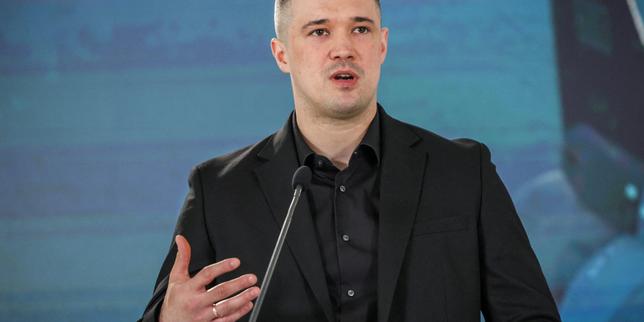
The defense of Ukraine relies on an asymmetric mix of civilian tech and rapid military innovation, a system largely built by Mykhailo Fedorov, the Minister of Digital Transformation. Yet, growing political maneuvering in Kyiv aimed at stripping his office of its defense-related portfolios has sparked deep anger among frontline drone operators, volunteer networks, and military tech founders. They warn that sidelining the architect of Ukraine's drone coalition will paralyze wartime procurement. This political friction threatens to replace a highly responsive, decentralized tech pipeline with the very Soviet-style military bureaucracy that Ukraine has spent years trying to dismantle.
Fedorov is not the Minister of Defense, despite foreign commentators frequently confusing his expansive role. He is something far more influential in modern conflict. He is the bridge between civil tech and the trenches. By utilizing his peacetime ministry to bypass the notoriously slow procurement pipelines of the Ministry of Defense, he built the "Army of Drones" from scratch. His team transformed civilian quadcopters into precision strike weapons and established Brave1, a joint defense-tech cluster that cut the bureaucratic approval time for new military equipment from years to mere weeks.
To understand why his potential sidelining or the dilution of his authority has triggered such fierce pushback, one must look at the structural paralysis that defined Ukrainian defense procurement before his intervention.
The Paper State Versus the Digital Trench
For decades, Ukrainian military procurement was governed by Soviet-era regulations designed for a slow, industrial-scale mobilization. If a private workshop developed a new radio jammer or a thermal imaging modification, getting it approved by the Ministry of Defense required navigating a maze of state testing, securing signatures from dozens of departments, and waiting for state funding cycles that operated on multi-year budgets.
Fedorov changed this by creating an alternative path.
Under his direction, the Ministry of Digital Transformation treated military procurement like a venture capital portfolio. They stripped away the requirement for extensive state trials for non-lethal and light drone technologies, allowing frontline units to test prototypes directly in combat. Feedback was sent back to developers via encrypted messaging apps, and iterations were made in days rather than quarters.
This model succeeded because it bypassed the traditional defense establishment. It also made enemies.
Traditionalists in the military hierarchy and the Ministry of Defense have long viewed Fedorov’s fast-track methods with suspicion. They argue that bypassing standard military certification risks putting unvetted, potentially insecure equipment into the hands of soldiers. There are legitimate concerns about electronic warfare vulnerabilities in rapidly deployed civilian tech.
However, soldiers on the zero-line view these arguments as bureaucratic turf protection. To a platoon commander facing constant Russian artillery fire, an imperfect drone delivered today is infinitely more valuable than a certified, military-grade system promised in eighteen months.
The Economics of Decentralized Warfare
The tension in Kyiv is not merely ideological. It is financial.
The Ministry of Digital Transformation successfully diverted significant portions of state and donor funding directly to private domestic drone manufacturers. By removing import duties on drone components and allowing private companies to earn a twenty percent profit margin on state contracts, Fedorov created a booming domestic defense industry out of nothing. Hundreds of small workshops across Ukraine began producing first-person view strike drones, reconnaissance UAVs, and robotic ground platforms.
This decentralized network operates outside the direct control of the defense ministry's centralized purchasing agencies.
+-----------------------------------------------------------------+
|               HOW THE TWO MODELS COMPARE                        |
+-----------------------------------------------------------------+
| Traditional MoD Pathway        | Fedorov's Tech Pipeline        |
+-----------------------------------------------------------------+
| Centralized bureaucracy        | Decentralized private networks |
| Multi-year state trials        | Direct combat testing          |
| Rigid Soviet-era regulations   | Flexible venture-style funding |
| Slow, paper-heavy procurement  | Rapid digital iteration        |
+-----------------------------------------------------------------+
As international aid becomes more difficult to secure, the struggle over who controls the domestic defense budget has intensified. The traditional defense apparatus wants to centralize all procurement under its own umbrella, arguing that a unified command structure is necessary for long-term strategic planning.
But centralized structures are highly vulnerable to corruption and inefficiency, two plagues that Ukraine has struggled to purge from its defense ministry. The highly publicized scandals involving military food contracts and overpriced winter uniforms under previous defense ministry leadership demonstrated the risks of concentrated purchasing power.
Fedorov’s system, while not entirely immune to abuse, relies on a digital paper trail that is much harder to manipulate.
Why the Frontline is Reacting with Anger
The anger from the trenches regarding any threat to Fedorov’s position is practical, not political.
Commanders of specialized drone wings rely on direct communication channels with tech ministry liaisons to report new Russian electronic warfare frequencies. When Russian forces deploy a new jammer on a specific sector of the front, Ukrainian software engineers need to push firmware updates to thousands of drones immediately.
Under the Ministry of Digital Transformation, this feedback loop was direct. If these responsibilities are absorbed back into the traditional military command structure, commanders fear that reporting a new enemy capability will require writing paper memos that must wind their way through layers of staff officers in Kyiv. By the time an update is authorized, the battalion that requested it could be gone.
There is also the matter of international trust.
Western technology executives, volunteer organizations, and private donors have shown a high willingness to work with Fedorov’s office because it speaks their language. He runs his ministry like a Silicon Valley startup, prioritizing metrics, speed, and transparency.
If Western donors and defense companies are forced to negotiate with the opaque, slow-moving officials of the traditional defense ministry, much of that goodwill and informal assistance will dry up. Private capital does not tolerate bureaucratic delays, especially when lives are on the line.
The political infighting in Kyiv reflects a deeper, systemic struggle occurring within many modern militaries. It is the clash between the rigid hierarchy of the industrial age and the flat, adaptive networks of the information age. Ukraine’s survival has depended on its ability to run faster than its adversary. Slowing down the tech pipeline to satisfy political ambitions or bureaucratic protocol is a luxury the country simply cannot afford.