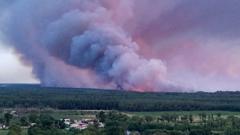
The air does not smell like smoke anymore. It smells like copper and the inside of an old television set, charged and metallic, vibrating just behind the teeth.
When you stand on a ridge in the interior of the American West and watch a wall of timber turn white, then grey, then the bruised, violent purple of a twilight bruise, you are no longer looking at a fire. You are looking at an atmosphere that has lost its mind.
We used to think we understood how these things worked. A spark hits dry pine. Wind pushes the flame. Firefighters dig a line, drop water from a belly-tanked helicopter, and pray for the humidity to rise at midnight. That was the old grammar of catastrophe.
Now, the fire writes its own dictionary.
Consider a hypothetical afternoon in late August, though anyone who lived through the Creek Fire or the Carr Fire recognizes the choreography immediately. The temperature sits stubbornly at ninety-eight degrees. The relative humidity has dropped into the single digits, dry enough to crack the skin on the back of your hands. A thousand acres of brush, baked by months of drought into the consistency of gunpowder, ignites.
At first, it behaves normally. It roars. It throws embers across a canyon.
Then the column starts.
This is where the ordinary rules of physics stop applying and the nightmare begins. As billions of cubic feet of superheated air rush upward, they create a colossal vacuum at the base of the fire. Cold air is sucked inward from miles around to feed the monster, creating erratic, screaming gales that knock mature fir trees down like matchsticks. The smoke plume punches through the troposphere, rising ten, twelve, sometimes fifteen miles high, forming an anvil-shaped monster known to meteorologists as a pyrocumulonimbus cloud.
Pyrocumulonimbus. Say the word out loud. It sounds like something dredged from a medieval grimoire, but it is simply the modern name for a fire-generated thunderstorm.
And it changes everything.
I remember talking to a veteran hotshot crew leader named Miller, a man whose face had the texture of cured leather and whose eyes had seen too many ridges go black. We were sitting on the tailgate of a rusted Ford, watching a column build six miles away. He didn't look at the flames dancing in the valley. He looked up. Way up. At the anvil.
"You aren't fighting the ground anymore," he told me, pulling a cold cigarette from a crushed pack. "You're fighting the sky. The sky wants to kill you, and it has the weather on speed dial."
Here is how these airborne monsters kill.
When the towering plume reaches the freezing layer miles above the earth, moisture condenses on the trillions of ash particles suspended in the column. Rain forms. But because the updrafts are so violently powerful—sometimes roaring upward at over a hundred miles per hour—that water is hurled back up into the sub-zero stratosphere, freezing into heavy chunks of hail before it can ever hit the ground.
The storm matures. It becomes a self-contained weather factory, entirely divorced from the regional forecast.
Then, the updraft collapses.
Imagine a massive column of superheated air and heavy water suddenly losing its upward thrust. The weight of millions of tons of water and ash crashes down simultaneously. Meteorologists call this a downburst. Firefighters call it a macro-burst of pure, unadulterated terror.
When that downburst hits the burning landscape below, it does not bring relief. It does not put the fire out. Instead, it hits the ground like a freight train hitting a brick wall, exploding outward in a three-hundred-and-sixty-degree ring of hurricane-force winds.
The fire is no longer moving in one direction. It is racing everywhere at once.
Flames that were crawling lazily up a hillside are suddenly whipped into a fifty-foot wall of horizontal destruction, driven by winds generated entirely by the fire's own digestion of the atmosphere. Embers are hurled forward a mile, two miles, three miles ahead of the main front, landing in dry grass, on wooden roofs, in fuel tanks, creating hundreds of spot fires that merge into a single, cohesive wall of annihilation.
And then comes the lightning.
A pyrocumulonimbus cloud is an engine of pure static electricity. Because the ash and ice particles are churning violently against one another within the towering column, millions of volts of charge accumulate within the smoke. The sky lights up with dry lightning—flashes that strike the ground miles away from the original fire, sparking entirely new blazes in unburned territory.
The fire reproduces. It spawns offspring in the dark.
This is why traditional evacuation models fail. This is why experienced incident commanders, men and women who have spent thirty years reading the topography of a mountain range, suddenly find themselves outsmarted by a plume that decides to pivot ninety degrees in fifteen minutes.
We are living in an era where the atmosphere has become an active participant in our disasters. Decades of fire suppression, combined with a warming climate that turns root systems into tinder, have given these blazes the raw energy required to manufacture their own weather. They are no longer dependent on the wind. They make it. They are no longer dependent on the humidity. They dry out their own air.
To look at a fire-generated thunderstorm from a satellite is to look at a living organism. It breathes in oxygen, it exhales poison, it builds its own storm system, and it strikes with the erratic cruelty of a cornered animal.
On the ridges, the crews keep digging. They swing Pulaskis until their palms blister and bleed through leather gloves. They drop lines through the dust and pray the wind holds. But they know, and we must learn, that the old rules are dead.
The sky is no longer a spectator to the fire.
It is the weapon.