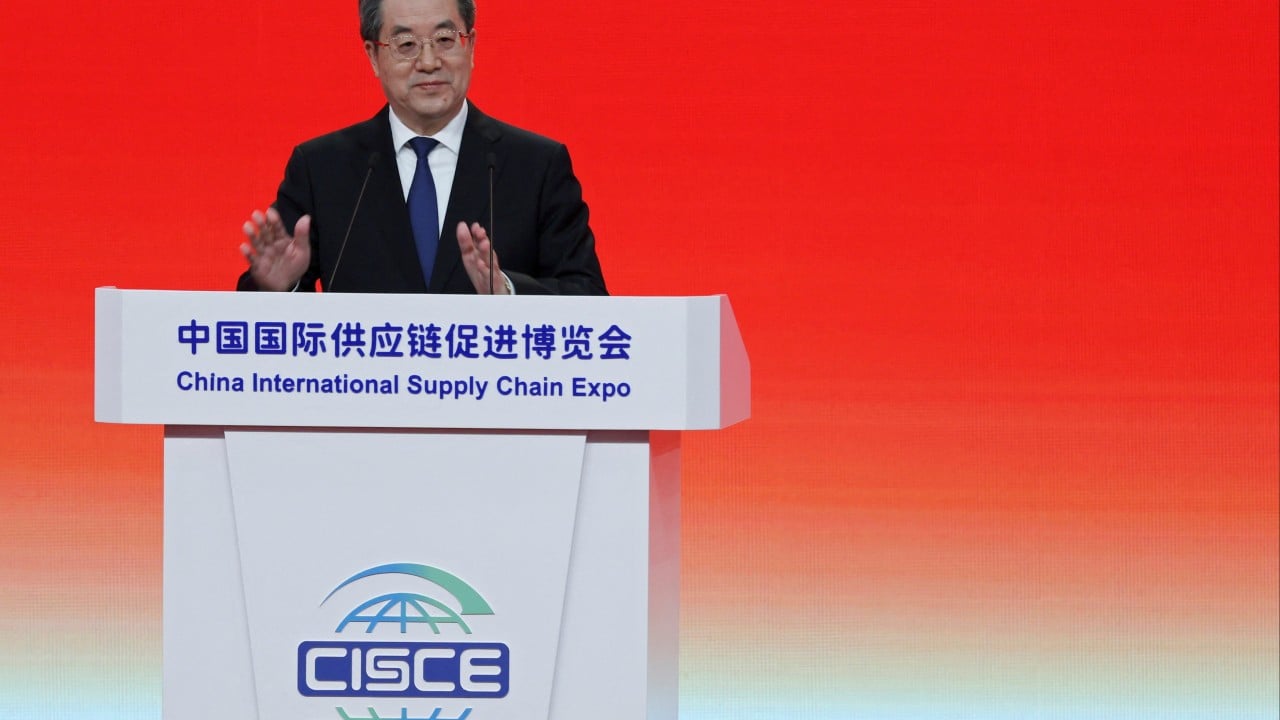
China is aggressively positioning itself as the indispensable anchor of global trade as supply lines fracture. While Western capitals view the escalating crisis in the Strait of Hormuz through the lens of maritime security and military deterrence, Beijing sees a structural opportunity. By framing its continuous flow of goods as a stabilizing force for the global economy, the Chinese government is attempting to decouple its manufacturing dominance from geopolitical volatility. It is a high-stakes diplomatic and economic maneuver designed to neutralize Western efforts at supply chain diversification.
The choke point in the Middle East has long been a vulnerability for international energy markets. Roughly a fifth of the world's liquid petroleum passes through this narrow strip of water daily. When regional tensions spike, shipping insurance premiums skyrocket, vessels reroute around Africa, and factory floors from Munich to Ohio brace for delays. For Beijing, the crisis serves a dual purpose. It highlights the vulnerability of traditional maritime security frameworks managed by the United States, while allowing China to present its state-backed logistics networks as the only reliable alternatives left on the map.
The Narrative of Indispensability
Western policymakers have spent the last five years preaching the gospel of de-risking. The goal was simple: move critical manufacturing out of China to countries like Vietnam, India, or Mexico. The current maritime bottlenecks demonstrate just how difficult that migration is in practice. Moving a factory requires more than cheap labor; it requires deep-water ports, massive container terminals, and predictable shipping corridors.
Beijing's current diplomatic counter-offensive relies heavily on this logistical reality. When Chinese officials defend their role in global trade during maritime emergencies, they are not just talking to Western politicians. They are talking to global corporations. The message is clear: when the world fractures, Chinese infrastructure remains operational.
This defense rests on massive capital investments. Over two decades, Chinese state-owned enterprises have acquired significant stakes in over 100 ports across dozens of countries. This is not just a commercial portfolio. It is a parallel logistics network. When a crisis hits a primary trade artery like the Strait of Hormuz, these state-linked hubs allow for rapid rerouting and cargo prioritization that Western governments cannot match by decree.
The Vulnerability Behind the Bravado
The confident rhetoric from the Chinese Ministry of Commerce masks an acute domestic anxiety. China is the world’s largest importer of crude oil, and a massive chunk of that supply originates in the Persian Gulf. A prolonged total blockade of the Strait of Hormuz would cripple Chinese industrial output within weeks, regardless of how much coal or domestic renewables the country ramps up.
To understand the strategy, one must look at the asymmetry of dependency.
- Energy Imports: China relies on the region for over 40 percent of its crude oil.
- Manufacturing Outflow: The West relies on China for finished components, electronics, and rare earth processing.
- The Leverage: Beijing calculates that the West will blink first in an inflation crisis caused by supply shortages.
By maintaining a neutral, commerce-first stance in regional conflicts, Beijing ensures its own state-owned fleets receive safe passage from various regional actors. It is a pragmatic, cynical neutrality. While US naval vessels patrol the waters to guarantee open navigation for all, Chinese state shipping lines leverage their national identity to secure informal guarantees of safety. The cost of maintaining global order is borne by Washington, while the commercial benefits of stability are harvested by Beijing.
Re-Engineering the Overland Route
The limitations of maritime trade during a crisis have forced a massive acceleration into overland alternatives. The Belt and Road Initiative is often criticized as a debt-trap mechanism, but its logistical utility becomes undeniable when sea lanes are threatened. The New Eurasian Land Bridge, a network of rail lines running through Central Asia into Europe, has seen a massive surge in traffic every time a maritime choke point faces disruption.
Rail transport cannot match the sheer volume of mega-container ships. A single modern container vessel can carry 24,000 twenty-foot equivalent units (TEUs). A standard freight train carries about 100 TEUs.
However, speed changes the math for high-value goods. Rail transit from western China to central Europe takes roughly 15 to 19 days. Sea freight, even under normal conditions, takes upwards of 30 days. When ships are forced to bypass the Suez Canal or navigate tense corridors like Hormuz, that transit time stretches past 45 days. For electronics manufacturers, automotive assembly plants, and pharmaceutical companies, the rail line ceases to be an expensive luxury. It becomes a vital insurance policy.
The Port of Gwadar Connection
The China-Pakistan Economic Corridor (CPEC) represents the ultimate insurance policy against a maritime blockade. The deep-water port of Gwadar, located just outside the mouth of the Persian Gulf, was built precisely for this scenario.
[Persian Gulf Oil Fields] ---> [Port of Gwadar, Pakistan] ---> Overland Pipeline/Rail ---> [Western China]
In theory, oil can be offloaded at Gwadar and transported overland directly into western China, bypassing the Strait of Hormuz and the Malacca Strait entirely. In practice, the geography is brutal, the infrastructure is incomplete, and security challenges in Balochistan remain a persistent threat. Yet, even at partial capacity, the existence of this corridor changes the geopolitical calculus. It signals to adversaries that a naval blockade of the Chinese coast or primary sea lines of communication would not be completely absolute.
The Corporate Calculus of De-Risking
For multinational corporations, the defense of Chinese supply chains creates a profound paradox. Boardrooms are under intense political pressure to diversify away from China to avoid future sanctions or conflict fallout. Yet, every time a regional crisis closes a canal or threatens a strait, alternative manufacturing hubs show their limitations.
Consider a hypothetical smartphone manufacturer that shifts 20 percent of its assembly to India to appease Western regulators. The sub-components—the capacitors, the display modules, the precision screws—still largely originate in the industrial clusters of Guangdong. If the shipping lanes carrying those sub-components westward are disrupted by a Middle Eastern crisis, the Indian assembly plants stall just as quickly as the factories in Europe. The illusion of a diversified supply chain evaporates when confronted with the reality of deeply entrenched component monopolies.
China has spent decades building complete industrial ecosystems. In cities like Shenzhen, an engineer can modify a prototype and have a factory floor printing thousands of units by the next morning. No other region possesses this density of suppliers, tooling experts, and logistical infrastructure. When Beijing defends its role in global trade, it relies on the knowledge that the West cannot decouple from this ecosystem without triggering severe domestic inflation.
The Weaponization of Logistics Data
Control over global trade requires more than just ships and ports. It requires data. China’s state-sponsored digital logistics platform, Logink, tracks the movement of cargo, ship manifests, and port efficiencies worldwide. It is a massive data aggregator that gives Beijing a granular view of global trade flows that no private shipping company or Western government possesses.
During a maritime crisis, information is the ultimate asset. Knowing which ports are congested, which routes are seeing a spike in insurance costs, and where specific critical components are currently floating allows state-directed shipping companies to optimize their routes in real-time. If a Western manufacturer does not know where its components are stuck, it cannot adjust its production schedules. Logink provides the Chinese state with the ability to see the entire global chessboard, turning logistical efficiency into a tool of economic statecraft.
This data dominance complicates Western efforts to build resilient, independent supply chains. Even if a company successfully moves its production lines, its logistics providers may still rely on Chinese data networks to move goods efficiently. The dependency is not merely physical; it is digital.
The Structural Limits of Neutrality
The current strategy of mercantile neutrality is not a permanent solution. It functions only as long as the regional actors causing the disruption see a benefit in sparing Chinese vessels or respecting Beijing’s diplomatic posture. If a conflict escalates to a point where indiscriminate anti-ship operations occur, or if regional state actors face existential threats, commercial flags will offer no protection.
Western nations are actively adjusting their strategies. The focus is shifting from total decoupling to targeted containment. Governments are subsidizing domestic semiconductor fabrication plants and securing exclusive agreements for critical mineral processing with allied nations. The goal is to isolate the most critical technologies from global maritime vulnerabilities entirely.
This shift means the battle for supply chain dominance will not be won or lost by naval deployments in the Strait of Hormuz. It will be decided by which economic bloc can faster build an industrial network resilient enough to withstand the inevitable closure of the world's primary maritime corridors. Beijing is betting its massive infrastructure footprint will keep the world dependent on its factories, while the West bets that high-tech autarky can break that dependence before the next major choke point closes for good.