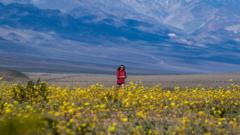
A Death Valley superbloom is not a singular event but the culmination of a precise, multi-stage ecological sequence where specific climatic inputs must meet rigorous geological thresholds. While casual observation treats the 2024 display as a visual anomaly, a structural analysis reveals it as a rare synchronization of three critical variables: seed bank dormancy, precipitation timing, and thermal stability.
The 2024 bloom—the most significant since the 2016 event—serves as a case study in how extreme environments utilize "biological hedging" to survive hyper-arid conditions. To understand the scale of this phenomenon, one must look past the aesthetic value and analyze the hydrological stressors and botanical responses that dictate whether a desert remains a wasteland or transforms into a high-density floral ecosystem.
The Tri-Factor Constraint Model
Desert ephemeral plants operate on a high-risk, high-reward reproductive strategy. For a "superbloom" to occur, the environment must satisfy a hierarchical set of conditions. If any single variable falls outside the narrow tolerance band, the event collapses into a standard, localized bloom.
1. The Priming Threshold (Autumn Precipitation)
The lifecycle begins with a "washout" phase. Most desert wildflower seeds contain a chemical germination inhibitor—a coating of abscisic acid that prevents the seed from sprouting during a brief, insufficient rain shower. A small storm would trigger germination only for the seedling to die of dehydration days later.
To overcome this inhibitor, Death Valley requires a heavy, sustained rainfall event in late autumn or early winter, typically exceeding 0.5 inches. This volume of water physically leaches the chemicals from the seed coat. In the lead-up to the current bloom, remnants of Hurricane Hilary and subsequent atmospheric rivers provided the necessary volumetric flow to "prime" the seed bank across the valley floor.
2. The Thermal Equilibrium
Once the seeds are primed, the soil temperature becomes the primary governor of growth rate. If the winter is too cold, the seedlings remain stunted and vulnerable to predation. Conversely, if an unseasonable heatwave occurs in February, the plants are forced into premature senescence, blooming small and dying before they can reach the density required for a "superbloom" designation.
The 2024 season benefited from a consistent thermal floor. The lack of extreme freezing events allowed for steady biomass accumulation, while a relatively cool spring extended the "vegetative phase," allowing plants to grow larger and produce more buds before the heat-induced reproductive trigger.
3. The Wind Shield
Wind is the most frequent "silent killer" of desert blooms. High-velocity gusts in the Mojave and Great Basin deserts cause rapid evapotranspiration, stripping moisture from the leaves faster than the shallow root systems can replace it. A superbloom requires a period of atmospheric stability. The 2016 and 2024 events were both characterized by a lack of sustained, drying "northers," which allowed the delicate Eraytheum and Phacelia species to maintain turgor pressure.
Botanical Stratification and Altitudinal Progression
The bloom does not occur simultaneously across the park’s 3.4 million acres. Instead, it follows a predictable altitudinal gradient dictated by the adiabatic lapse rate—the rate at which air temperature decreases with an increase in altitude.
- Zone 1: The Valley Floor (0 to 2,000 feet)
This zone is dominated by Encelia farinosa (Brittlebush) and Geraea canescens (Desert Gold). Because this area is the hottest, the bloom starts here earliest (mid-February to March) but also vanishes first. - Zone 2: The Alluvial Fans (2,000 to 4,000 feet)
As the valley floor heats up, the bloom "migrates" up the fans. Here, the soil composition shifts from fine silt to rocky debris, favoring species like Phacelia and Lupinus. This zone acts as the bridge between the early and late seasons. - Zone 3: The High Peaks (Above 4,000 feet)
In late April and May, the bloom reaches the higher elevations. While the density is lower than the valley floor, the diversity increases, featuring Mojave Wildrose and various cactus species.
The current 2024 display is particularly notable for its density in Zone 1, which had been largely dormant for eight years. The accumulation of organic matter from the 2016 cycle, combined with the extreme saturation of 2023, created a nutrient-dense substrate that maximized the yield per square meter.
The Economics of Ephemeral Tourism
The surge in wildflower density triggers an immediate and massive shift in regional logistics and resource allocation. For the National Park Service (NPS) and the surrounding Gateway communities, a superbloom is a "black swan" event that stresses infrastructure designed for lower baseline traffic.
Infrastructure Bottlenecks
Death Valley is the largest National Park in the lower 48 states, yet its paved road network is limited. During peak bloom periods, vehicle density on Badwater Road increases by several hundred percent. This creates a "crowding tax" where the time-cost of accessing the bloom sites increases exponentially.
Tactical visitors must account for the following logistical constraints:
- Fuel Scarcity: Distances between service stations (Stovepipe Wells, Furnace Creek, Panamint Springs) are vast. High-idling traffic in hot temperatures increases fuel consumption rates beyond standard estimates.
- Thermal Management: Even during a bloom, surface temperatures on the valley floor can exceed 90°F (32°C). Dehydration occurs faster than visitors anticipate because the low humidity (often below 10%) causes sweat to evaporate instantly, masking fluid loss.
Factual Accuracy and Ecological Risk
It is a common misconception that superblooms occur every ten years. In reality, there is no fixed frequency. The interval is entirely dependent on the El Niño Southern Oscillation (ENSO) cycles. While El Niño years typically correlate with higher rainfall in the Southwest, the correlation is not a guarantee of a bloom.
The primary threat to the longevity of these events is the encroachment of invasive species, specifically Brassica tournefortii (Sahara Mustard). This invasive weed grows faster than native wildflowers, monopolizing the limited water supply and creating a "fire cycle" by providing dry fuel in the summer—something the native desert ecology is not evolved to survive.
Current management strategies involve targeted manual removal in high-value "core zones" to ensure the native seed bank is not outcompeted. The 2024 bloom has shown high native resilience, but the presence of Sahara Mustard on the park's eastern fringes remains a long-term risk factor for the 2030–2040 decadal outlook.
Strategic Action for Observation
To maximize the value of an expedition to Death Valley during a high-yield year, a structured approach to timing and location is required.
The optimal window for the 2024 valley-floor display is rapidly closing as temperatures rise. To capture the remaining biomass, focus operations on the mid-elevation alluvial fans between 2,500 and 4,000 feet. These areas currently hold the highest moisture-to-heat ratio, ensuring the flowers remain in a "peak" state of anthesis.
- Prioritize the "Golden Hour" Window: Plan to be on-site at sunrise. This is not for aesthetics alone; it is the only time wind speeds are consistently low enough for high-detail macro observation and stable drone photography (where permitted).
- Monitor the 72-Hour Heat Map: If temperatures in Furnace Creek exceed 95°F for three consecutive days, the valley floor bloom will undergo rapid desiccation. In this scenario, shift all resources to the Jubilee Pass or Townes Pass corridors immediately.
- Cross-Reference Rainfall Totals: Use the NOAA Precision Real-Time Precipitation Map to identify "pockets" of higher rainfall within the park. The central valley often receives more runoff than the western edges due to the rain-shadow effect of the Panamint Range.
The window for the highest-density display is a decaying function of temperature. Move now or wait for the next cycle, which may not return until the next decade.