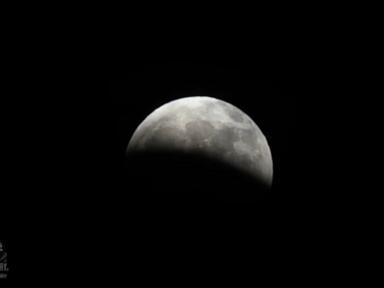
Every time Earth's shadow happens to brush the Moon just right, humanity collectively loses its mind. Social media floods with grainy smartphone photos of a murky, reddish-brown rock, accompanied by breathless captions about cosmic alignment, ancient prophecies, and rare celestial miracles.
Stop it. Don't miss our earlier article on this related article.
You are staring at a completely routine orbital shadow while ignoring the actual physics happening right above your head. The obsession with total lunar eclipses, commonly branded as the Blood Moon, is a masterclass in collective astronomical illiteracy. It turns a basic geometry lesson into pop-astrology, convincing millions of people that a normal atmospheric filter is some kind of divine warning or once-in-a-lifetime spectacle.
Let us dismantle the laziness. If you want more about the history here, USA Today provides an in-depth summary.
The Lazy Consensus Of The Cosmic Spectacle
The standard narrative pushes a tired script. Media outlets treat every lunar eclipse like the sky is falling, framing it as a rare, mystical event that demands your immediate attention. They hype up the red hue as if the Moon is bleeding out, playing directly into medieval superstitions that science supposedly cured centuries ago.
Except science hasn't cured the superstition; it has just repackaged it for Instagram.
When you look at a Blood Moon, you are not looking at rare energy or a cosmic anomaly. You are looking at a planetary shadow trick. Earth sits directly between the Sun and the Moon. Sunlight passes through Earth's atmosphere, our air scatters away the blue light via Rayleigh scattering, and the leftover red wavelengths bend around the edge of our planet to paint the lunar surface.
It is the exact same optical mechanic that gives us every single sunset on Earth.
Imagine a scenario where we treated every ordinary Tuesday sunset with the same apocalyptic hysteria. People would be running into the streets screaming that the atmosphere is catching fire. Yet, because the sun goes down every twelve hours, we ignore sunsets and lose our minds over a lunar eclipse that happens twice a year on average.
The frequency alone kills the romance. A total lunar eclipse is not a rare beast. It is a recurring math problem.
Why The View From The Ground Is Actually Garbage
Let us talk about the experience of actually watching one. You stand outside in the freezing dark for hours, squinting at a dim, muddy copper disc that looks like a dirty copper penny stuck in velvet.
Astrophotographers post jaw-dropping, hyper-saturated images online taken with heavy telescope rigs and long-exposure sensors. Then you walk outside with your naked eyes and wonder why your $1,000 smartphone captured a reddish smudge that looks like a dead pixel.
The naked-eye reality of a total lunar eclipse is aggressively underwhelming. During totality, the Moon's brightness drops by a factor of ten thousand or more. It dims so significantly that stars pop out around it, which is neat for about forty-five seconds before you realize you are just looking at a very dark, very dull rock.
Contrast this with a solar eclipse. A total solar eclipse gives you the corona, the sudden drop in temperature, the 360-degree sunset on the horizon, and the primal shock of day turning to night. That is an event worth traveling for. A lunar eclipse is just a dimming of the porch light.
The Real Astronomy We Are Missing
While the masses stare at the red Moon, they completely miss the dynamic physics happening elsewhere in the solar system.
If you want to understand orbital mechanics, look at the shadow itself. The umbra of Earth has a distinct curved edge. Ancient Greek astronomers used that exact curvature to prove that Earth is a sphere, long before anyone sailed around it. That is the real utility of an eclipse. It is a tangible proof of planetary geometry, yet we treat it like a horoscope.
Furthermore, we ignore the impact data. Lunar eclipses are actually prime time for planetary scientists studying the thermal inertia of the lunar regolith. When Earth's shadow crosses the Moon, the surface temperature plunges hundreds of degrees in minutes. Instruments left behind by the Apollo missions measure how fast the dust cools, giving us clues about the structure of the lunar crust.
None of that makes it onto your social media feed. Instead, we get influencers warning us about impending doom because the Moon turned the color of rust.
Stop Asking The Wrong Questions
People Google things like "What does a Blood Moon mean for my zodiac sign?" or "Is the lunar eclipse a sign of the end times?"
The answers are nothing and no.
The real question you should be asking is why society prefers comforting illusions over basic orbital mechanics. We love the myth because it requires zero effort to consume. Real astronomy requires patience, dark adaptation, math, and an appreciation for scale that doesn't fit into a TikTok reel.
If you want to step outside during the next eclipse, go ahead. Feel the cool air, look up at the geometry of three bodies floating in a vacuum, and appreciate the clean physics of light bending through nitrogen and oxygen.
Just leave the mysticism indoors.