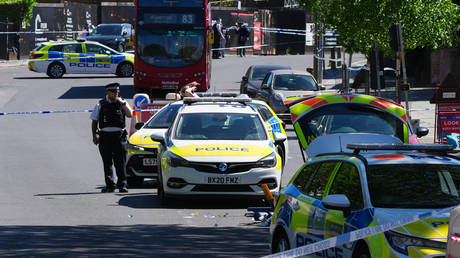
The iron scent of blood is a universal constant. It does not care about the neighborhood it stains or the history of the soil it drips upon. In the North London district of Stamford Hill, where the air usually carries the faint, comforting smell of fresh challah and the rhythmic hum of a community in prayer, that metallic tang hung heavy on a Friday that should have been peaceful. It was a day that was supposed to drift quietly into the Sabbath. Instead, it became a crime scene.
Two men, members of the local Jewish community, were standing on a street corner. They weren't doing anything remarkable. They were existing. In a city of nine million people, they were two points of light in a sea of commuters, shoppers, and dreamers. Then, the steel found them. A knife—cold, indiscriminate, and driven by a motivation that feels increasingly ancient and modern all at once—pierced the afternoon.
One man was 54. The other, 50. These are ages where you have built a life, raised children, and contributed to the collective memory of your streets. Within seconds, they were statistics. But statistics are a lie told by people who are too afraid to look at the bandages.
The Anatomy of a Neighborhood Under Siege
Stamford Hill is not just a collection of postcodes. It is one of the most visible Jewish enclaves in Europe. When you walk these streets, you see the long coats, the hats, and the hurried, purposeful strides of people living a life of deep tradition. This visibility is a source of pride, but it is also a target. To wear your identity on your sleeve in a world that is increasingly polarized is an act of quiet, daily courage.
When a "suspected anti-Semitic attack" occurs, the words on the news ticker feel sanitized. They don't capture the sound of the siren as it cuts through a conversation about groceries. They don't capture the way a mother’s grip tightens on her child’s hand when she sees the blue lights reflecting in a shop window. This isn't just about two men being wounded; it is about the wounding of a sense of safety that takes decades to build and only seconds to shatter.
Consider a hypothetical shopkeeper nearby—let’s call him Elias. Elias has lived in Stamford Hill for forty years. He knows which neighbors like their rye bread extra dark and which ones are struggling to pay their bills. When he hears the shouting and the scuffle outside, his first instinct isn't to check the news. It’s to lock the door. That click of the deadbolt is the sound of a community retreating into itself. It is a sound that echoes across history, a reflexive flinch born from a long memory of being the "other."
The Shadow of the Rising Percentage
We often talk about hate crimes as if they are weather events—unpredictable, unfortunate, but ultimately beyond our control. The reality is far more clinical. According to the Metropolitan Police, incidents of anti-Semitic hate crimes have seen staggering spikes in recent years, often fluctuating with geopolitical tensions thousands of miles away.
But what does a 100% or 200% increase actually look like? It looks like a man in his fifties being airlifted to a major trauma center because he chose to walk down a specific street at a specific time. It looks like the Metropolitan Police deploying extra patrols to synagogues and schools, turning places of sanctuary into fortresses. It looks like the sudden, jarring realization that the person standing next to you on the sidewalk might be harboring a resentment so deep it can only be expressed through violence.
The suspect in the Stamford Hill attack was eventually detained. The law will take its course. There will be court dates, witness statements, and forensic reports. But the legal process is a bandage on a wound that goes much deeper than the skin. The trauma of a hate crime is radioactive; it has a half-life that persists long after the stitches are removed. It radiates through the family of the victims, through the congregation, and through the city itself.
The Invisible Stakes of the Afternoon
Why does this matter to someone living in a different city, or even a different part of London? It matters because the integrity of a society is measured by how it treats its most visible minorities. If two men cannot stand on a street in Stamford Hill without the fear of being hunted, then the promise of the modern city—the promise of pluralism and coexistence—is a hollow one.
The attacker didn't just target two individuals. He targeted the idea that we can live together while remaining different. He targeted the quiet Friday afternoon. He targeted the Sabbath.
Imagine the dinner table that night. The chairs are there, the candles are lit, but the conversation is fractured. There is a vacancy where a father or a friend should be. The prayers are whispered with a slight tremor. This is the invisible cost of hate. It steals the mundane. It robs a community of its right to be bored, to be average, to be safe in its own skin.
London prides itself on being a melting pot, but a melting pot requires heat that fuses, not heat that burns. When we see headlines about stabbings in North London, our brains often go into a defensive crouch. We categorize it. We label it "them" or "there." We distance ourselves to keep the horror at bay. But there is no distance in a city where the blood of a neighbor flows into the same gutters we all walk past.
The Architecture of Fear
When the police tape comes down, the street doesn't go back to normal. A ghost remains. For weeks, every passerby will look at that specific patch of pavement and remember. They will check over their shoulders more often. They will wonder if the person walking toward them sees a neighbor or a target.
This is how hate wins—not through the initial act of violence, but through the long-term erosion of trust. It turns a neighborhood into a series of barricades. It replaces the open hand with a clenched fist.
The two men who were attacked will, hopefully, heal. The physical wounds will close. They will carry scars that tell a story of a Friday that went horribly wrong. But the city carries a scar, too. Every time we fail to protect the vulnerable, every time we allow rhetoric to boil over into the physical realm, we lose a piece of the social contract.
We are living in an era where the digital world bleeds into the physical one. The animosity fermented in online forums and social media echo chambers eventually finds a vessel—someone willing to pick up a blade and act on the poison they’ve swallowed. The victims in Stamford Hill were the end point of a very long, very dark chain of events that started long before that Friday afternoon.
The Weight of the Silence
There is a specific kind of silence that follows an act of public violence. It’s not a peaceful silence; it’s a heavy, expectant one. It’s the silence of a community waiting to see if anyone else cares. It’s the silence of people wondering if their lives are worth the outrage of the majority.
The response to the Stamford Hill attack must be more than a press release or a fleeting moment of sympathy. It must be a recognition that these two men are us. Their safety is our safety. Their fear is our failure.
As the sun set over London that evening, the shadows in Stamford Hill grew long. The ambulances had gone. The crowds had dispersed. But on the pavement, barely visible to the casual observer, was the faint, stubborn residue of the afternoon. It was a reminder that we are all just one heartbeat away from becoming a headline, and that the only thing standing between us and the dark is the collective will to see each other as human.
The city moved on, as it always does. The buses roared, the lights flickered to life, and millions of people went about their business. But in a few homes in North London, the world had stopped. It had stopped because a man with a knife decided that some lives are less valuable than others. And until we can prove him wrong—not with words, but with the way we guard each other's peace—the iron scent of that afternoon will never truly fade from the air.
A man walks home, his hand hovering over his pocket, eyes scanning the horizon for a threat that shouldn't be there, wondering if the next shadow he sees is a neighbor or a ghost.