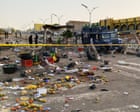
The ground in Gwoza does not just shake from the blast; it shudders from the weight of a decade of failed promises. Over the weekend, at least 23 people were torn apart in a coordinated wave of suicide bombings across north-eastern Nigeria. These were not random acts of desperation. They were calculated strikes against the most vulnerable—mourners at a funeral, families at a wedding, and patients at a hospital. While the official narrative often retreats into talk of "remnants" of a defeated insurgency, the reality on the ground tells a much more terrifying story of a resilient, evolving threat that the state is struggling to contain.
This latest massacre marks a grim return to the use of female suicide bombers, a tactic that turns the traditional fabric of Nigerian society against itself. By using women and girls, the attackers exploit the very cultural norms of modesty and protection that usually grant women easier passage through security checkpoints. This is the brutal calculus of modern insurgency in the Sahel. It is a war of attrition where the primary target is not a military base, but the psychological resolve of a population trying to rebuild their lives in the shadow of Lake Chad.
The Anatomy of a Coordinated Strike
The sequence of events in Gwoza suggests a level of planning that contradicts the idea of a disorganized enemy. The first blast hit a wedding celebration. As the dust settled and neighbors rushed to help the wounded, a second bomber targeted the gathering crowd. This "double-tap" method is designed to maximize casualties among first responders and create a secondary wave of trauma. It is a signature of sophisticated terror cells globally, yet here it was executed in a town that was supposed to be a success story for the military’s "Safe Corridor" initiatives.
The third explosion occurred at a hospital, hitting those who had already fled the initial carnage. By targeting a medical facility, the perpetrators ensured that the local healthcare infrastructure—already stripped thin by years of conflict—would be paralyzed. This is strategic. When you destroy a hospital, you don't just kill the people inside; you kill the hope of recovery for the entire district.
The Intelligence Gap
Why did no one see this coming? For months, local hunters and members of the Civilian Joint Task Force (CJTF) have whispered about increased movement in the Mandara Mountains. These rugged peaks provide a natural fortress for insurgents, a place where drone surveillance struggles against the deep ravines and thick scrub.
The disconnect between local intelligence and federal response is a chasm that blood fills. The villagers know the faces of the strangers in the market. They notice when the charcoal trade shifts or when certain trails are suddenly blocked. Yet, the mechanism to funnel this ground-level data into actionable military operations remains broken. Trust is the missing currency. When a villager reports a suspicious gathering and nothing happens, or worse, they face interrogation themselves, the flow of information dries up. The insurgents fill that silence with fear.
The Myth of the Decimated Insurgent
For years, the political rhetoric in Abuja has centered on the idea that Boko Haram and its offshoots, such as the Islamic State West Africa Province (ISWAP), are "technically defeated." This phrase has become a bitter joke among those living in Borno State. You cannot defeat an ideology with a press release.
While the military has successfully pushed insurgents out of major urban centers, the vast, ungoverned spaces of the northeast remain a playground for radicalization. The group responsible for the Gwoza attacks—likely a faction of the original Boko Haram known as JAS—has shifted its strategy. They have moved away from holding large swaths of territory, which made them easy targets for airstrikes, toward a decentralized model of "lone wolf" cells and high-impact suicide missions.
This shift makes the enemy invisible until the moment of detonation. It also means that the traditional metrics of military success—territory captured or bunkers destroyed—are irrelevant. The only metric that matters now is the number of days since the last blast. By that count, the current strategy is failing.
The Role of the Mandara Mountains
The geography of the Gwoza local government area is a tactical nightmare. The Mandara Mountains straddle the border between Nigeria and Cameroon, allowing insurgents to slip across international lines when the heat gets too high.
- Cross-border mobility: Insurgents exploit the lack of coordination between the Nigerian and Cameroonian militaries.
- Terrain advantage: High altitude and caves make traditional heavy artillery ineffective.
- Supply lines: The mountains provide access to hidden caches of food and small arms smuggled through illicit trade routes.
Until there is a permanent, fortified presence within these highlands, Gwoza will remain a frontline town, no matter how many "reintegration" ceremonies are held in the state capital.
The Weaponization of Vulnerability
The most chilling aspect of the Gwoza attacks is the identity of the bombers. In one instance, a woman was seen carrying a baby on her back before she detonated her vest. This use of a child as a "prop" to bypass security is a level of depravity that challenges the limits of human understanding.
It also points to a desperate recruitment crisis. The insurgents are increasingly relying on coerced labor. Many of these women are captives, given a choice between a slow death in the forest or a quick one in a crowded market. This isn't radicalization; it’s enslavement. The security forces' response—often involving the profiling and detention of displaced women—frequently plays right into the hands of the insurgents by further alienating the civilian population.
Economic Desperation as a Recruitment Tool
The northeast is currently facing some of the worst food insecurity in its history. Inflation has made basic grains unaffordable, and the suspension of many international aid programs due to security risks has left a vacuum.
Insurgents move into this vacuum with bags of rice and promises of protection. In a village where a father cannot feed his children, a small payment in exchange for "logistical support" can seem like a lifeline. This is how the insurgency sustains itself. It is a cycle of poverty and violence where each feeds the other. To stop the bombs, you have to stabilize the markets.
A Failed Policy of Reintegration
The Nigerian government’s "Operation Safe Corridor" was designed to de-radicalize and reintegrate former fighters. On paper, it is a noble attempt to end the war through soft power. In practice, it has created a deep sense of injustice among the victims.
Imagine a farmer whose entire family was killed by an insurgent group. Two years later, he sees a former member of that same group being given a starter kit for a trade and a monthly stipend by the government, while the farmer himself remains in a displacement camp with nothing. This perceived favoritism breeds resentment.
Furthermore, there are serious questions about the vetting process. How do you truly know if someone has abandoned their extremist views? The Gwoza attacks, occurring so close to areas where many "reintegrated" individuals have settled, have reignited fears that the program is being used as a Trojan horse for sleepers cells to infiltrate civilian populations.
The Security-Development Nexus
The solution is often framed as a choice between more boots on the ground or more schools in the bush. This is a false dichotomy. Security and development are two sides of the same coin. You cannot build a school in a place where the teachers are afraid of being kidnapped, and you cannot secure a village where the youth have no jobs except for the ones offered by terrorists.
The current approach is too top-heavy. Huge sums are spent on fighter jets and sophisticated surveillance equipment that are often grounded due to maintenance issues or lack of fuel. Meanwhile, the local police and the CJTF—the people who actually know the terrain—are underpaid and poorly equipped.
The International Shadow
While the world's attention is focused on conflicts in Gaza or Ukraine, the Sahel is becoming the new global epicenter of extremist violence. The withdrawal of Western forces from neighboring Mali and Niger has created a regional instability that is spilling over into Nigeria.
Arms from the Libyan conflict and equipment captured from other regional militaries are flowing into the hands of Boko Haram and ISWAP. This is no longer just a "local" Nigerian problem. It is a regional contagion that requires a unified military and economic response from the Lake Chad Basin Commission. Yet, diplomatic tensions between Nigeria and the newly formed military juntas in the Sahel have stalled the very cooperation needed to secure the borders.
The Cost of Apathy
The 23 victims in Gwoza are more than just a statistic. They represent the failure of a state to protect its citizens. Every time an attack like this occurs, the social contract is shredded further.
If the government cannot guarantee safety at a funeral, where can it guarantee it? The silence from the capital after these events is often more deafening than the blasts themselves. Short-term condolences and promises of "bringing the perpetrators to justice" have lost their meaning. The people of Borno don't want justice after they are dead; they want protection while they are alive.
The Hard Path Forward
Stabilizing the northeast requires a ruthless audit of the current security architecture. The military must move away from the "super camp" strategy, which sees soldiers huddled in fortified bases while the rural population is left to fend for itself.
There needs to be a shift toward mobile, community-based policing. This means empowering local leaders and providing the CJTF with the training and oversight necessary to act as a bridge between the military and the people.
Crucially, the government must address the corruption that siphons off defense budgets. When soldiers at the front lines lack basic ammunition or food, the high-tech drones bought with millions of dollars are useless. The war in the northeast will not be won with a single decisive battle. It will be won in the markets, the schools, and the small mountain trails where trust is either built or betrayed every single day.
The fires in Gwoza have been extinguished, but the embers of the next attack are already being fanned in the hills. Nigeria cannot afford to keep treating these massacres as isolated incidents. They are the symptoms of a deep, systemic rot that requires more than just a military bandage. It requires a fundamental rethinking of what it means to be a secure nation.
Hold the line on border security or prepare for the mountain to come to the city.