The mud of western Slovakia does not yield its secrets easily. It is heavy, clay-rich earth that clings to your boots, the kind of soil that swallows footsteps and, occasionally, entire civilizations. For millennia, farmland near the town of Vráble-Veľké Lehemby looked like any other rolling green expanse in Central Europe. Tractors rolled over it. Wheat rippled in the breeze.
Then came the drones, the magnetometers, and the trowels.
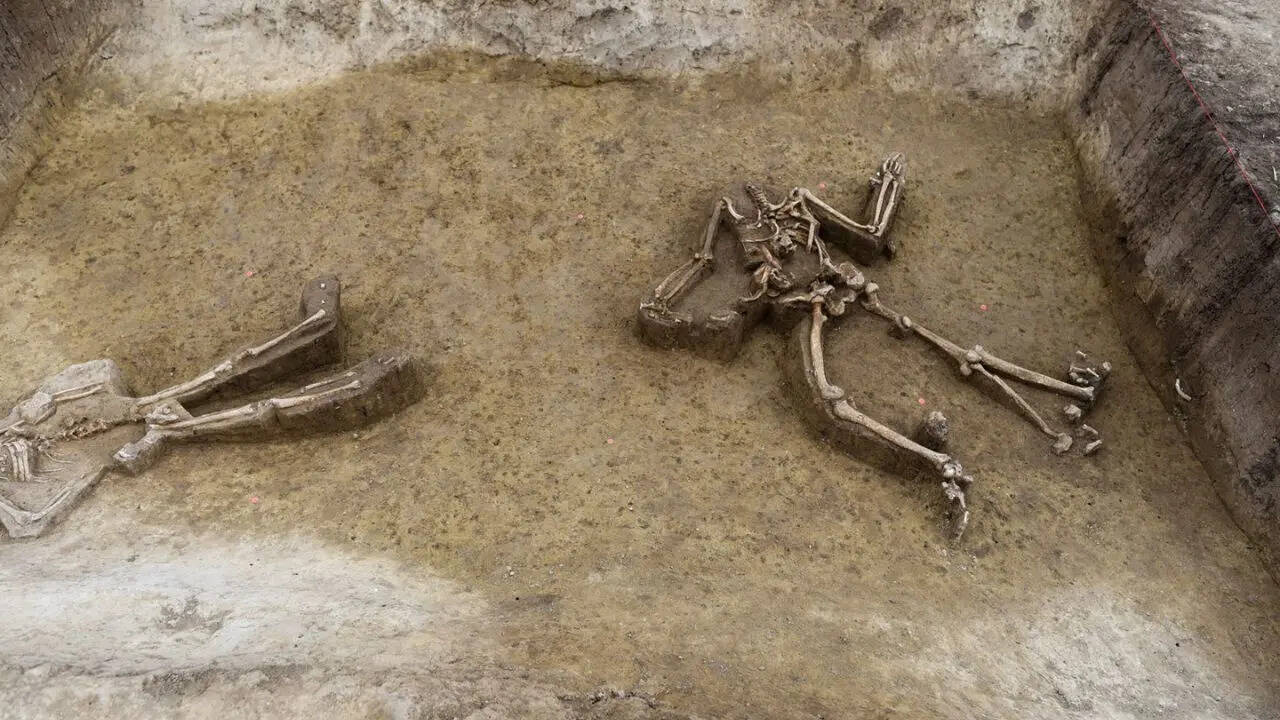
What lay beneath the topsoil was not just an ancient settlement, but a crime scene spanning generations. Or perhaps a sacred sanctuary. Or a theater of unimaginable terror. When archeologists from the Slovak Academy of Sciences and Germany’s Kiel University finished clearing away the dirt, they were staring into a massive ditch. Inside lay seventy-seven human skeletons.
Almost all of them were missing their heads.
The Weight of the Dirt
To understand the sheer scale of what happened at Vráble, you have to shed the modern world entirely. Forget the nearby highways. Forget the hum of electricity. Travel back roughly seven thousand years, to the Early Neolithic period. This was the era of the Linearbandkeramik (LBK) culture, Europe’s first true farming pioneers.
Imagine a sprawling megasite. It is one of the largest settlements of its time in Central Europe, divided into three distinct neighborhoods. Picture hundreds of longhouses constructed from timber and thatch, smoke drifting from cooking fires, the sound of stone axes clearing the dense primeval forest. Around six hundred people lived here at any given time—a metropolis for the Stone Age.
But security was an illusion. The entire settlement was ringed by a massive system of defensive ditches and palisades, stretching for over a mile.
As an excavator scraping away at the soil, the first thing that hits you is the smell of damp earth, followed by the sudden, stark whiteness of bone against the dark clay. Finding a skeleton is always a profound moment. It is a direct confrontation with a person who loved, feared, breathed, and survived in the very same spot thousands of years ago.
But finding dozens of them jammed together? That changes the air in the trench. It becomes heavy.
The skeletons at Vráble were not laid to rest with the gentle care of a standard cemetery. They were found packed into a defensive ditch near one of the settlement's main gates. They were young. Most of the remains belonged to adolescents and young adults between the ages of 15 and 25.
And then the realization settles in, chilling you despite the summer heat.
Where are the skulls?
Decapitation and the Absence of Answers
Excluding the remains of a single infant, every single one of the dozens of skeletons unearthed in that specific ditch lacked a head.
In archeology, the absence of evidence is often the most screaming piece of data. If a skeleton is missing its skull, you look for marks of violence. You look for chop wounds on the cervical vertebrae, the delicate bones of the neck. You look for signs that a blade or a stone tool severed flesh and bone.
Here, the mystery deepens into something far more baffling.
Preliminary examinations suggested that many of the heads were not hacked off in the heat of a brutal raid. Instead, the decapitations appeared to have happened after death. The heads were removed cleanly, purposefully, once the bodies had already begun to decompose or were newly dead.
Consider what that implies.
If an enemy tribe raided Vráble, slaughtered its youth, and took their heads as trophies, they would have left chaotic, violent cut marks on the neck bones. They likely wouldn't have waited for the bodies to soften. Trophy hunting is swift and brutal.
What happened here was something else. It was systematic. It was deliberate.
Could it have been an internal ritual? A profound, terrifying honoring of the dead? In many ancient cultures, the head was viewed as the seat of the soul, the locus of power. Removing the head might have been a way to keep the ancestor's spirit close, or conversely, a way to ensure the dead could never return to haunt the living. Perhaps the skulls were curated, painted, and kept in the longhouses while the bodies were returned to the earth.
But the ditch offers another clue that disrupts the idea of a peaceful ritual. The limbs.
Many of the skeletons were found in impossible, contorted positions. Arms crossed over faces. Legs twisted unnaturally. Some bodies were layered directly on top of one another, as if they had been dumped into the trench en masse, discarded like refuse rather than escorted to the afterlife with reverence.
The mind struggles to find a middle ground between these two realities: the calculated, post-mortem removal of skulls, and the careless, chaotic dumping of the torsos.
A Frontier in Crisis
To grasp why Vráble became a flashpoint for such extraordinary behavior, we have to look at the broader landscape of the European Neolithic. The transition from hunting and gathering to farming wasn't a peaceful, utopian march toward progress. It was a pressure cooker.
For centuries, the LBK culture expanded across Europe, clearing land, planting crops, and multiplying. But by the late stages of their era, the easy land was gone. The climate was shifting. Resources were dwindling.
When communities face starvation, social cohesion fractures. Neighbors become rivals. Boundaries become battlefields.
We know from other European sites—like the Talheim Death Pit in Germany or the Asparn-Schletz mass grave in Austria—that the late Neolithic was scarred by extreme collective violence. Entire villages were massacred, men, women, and children bludgeoned to death with stone adzes.
Vráble, however, represents a different manifestation of that societal stress.
The presence of the massive defensive ditches proves that the people here were terrified of something. They spent thousands of hours digging into the earth, creating barriers to keep the outside world at bay. The ditch wasn't just a geographical feature; it was a psychological border. It separated the safety of the community from the chaos of the wilderness.
Depositing dozens of headless bodies precisely at the gateway of this settlement sends a powerful message. But who was the message for?
If the bodies belonged to outsiders, attackers who failed to breach the walls, their headless torsos might have been dumped in the ditch as a gruesome deterrent. A warning to any other tribe looking at the smoke of Vráble’s fires with hunger in their bellies: Look what happens to those who cross this line.
If the bodies belonged to the inhabitants themselves, perhaps sacrificed during a time of plague, famine, or political upheaval, then the ditch served as a sacred boundary. The headless dead were guardians, or perhaps scapegoats, cast out to appease whatever forces were tearing their world apart.
The Stories in the Enamel
Archeologists are no longer limited to analyzing the shapes of bones. The real breakthroughs are happening at the molecular level. Currently, international research teams are utilizing dental analysis and ancient DNA tracking to unlock the secrets of the Vráble seventy-seven.
Every time you drink water or eat food as a child, your teeth record a chemical signature of the local geology through strontium isotopes. It is an indelible geological passport stamped into your tooth enamel.
When the results of these tests are fully realized, they will rewrite the narrative of Vráble.
If the strontium signatures reveal that these young people grew up hundreds of miles away, we will know they were outsiders. We will know that Vráble was a fortress that successfully defended itself, executing its captives and using their bodies as a horrific border wall.
But what if the teeth reveal they were local? What if these teenagers grew up eating the grain grown in the very fields where they were buried?
That reality is far darker. It points to an internal collapse. A society devouring its own youth in a desperate bid for survival, turning to ritualized execution or extreme mortuary practices as their world crumbled around them.
The truth is, we may never fully comprehend the exact theology or ideology that drove a community to separate seventy-seven heads from their shoulders. The distance of seven millennia forms a wall that even the most advanced science cannot entirely breach. We look into the trench and see horror; they may have looked into the trench and seen cosmic order, necessity, or justice.
Shadows in the Wheat
Walk the fields of Vráble today when the sun is setting, casting long shadows across the Slovakian landscape, and the past feels remarkably close.
The modern world likes to view history as a straight line moving from primitive darkness into enlightened light. We look at the ancient past as something detached, a museum exhibit behind glass. But the bones in the dirt remind us that the human emotional palette has not changed. The people of the LBK culture felt the same gripping fear of the unknown, the same fierce loyalty to their kin, the same desperate desire to survive when the environment turned hostile.
The excavation trenches have been backfilled. The wheat will grow again over the site of Europe’s most enigmatic Neolithic burial. The seventy-seven rest in climate-controlled labs now, their bones measured, cataloged, and scanned by lasers.
Yet, the true haunting of Vráble doesn't come from the macabre image of headless skeletons. It comes from the realization of the silence that followed them. A thriving community of hundreds, protected by miles of ditches, bustling with life, eventually vanished into the soil. All their fears, their rituals, their defenses, and their warnings were ultimately swallowed by the quiet, indifferent earth, leaving only a puzzle of bone for a future they could never have imagined.