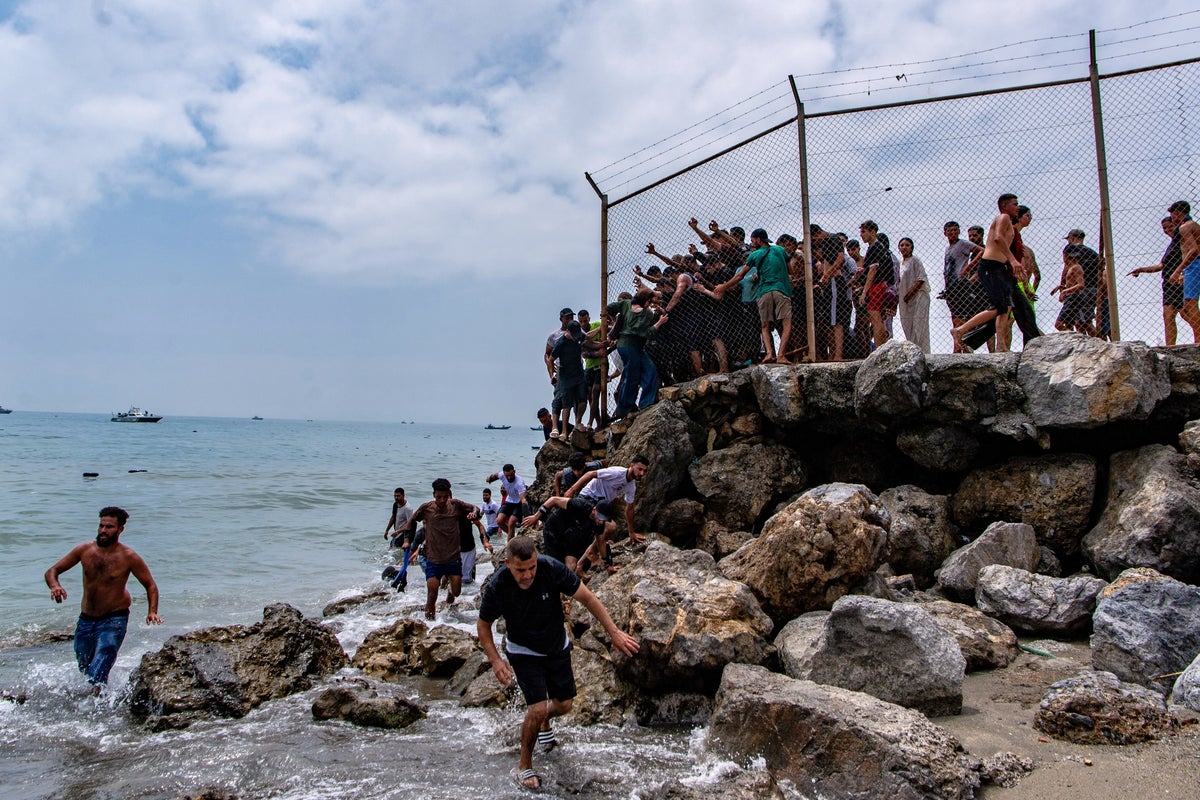
The sudden influx of thousands of migrants swimming and wading past the Tarajal breakwater into the Spanish enclave of Ceuta exposes the brittle limits of municipal reception frameworks when subjected to coordinated or high-density maritime pressure. Operating as a territorial projection of the European Union on the North African coast, Ceuta combines a geographic vulnerability with a stark demographic mismatch. A municipality supporting roughly 84,000 residents cannot absorb thousands of irregular arrivals within a forty-eight-hour window without triggering immediate operational failure across health, security, and housing infrastructure.
The Mechanics Of Municipal Collapse
When maritime arrivals bypass traditional land barriers, the administrative burden shifts immediately from federal border management to municipal emergency assets. The structural breakdown occurs across three distinct vectors:
- Physical containment capacity reaches saturation point when processing centers, such as local stadiums or temporary warehouses, absorb overflow populations without adequate sanitation or security controls.
- First-responder burnout sets in as local police, maritime civil guards, and medical volunteers face continuous water-rescue operations across dangerous coastal currents.
- Jurisdictional bottlenecks emerge between municipal leaders demanding immediate federal intervention and national ministries bound by legal procedures regarding asylum evaluation and repatriation treaties.
Local governance structures operate under baseline operational capacities designed for steady-state migration flows. When arrivals spike exponentially, the local economy and administrative apparatus enter a state of functional paralysis.
Judicial Friction And Border Enforcement Mechanics
The operational crisis in Ceuta is exacerbated by conflicting legal interpretations regarding maritime versus land-based entry. Recent judicial parameters dictate that individuals arriving via sea routes possess rights to procedural processing that prevent immediate summary returns, contrasting with protocols historically applied to land-fence breaches. This creates an asymmetric incentive structure:
Maritime Arrival -> Mandatory Procedural Review -> Municipal Holding Capacity Strain
Land Fence Breach -> Accelerated Repatriation Protocols -> Stabilized Border Flow
This legal divergence directly impacts enforcement tactics. Border security units find themselves constrained by judicial oversight while managing fluid tactical environments where thousands of individuals cross open breakwaters simultaneously. The reliance on military deployment to support the Civil Guard reflects a temporary stabilization measure rather than a structural solution to ongoing legal and geographic friction.
Diplomatic Leverage And Bilateral Dependencies
The permeability of the frontier at Ceuta functions as an indicator of broader diplomatic friction points between Spain and neighboring North African transit states. Border integrity relies heavily on active deterrence mechanisms maintained on the exterior side of the perimeter. When bilateral cooperation fluctuates, enforcement pressure drops, directly translating into immediate maritime surges.
The cost function of maintaining European southern borders involves continuous diplomatic alignment, financial burden-sharing between Madrid and Brussels, and precise legal harmonization. Without unified policy frameworks that address the economic disparities driving populations toward the Mediterranean coast, enclaves like Ceuta will remain perpetual focal points for systemic border stress.
Deploy the armed forces to establish immediate logistical control over processing facilities, while simultaneously establishing fast-track bilateral administrative channels to execute lawful repatriations and relieve municipal infrastructure strain.
Spain to deploy military to restore order in Ceuta after thousands of people breach Morocco's border
This video provides visual context on the military deployment and security response required during mass border surges in the enclave of Ceuta.