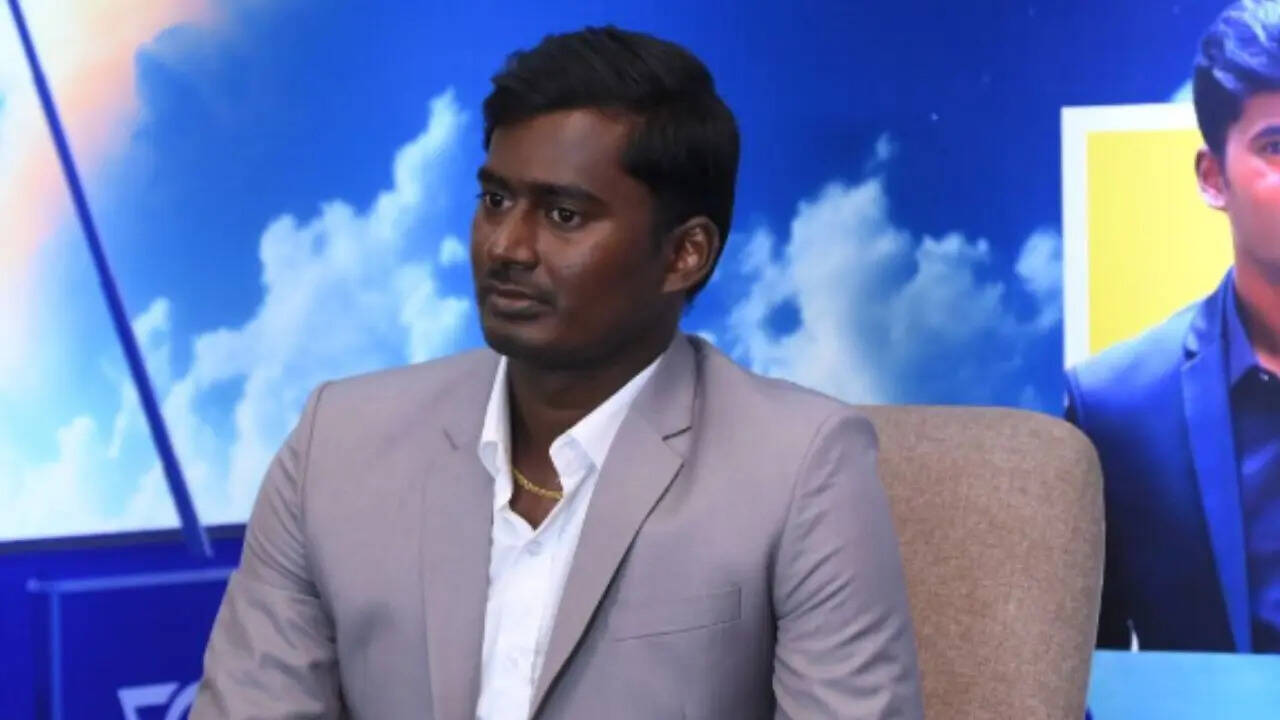
The dust in the village of Manakkal is a persistent thing. It clings to the hem of a dhoti and settles into the deep creases of a farmer’s palm. For a young Anand Megalingam, this dust was the boundary of his world. It was the grit he felt between his toes as he began his daily six-kilometer trek to school, a journey taken on foot because the luxury of a bus fare was as distant as the moon.
Most people look at a tractor and see a tool for survival. Anand’s father, a man who coaxed life out of the earth for daily wages, saw it as the ceiling of his son’s potential. But Anand was looking past the steering wheel. He was looking at the way the gears synchronized. He was looking at the sky.
This is not a story about a "success journey." It is a story about the stubborn refusal to accept the gravity of one's circumstances.
The Long Walk to Somewhere Else
Imagine the heat of a South Indian afternoon. It doesn’t just warm you; it presses down on you with a physical weight. Every morning, Anand stepped out of his house with the knowledge that his education was earned through physical endurance. Six kilometers. Every day.
For a child, that distance is an odyssey.
He didn’t have a backpack full of high-tech gadgets. He had the silence of the road and the internal hum of a mind that couldn't stop wondering how things worked. While his peers might have been thinking about the next meal or the evening chores, Anand was mentally dismantling the machines he saw in the fields.
The struggle wasn't just the walk. It was the contrast. On one side was the red earth, the manual labor, and the cycle of poverty that had claimed generations before him. On the other was the sheer, intoxicating complexity of the cosmos he read about in tattered schoolbooks.
He wasn't just walking to a classroom. He was walking away from a predetermined fate.
The Physics of a Dream
There is a specific kind of bravery required to be the first person in your bloodline to ask "Why?" instead of "How much?"
Anand eventually found himself in the halls of engineering colleges, but the transition wasn't a magic trick. It was a grind. Poverty has a way of following you even when you have a degree in your hand. It’s a ghost that whispers about stability and "playing it safe."
But the "safe" path doesn't lead to the stars.
He became obsessed with the concept of propulsion. While the world was focused on the internet boom and software services, Anand was looking at the hardware of the future. He saw a gap in how India—and the world—approached space. Space tech was the playground of giants, of governments with billion-dollar budgets and legacies that stretched back to the Cold War.
What could a tractor driver’s son contribute to a field dominated by titans?
The answer was Space Zone India.
Building a Ladder in the Dark
Starting a space-tech company in a garage isn't a cliché when you actually have to worry about where the next meal is coming from. Anand founded Space Zone India with a vision that felt almost delusional to outsiders: making space accessible.
He wasn't looking to just build another satellite. He wanted to change the fundamental cost of reaching the upper atmosphere. This meant diving into the world of hybrid rocketry.
For the non-engineers among us, think of a rocket like a high-performance athlete. Most rockets use either solid or liquid fuel. Solid fuel is like a firework—once you light it, you're going for the ride whether you like it or not. Liquid fuel is like a car engine—controllable, but incredibly complex and expensive.
Anand pivoted toward a third way: the hybrid.
$$F = \dot{m} v_e + (p_e - p_a) A_e$$
By using a solid fuel grain and a liquid oxidizer, his team could create a system that was safer, cheaper, and more manageable. It was the engineering equivalent of building a bridge out of recycled glass and finding it stronger than steel.
The stakes were invisible to the public but crushing for the team. Every failed test wasn't just a technical setback; it was a personal blow to a man who had staked his entire existence on the idea that a boy from Manakkal belonged in the boardroom of the future.
The NASA Connection and the Weight of Validation
There is a moment in every innovator's life when the world finally looks back. For Anand, that moment involved the most famous acronym in the history of exploration.
When Space Zone India began collaborating on projects that caught the attention of global agencies, including links to NASA-related initiatives and high-altitude balloon launches, the narrative shifted. He was no longer the "ambitious kid." He was a player.
In 2023, the mission "Dr. APJ Abdul Kalam Space Research Flight V5" became a landmark. It wasn't just a rocket launch. It was a mobilization of over 5,000 students from across India. Anand didn't just want to build a company; he wanted to build an ecosystem.
He remembered the six-kilometer walk. He remembered the red dust.
He realized that for every Anand Megalingam who makes it out, there are ten thousand who are buried by the weight of their own zip code. By involving students—specifically those from underprivileged backgrounds—in the assembly and launch of thousands of femto-satellites, he was effectively handing them the shoes he never had.
The Human Cost of High Altitudes
We often talk about CEOs in terms of their "net worth" or their "disruptive potential." We rarely talk about their sleep deprivation.
Anand Megalingam’s life is a testament to the fact that brilliance is often just another word for endurance. To go from the rural fields of Tamil Nadu to the cutting edge of aerospace requires a level of cognitive dissonance that would break most people. You have to believe in the impossible while dealing with the very possible reality of a bank account hitting zero.
He had to learn the language of venture capital while never forgetting the language of the village. He had to convince investors that a startup from Chennai could compete with the established aerospace corridors of the West.
It wasn't a "seamless" transition. It was a series of fractures and repairs.
The Horizon is Only a Suggestion
If you visit the facilities of Space Zone India today, you see a hub of high-tech manufacturing and ambitious young engineers. But if you look closely at the man leading them, you still see the walker.
Anand Megalingam didn't just build a company. He proved that the laws of physics are the only laws that are truly immutable. The laws of society, the laws of birthright, and the laws of "who is allowed to be a scientist" are all negotiable.
Space is often described as the "final frontier." It’s a cold, vacuum-sealed expanse that doesn't care about your pedigree. To a rocket, it doesn't matter if you grew up in a penthouse or a hut with a thatched roof. The only thing that matters is if your math is right and your heart can handle the G-force.
The red dust of Manakkal is still there, settling on the roads and the tractors. But now, when the children of the village look at that dust, they don't just see the ground. They see a launchpad.
The boy who walked six kilometers didn't just reach the schoolhouse. He reached the thermosphere, and he did it by realizing that the greatest distance anyone ever has to travel is the space between who the world says they are and who they know they can be.
Anand Megalingam is still walking. Only now, the steps are measured in light-years.