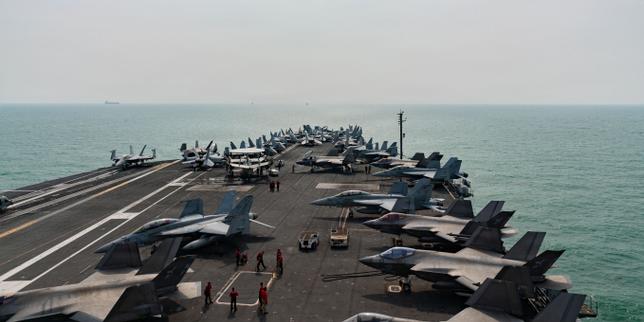
The arrival of the USS George Washington in the Middle East is being framed by official channels as a routine rotation. It is anything but. This transition marks a desperate, overdue intervention to save the crew of the USS Abraham Lincoln from what has effectively become an indefinite, record-shattering deployment. After more than 250 days at sea, the Lincoln is not just a vessel; it has become a floating testament to the fraying edges of American naval endurance.
For the sailors aboard the Lincoln, the reality has been stark. Whispers from the ship—filtered through the anxieties of families back home—speak of dwindling supplies, crumbling infrastructure, and a psychological toll that is difficult to quantify but impossible to ignore. These are not merely logistical inconveniences. When a carrier strike group spends nearly 200 consecutive days without a single port call, the machine begins to cannibalize its own resources, both mechanical and human.
The Pentagon asserts that the Washington’s arrival preserves a continuous, high-intensity presence in the region to counter Iranian influence and secure maritime chokepoints. This is the official script. It focuses on the strategic output: the blockade of Iranian ports, the projection of air power, and the maintenance of a deterrent posture. Yet, this strategic focus consistently ignores the hidden cost of the force generation model. We have reached a point where the demands of the current conflict have outpaced the replenishment cycle. The Navy is effectively burning its reserves to keep a single, high-value asset on station in the Arabian Sea.
By shifting the George Washington from the Pacific, the United States is playing a precarious game of musical chairs. The Indo-Pacific theater, already a pressure cooker, now faces a temporary void in its carrier coverage. This is a choice that carries profound implications. Does the relative stability of the Middle East theatre warrant the strategic exposure of the Pacific? The current doctrine suggests the answer is a begrudging yes, but the long-term impact on fleet readiness suggests a system nearing a critical state.
The disconnect between political rhetoric and the lived reality of those serving is widening. While leadership in Washington speaks of "performances for the ages" and dismisses internal reports of poor conditions as resolved or misrepresented, the sailors are the ones left to contend with sparse rations and failing systems. A carrier is a city at sea, and when the supply chain falters, it does not do so gracefully. Shortages of fresh food are not just morale issues; they are indicators that the logistics tail is not sufficiently robust to support the current operational tempo.
Observers must ask why the threshold for "extended deployment" keeps shifting. We are seeing a normalized acceptance of exhaustion. The expectation that a crew can maintain peak combat readiness for nine months without significant rest is an assumption that defies historical norms. Modern warfare, defined by high-intensity electronic environments and the threat of rapid escalation, demands a level of cognitive acuity that simply evaporates under the pressure of prolonged isolation.
The USS George Washington brings fresh hulls and a refreshed crew, but it inherits the same, unsustainable operational requirement. If the objective is to maintain this specific level of pressure in the Middle East indefinitely, the math will eventually fail. You cannot simply cycle ships indefinitely without expanding the fleet or narrowing the mission scope.
The reliance on these massive, singular strike groups creates a brittle dependency. If one ship breaks—mechanically or socially—the entire regional strategy risks collapse. This current rotation is not a solution; it is a temporary patch on a systemic problem that has been building for years. The Navy is operating on a deficit of time, a deficit of equipment, and, perhaps most critically, a deficit of the goodwill and endurance of its sailors.
Strategic strength is often measured by the hardware on the waves, but it is sustained by the mechanics, the pilots, and the maintainers who keep the engines humming. When you push that human element past the breaking point, the hardware becomes irrelevant. We are watching the limits of a strategy that mistakes presence for power, ignoring the reality that even the most advanced carrier is ultimately just as strong as the crew left to man the deck.
The rotation of the Washington is a tactical necessity, but it should be viewed as a warning light flashing red. The current pace is not a permanent state; it is a rapid depletion of the very assets required to maintain global standing. We are seeing the cost of that depletion in real-time, and it is higher than any official statement will admit. The ship has arrived, but the crisis remains at sea, waiting for the next cycle of the clock.