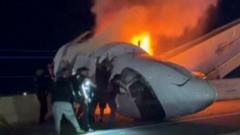
A private aircraft clips its landing gear, skids off the tarmac, and comes to a rest in a crumpled heap. Within seconds, smoke billows from the fuselage. Bystanders rush forward, wielding rocks, hammers, and tire irons, shattering the thick windows to drag terrified passengers to safety. It is a cinematic sequence that plays perfectly on social media feeds and evening news broadcasts. It is also an statistical anomaly that masks a terrifying truth about aviation safety.
When a small aircraft crashes, immediate extraction is the difference between life and death. Public instinct celebrates the heroism of onlookers who breach a downed fuselage from the outside. However, relying on civilian intervention highlights a glaring, systemic vulnerability in the design, regulation, and operation of private aviation. The aviation industry spends billions on luxury and speed, yet the structural realities of modern corporate jets mean that if the crew cannot open the main cabin doors from the inside, passengers are trapped in a titanium and composite tube that is nearly impervious to external rescue efforts.
The Illusion of the Fragile Cabin
Most people base their understanding of aviation materials on what they see in automobiles. Car windows are made of tempered or laminated glass designed to shatter into tiny, harmless pieces under localized impact, allowing quick access for first responders.
Aviation windows do not follow this design philosophy.
A corporate jet cabin is a pressure vessel. At 41,000 feet, the pressure differential between the interior cabin and the thin outside air places immense structural stress on every square inch of the fuselage. To withstand these forces, aircraft windows are engineered multi-layer assemblies. They typically feature an outer pane of stretched acrylic, a middle pane, and an inner scratch shield, all held together by heavy-duty rubber seals and bolted metal retainers.
Stretched acrylic does not shatter. It deforms, cracks slowly, and absorbs impacts that would pulverize automotive glass.
When bystanders approach a burning private jet with makeshift tools, they are fighting against materials designed to survive bird strikes at 500 miles per hour. A hammer or a rock will bounce off an intact cabin window, often injuring the person swinging it rather than breaching the fuselage. The rare instances where onlookers successfully smash through an aircraft window usually involve older, unpressurized light aircraft or situations where the impact forces of the crash had already compromised the structural integrity of the window frame. Relying on this as a viable rescue strategy is a mathematical gamble with a high casualty rate.
The Internal Exit Bottleneck
Commercial airliners are subject to stringent evacuation rules. Regulatory bodies force manufacturers to prove that a fully loaded Boeing 777 or Airbus A320 can be completely evacuated in 90 seconds or less, even with half the exits blocked.
The private aviation sector operates under a vastly different framework.
Because corporate jets carry fewer passengers, their cabin layouts face fewer regulatory hurdles regarding exit accessibility. The primary entry door often doubles as the main emergency exit, featuring integral stairs that drop downward. If an accident deforms the fuselage, or if the aircraft lands on its belly with the landing gear retracted, these downward-opening doors can become physically pinned against the ground.
+-------------------------------------------------------------+
|               TYPICAL PRIVATE JET EXIT RISKS                |
+----------------------------------+--------------------------+
| Door Design                      | Vulnerability            |
+----------------------------------+--------------------------+
| Downward-opening Airstair        | Pinned by belly landings |
| Plug-type Overwing Hatch         | Blocked by cabin luxury  |
| External Handle Mechanisms       | Shear off during impact  |
+----------------------------------+--------------------------+
When the main door is compromised, passengers must rely on smaller overwing emergency hatches. Here, the bespoke nature of private jet interiors introduces a silent hazard. Wealthy owners customize their cabins with heavy leather swiveling armchairs, solid wood partitions, and entertainment centers. While federal regulations dictate minimum clearance paths to emergency exits, a shifting seat during a violent crash can instantly block an already narrow escape hatch.
Furthermore, commercial airline passengers receive a standardized safety briefing before every flight. On private flights, the atmosphere is informal. Passengers are often business executives or high-net-worth individuals who treat the cabin as an extension of their office or living room. The psychological conditioning required to immediately locate, unlock, and manually lift a heavy, 40-pound plug-type window exit during the disorientation of a smoke-filled cabin is frequently absent.
The Failure of External First Responder Access
Airport fire departments and municipal rescue teams train extensively on commercial airframe cut points. These are specific, marked areas on an airliner's fuselage where the metal is thin and free of electrical wiring, hydraulic lines, or structural frames, allowing firefighters to use rotary saws to cut into the cabin.
Private jets rarely feature these markings.
The structural variance between a Gulfstream, a Bombardier Global, and a Cessna Citation is immense. A rescue crew arriving at the scene of a private jet crash outside the airport perimeter faces a guessing game. If they attempt to cut through the fuselage with hydraulic shears or rescue saws without precise knowledge of that specific model's blueprints, they risk severing high-voltage electrical lines or breaching fuel lines that run through the wing-root fairings, instantly worsening the post-crash fire.
Modern private aircraft increasingly utilize carbon-fiber composite materials instead of traditional aluminum. Composite structures offer incredible strength-to-weight ratios, which improves fuel efficiency and range. They behave differently under mechanical stress and fire.
Aluminum melts and tears. Composites splinter, burn, and release highly toxic particulate matter into the air when cut.
This toxicity forces first responders to wear specialized breathing apparatus and alters the tactics required to breach the hull. A rescue saw that slices through aluminum like butter can bind and seize when hitting the woven fibers of a composite fuselage, delaying entry during the critical moments when smoke inhalation threatens passenger survival inside the cabin.
The Economic Equation of Safety vs Luxury
The private aviation industry thrives on discretion, speed, and comfort. Safety features are embedded deep within the avionics, engine redundancy, and pilot training metrics. When it comes to the physical cabin, the market prioritizes aesthetics.
Adding secondary, externally operable emergency doors or installing breakable emergency panels adds weight. Weight reduces range. For a corporate client purchasing a $70 million jet, the ability to fly nonstop from New York to Tokyo outweighs the statistical probability of needing a specialized hull-breach panel.
Manufacturers design to the letter of the law. If regulatory agencies do not mandate standardized, externally accessible emergency releases for every cabin window or section, manufacturers will not voluntarily add them. The current regulatory framework assumes that the crew will always be conscious and capable of executing an evacuation. This assumption ignores the chaotic reality of runway excursions, where the flight deck often takes the brunt of the initial impact, leaving the pilots incapacitated and the passengers to fend for themselves.
The Practical Realities of Post-Crash Survival
Hoping for a crowd of brave bystanders with heavy tools is not an aviation safety strategy. Survival in a private aircraft accident depends on immediate, self-sustained action within the first 60 seconds.
Passengers must treat the cabin with the same tactical awareness required in any high-risk environment. This means physically identifying the location of the overwing hatch before engine start. It means ensuring that luxury cabin amenities are locked in their take-off positions, preventing them from becoming heavy projectiles or exit blockades during a sudden deceleration.
For the industry, the path forward requires a shift in how airframe accessibility is treated during the certification process. External emergency release handles, which allow rescue crews or trained onlookers to open overwing hatches from the outside, should be standard on every corporate aircraft, regardless of size or passenger capacity. These handles must be recessed and clearly illuminated to ensure they remain functional and visible after a destructive impact.
Aviation safety advances through the cold analysis of tragedy. Celebrating a lucky rescue where bystanders broke through a window obscures the structural engineering traps built into modern private cabins. Relying on makeshift tools to breach an aircraft hull is a systemic failure masquerading as an act of heroism.
:quality(75)/cloudfront-us-east-1.images.arcpublishing.com/elcomercio/RN7DCPKVX5H5VOIG6N2VXN5H5Q.jpg)