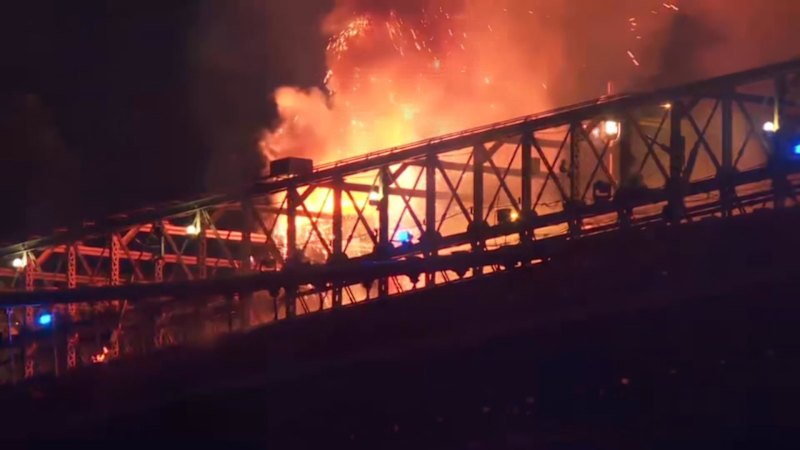
A standard Independence Day celebration turned into an infrastructure emergency when a fire erupted on the Brooklyn Bridge during the annual July 4th fireworks show. While spectators expected a flawless visual display, they instead witnessed emergency crews rushing to contain a blaze on one of the most heavily trafficked historic structures in the United States. The incident immediately halted local foot traffic and triggered a rapid response from the New York City Fire Department. Beyond the immediate chaos, the event exposes a critical, growing conflict between traditional mass entertainment and the physical vulnerabilities of aging urban monuments.
The Anatomy of an Overheated Spectacle
Pyrotechnic displays of this scale are meticulously planned, yet they inherently carry extreme thermal risks. Initial reports point toward falling embers or a localized electrical malfunction near the staging equipment stationed on the bridge span. When thousands of pounds of explosives detonate in tight proximity to historical wood, steel, and suspension cabling, the margin for error disappears.
The physical mechanics of modern fireworks involve high-velocity black powder charges and chemical pellets designed to burn at temperatures exceeding 2,000 degrees Fahrenheit. When these materials are launched from or near a suspension bridge, the debris field must be tightly controlled.
On July 4th, that control failed. Sparks breached the designated safety perimeter, igniting construction materials or protective decking utilized for ongoing maintenance projects on the bridge. The fire was not a freak accident. It was the predictable result of introducing extreme heat to a complex environment loaded with temporary industrial materials.
The Vulnerability of Century Old Steel
The Brooklyn Bridge is not a modern concrete highway. Completed in 1883, it relies on a delicate combination of limestone, granite, and steel wire wrap. High heat is the natural enemy of structural metallurgy.
- Thermal Expansion: Sustained exposure to intense localized heat causes steel beams to expand rapidly, putting uneven pressure on surrounding rivets and joints.
- Tensile Strength Loss: While a brief fire rarely causes a total collapse, repeated exposure to high-temperature incidents degrades the long-term load-bearing capacity of historical metal components.
- Combustible Additions: Decades of paint layers, protective coatings, and modern construction scaffolding add highly flammable variables to a structure that was never engineered to host industrial-grade pyrotechnics.
The Failure of Modern Safety Perimeters
Municipalities frequently treat historic bridges as picturesque backdrops rather than active, sensitive engineering projects. Security perimeters for major holidays are designed primarily for crowd control, often neglecting the technical realities of fire prevention on elevated spans.
When fireworks platforms are positioned close to structural elements, wind patterns become highly unpredictable. River currents create thermal updrafts that can carry burning debris hundreds of feet away from the intended drop zone.
Municipal event planners face intense pressure to deliver bigger, louder, and more visually aggressive shows every year to satisfy corporate sponsors and tourism boards. This escalation directly compromises safety margins. Fire suppression systems on historic bridges are notoriously difficult to deploy quickly, relying on manual lines dragged up pedestrian walkways or fireboats operating far below the deck level.
Balancing Tourism Revenue and Structural Integrity
Cities face a difficult calculation when managing historic landmarks. The economic drive to utilize iconic infrastructure for global television broadcasts often overrides the conservative recommendations of structural engineers.
| Risk Factor | Operational Impact | Long-term Consequence |
|---|---|---|
| Pyrotechnic Proximity | Increased localized heat signatures on cables | Micro-fractures in protective steel casings |
| Debris Accumulation | Smoldering ash settling in structural crevices | Accelerated corrosion and hidden fire hazards |
| Emergency Vehicle Access | Gridlocked pedestrian walkways delaying first responders | Extended burn times for active structural fires |
Relying on legacy infrastructure to support modern mass entertainment is unsustainable without radical changes to staging protocols.
Rethinking the Future of Public Celebrations
The Brooklyn Bridge incident serves as a clear warning for municipal engineering departments nationwide. Continuing to launch heavy explosives from vulnerable historic platforms invites catastrophic structural failure. The solution requires moving beyond traditional combustion-based entertainment.
High-altitude drone light shows and precision projection mapping offer viable alternatives that eliminate the fire risk entirely. These technologies remove the threat of thermal damage, toxic chemical runoff, and structural strain while delivering highly customizable visual experiences.
Cities that refuse to modernize their approach to public spectacles remain stuck in a dangerous cycle of reactive crisis management. Protecting irreplaceable architectural history must take precedence over traditional showmanship. The smoke over the East River proved that the current model has reached its absolute limit.