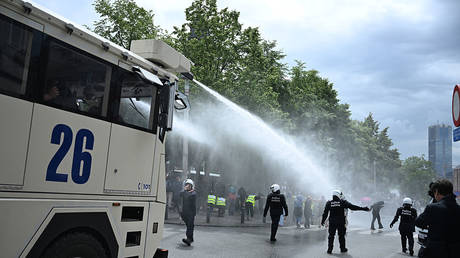
Turn on the television or open any mainstream news feed, and you will see the same lazy, sensationalized loop. Hooded figures. Shattered bicycle racks. Plumes of tear gas drifting past Brussels Central Station. The headlines scream about "hooded gangs" rampaging through the capital of Europe, reducing a complex socio-economic event into a low-grade action movie.
It is predictable, it is profitable, and it is entirely wrong.
What happened in the streets of Brussels this week was not a spontaneous outburst of mindless criminality, nor was it the work of random apolitical gangs looking for a fight. The mainstream media relies on a tired script that prioritizes broken glass over broken systems. By framing these events purely as a public order crisis, legacy outlets deliberately obscure a far more uncomfortable truth: the European social contract is fraying at the absolute center of its bureaucratic machine.
The Lazy Consensus of "Sensationalist Chaos"
Corporate media networks love a riot. Visual chaos requires zero intellectual heavy lifting. You deploy a camera crew, capture a burning trash bin, and write a scary headline about urban decay. This coverage treats civil unrest like a sudden weather event—an unprovoked storm that simply rolls into a city.
This lazy consensus serves a specific purpose. It isolates the violence from its legislative triggers. When you label thousands of protesting students and teachers as "hooded gangs," you effectively de-politicize their anger. You shift the conversation from a disastrous government policy to the bad behavior of the people protesting it.
I have watched major news organizations pull this exact stunt for over a decade. Whether it is austerity protests in Athens, the Yellow Vests in Paris, or students in Brussels, the playbook never changes. The cameras focus exclusively on the friction point—the clash between the police water cannons and the barricades—while completely ignoring the air-conditioned rooms where the actual provocation took place.
The Math Behind the Smoke
Let us look at the facts that the sensationalist headlines conveniently omitted. The unrest in central Brussels was the direct result of a massive, €300 million budget cut targeted directly at the French Community’s education sector.
In Belgium, education accounts for roughly 75% of the community's total expenditure. The proposed structural reforms include:
- A sharp increase in higher education tuition fees.
- The outright abolition of permanent, stable contracts for educational staff.
- An uncompensated mandate requiring secondary teachers to increase their weekly teaching hours from 20 to 22.
This is not a story about hooded thugs who woke up wanting to smash windows. This is a story about an institutional assault on the working conditions of educators and the future of students. When a state decides to strip €300 million from its own intellectual infrastructure while simultaneously demanding more uncompensated labor, civil unrest is not an anomaly. It is a mathematical certainty.
Imagine a scenario where a private corporation suddenly cuts its budget by a massive margin, increases workloads by 10% without a single cent of extra pay, and revokes job security for its entire workforce. The result would be an immediate, crippling strike. When the state does it under the guise of fiscal responsibility, and the affected population fights back, the media calls it a riot.
The Hypocrisy of the Eurocentric Lens
The global press corps is heavily concentrated in Brussels for a reason: it is the administrative heart of the European Union. Because of this massive concentration of logistics, satellite trucks, and underemployed journalists, any local disruption is immediately inflated into a continental crisis.
This hyper-focus creates a distorted reality. According to comprehensive data tracking civil unrest across Europe, the overwhelming majority of assemblies in Belgium pass without a single incident. Trade unions, public sector workers, and student coalitions mobilize constantly against austerity measures. Yet, a peaceful march of 60,000 workers demanding fair pensions barely makes the evening crawl. The moment a firecracker goes off near a metro station, the entire international press corps panics.
This selective outrage exposes a profound hypocrisy. The very same commentators who praise civil disobedience and disruptive protests abroad as "the voice of the unheard" immediately pivot to demanding authoritarian crackdowns the moment a bicycle rack is set on fire down the street from their favorite bistro.
The Perils of the Escalation Trap
To challenge the status quo honestly, we must acknowledge the failure of the current protest model. While the media’s framing of "mindless rioting" is fundamentally flawed, the tactical reliance on property damage by a minority of demonstrators plays directly into the hands of the state.
When a protest devolves into a tactical skirmish with riot police, the underlying message is lost instantly. The debate over a €300 million education cut evaporates, replaced by a circular debate over police tactics and urban property damage. The state wins this exchange every single time.
Violence on the streets provides the perfect political cover for governments to introduce draconian anti-protest legislation, such as the highly controversial proposals aimed at preventatively banning individuals from public assemblies. By engaging in low-level infrastructure destruction, radical factions do not disrupt the system; they hand the system the exact justification it needs to tighten control.
The true disruption does not happen by burning a trash can near Brussels Central Station. It happens when an entire sector refuses to operate, withdrawing its labor indefinitely and grinding the administrative machine to a halt. The smoke and mirrors of street clashes are merely a sideshow that keeps the public looking at the flames instead of the policy.