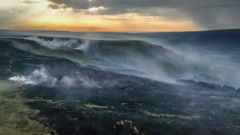
The United Kingdom is facing a terrifying surge in exceptional wildfire risk as heat health alerts push emergency services to their absolute limits. This is not a distant, tropical crisis. It is a domestic reality. While public safety announcements focus heavily on vulnerable citizens staying hydrated indoors, a systemic failure in land management, climate readiness, and infrastructure funding is leaving the British countryside highly vulnerable to unprecedented blazes. The primary mechanism driving this threat is a combination of prolonged, intense heatwaves and a severe lack of specialized, national wildfire coordination.
To truly understand why the UK is suddenly combustible, one must look beyond the daily weather forecast. The narrative broadcast to the public usually centers on immediate discomfort—melting tarmac, disrupted train schedules, and warnings from health officials. These are symptoms, not the disease. The underlying crisis is that the British ecosystem and its emergency frameworks were built for a temperate climate that no longer exists.
The Mechanized Ignition of the British Countryside
Wildfires in the UK do not behave like those in the Mediterranean or western North America, at least not yet. However, the gap is closing fast. The danger lies in the fuel load. Decades of changing agricultural practices and the abandonment of traditional land management have left vast tracts of heathland, moorland, and even urban-fringe green spaces choked with dead, dry vegetation.
When a heat health alert is triggered, it signals more than just hot days. It marks the rapid dehydration of these fuel sources. The moisture content in vegetation drops to critical levels, turning ordinary grass and gorse into highly flammable tinder.
Fire briafes face a distinct tactical disadvantage here. British fire and rescue services are predominantly trained and equipped for structural firefighting—tackling house fires, commercial blazes, and road traffic accidents. A wildfire requires an entirely different playbook. It demands prolonged, grueling wildfire suppression tactics, extensive off-road vehicle capability, and high-volume water transport systems that many regional brigades simply do not possess in sufficient quantities.
The Illusion of National Readiness
The current operational framework relies heavily on mutual aid agreements. If a massive blaze breaks out in one county, neighboring services send assets to help. But when exceptional wildfire risk spans multiple regions simultaneously, this system collapses.
Consider a scenario where the entire south of England is baking under a protracted heatwave. If three separate counties face major blazes at the same time, the ability to share resources vanishes. Local brigades are forced to make impossible choices about which properties to protect and which habitats to surrender to the flames.
The Funding Void and Policy Blindspots
Money, or the lack thereof, sits at the heart of this vulnerability. Over the past fifteen years, central funding for fire and rescue services has seen significant real-terms cuts. Stations have closed, crew numbers have dwindled, and specialized equipment procurement has been deferred.
- Deficit in Specialized Training: Most firefighters receive basic training on wildland fires, but few achieve the level of specialist tactical advisor status required to predict fire behavior in shifting winds.
- The Urban Intermix Problem: Unlike the vast wilderness of the US, British wildfires frequently occur in close proximity to major infrastructure, housing estates, and transport links, raising the stakes exponentially.
- Outdated Risk Assessments: National planning registers have historically ranked wildfires as a secondary threat, vastly underestimates the economic and human toll of a modern, climate-driven fire season.
This policy blindspot extends to land ownership. Large estates, conservation bodies, and private farmers often disagree on how to manage the land to prevent fires. Some advocate for controlled burning to reduce fuel loads, while others argue this damages carbon-sinking peatlands. While these factions argue, the fuel continues to accumulate, waiting for a single spark from a discarded cigarette, a stray piece of glass, or an illegal barbecue.
The Changing Physics of British Summer Heat
The heatwaves hitting the UK are changing in their fundamental physics. We are no longer experiencing isolated hot days, but prolonged periods of high atmospheric pressure that trap heat and sap every ounce of moisture from the soil.
$$\text{Soil Moisture Deficit} \propto \text{Temperature} \times \text{Duration of Heatwave}$$
As the formula implies, the risk does not increase linearly; it compounds. Each successive day of a heat health alert doubles the volatility of the landscape.
When a fire does ignite under these conditions, it exhibits behavior previously unseen in the British Isles. Extreme flame lengths, rapid spot-firing—where embers fly ahead of the main fire front to ignite new blazes—and intense thermal drafts make direct attack impossible. Firefighters are forced into defensive postures, merely trying to steer the fire away from critical infrastructure rather than extinguishing it.
Infrastructure on the Frontline
The true cost of this threat is measured in the vulnerability of critical infrastructure. The UK transport network is uniquely susceptible to extreme heat and fire.
Railway lines buckle under extreme temperatures, but the threat of trackside fires is even more disruptive. Vegetation management along rail corridors has lagged behind for years. A single spark from a train's braking system can ignite a trackside fire that paralyzes an entire commuter main line, stranding thousands and cutting off vital economic arteries.
Similarly, the electrical grid faces severe strain. High ambient temperatures reduce the efficiency of power lines, while smoke from nearby wildfires can ionize the air, causing high-voltage lines to short-circuit and trip, leading to localized blackouts just when households need power most to run cooling systems.
The current strategy of issuing heat health alerts and hoping for rain is a recipe for disaster. Relying on public compliance and overstretched emergency workers cannot substitute for a fully funded, nationally coordinated wildfire resilience strategy. The landscape is primed, the climate has shifted, and the window to prevent a catastrophic, multi-regional fire disaster is rapidly closing. Every day spent treating this as a temporary weather inconvenience rather than a structural crisis brings the country closer to a devastating reckoning.