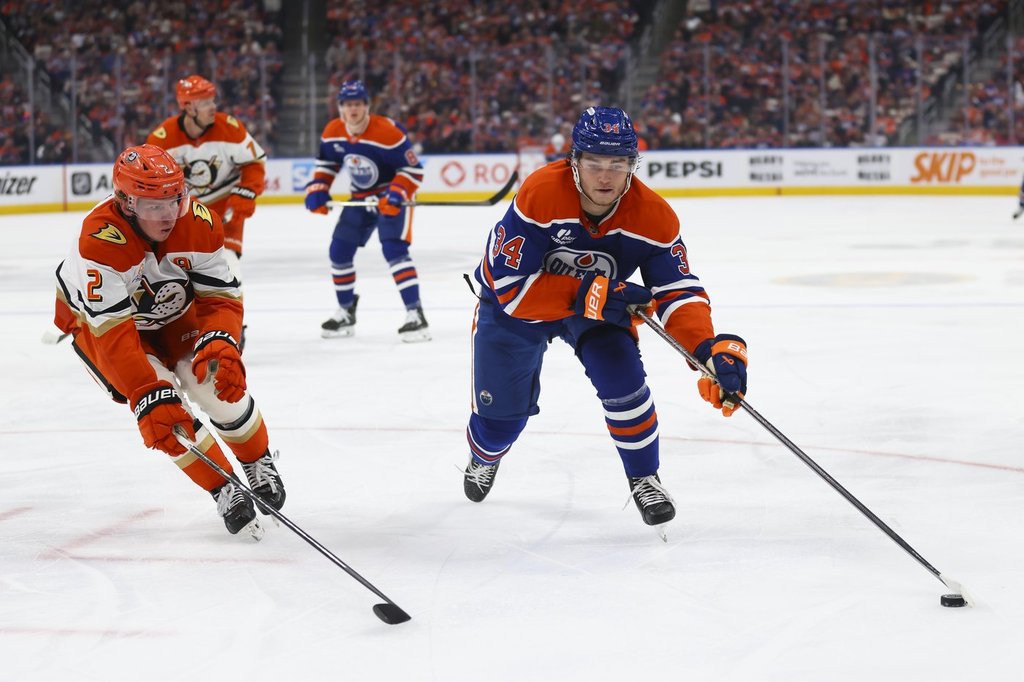
The Edmonton Oilers finalized their summer bookkeeping by signing restricted free agent center Colton Dach to a two-year contract extension worth $2.4 million. Carrying a cap hit of $1.2 million per season through the 2027-28 campaign, this deal represents far more than a simple depth transaction for a team trying to squeeze every ounce of value out of a top-heavy roster. General Manager Stan Bowman is gambling that a hometown kid with a massive frame can solve the persistent bottom-six structural deficiencies that have plagued this franchise. It is a calculated wager on untapped potential, physical oppression, and cap compliance.
The Cost of Moving Away From the Past
To truly understand why this contract matters, you have to look back to the frantic hours of the March 2026 trade deadline. Edmonton was suffocating under the weight of Darnell Nurse’s massive $9.25 million annual cap hit, an albatross that limited structural flexibility. Bowman engineered a massive reshuffling, unloading that contract and sending winger Andrew Mangiapane alongside a conditional 2027 first-round draft pick to the Chicago Blackhawks. In return, the Oilers received defensive anchor Jason Dickinson and the towering Colton Dach.
Paying a first-round draft choice for depth pieces is always a dangerous proposition for a contending franchise. The draft capital represents cheap, controllable talent that a championship team needs to survive over a multi-year window. By surrendering that pick, the front office essentially declared that Dach was not just a throw-in prospect, but a critical pillar of their immediate future. If the twenty-three-year-old forward fails to establish himself as a regular, impactful NHL contributor, the trade will look like a desperate overpayment.
The pressure is now squarely on the player to justify that structural sacrifice. He arrives with the pedigree of a second-round draft pick from 2021, but his professional trajectory has been uneven, interrupted frequently by physical ailments that derailed his development momentum.
The High Risk Profile of a Heavyweight Forward
Scouts have long been enamored by the raw physical tools that the St. Albert native brings to the ice. Standing six feet four inches tall and weighing over 215 pounds, he possesses the ideal frame for modern postseason hockey, where space evaporates and the game transforms into a series of brutal wall battles. He plays with an edge, registering 219 hits across his combined appearances for Chicago and Edmonton last season.
Yet, the modern game demands mobility, and this is where the analytical red flags begin to appear. Talent evaluators have consistently noted that his stride lacks the explosive acceleration required to recover from positioning errors at the NHL level. A heavy skating stride can turn a promising forechecker into a liability against quick-transitioning opponents. If he cannot get to the spot in time, his physical size becomes entirely irrelevant.
The underlying numbers from his tenure in Chicago paint a complicated picture of his utility down the middle of the ice.
- He won just 36.6 percent of his face-offs while wearing a Blackhawks sweater last season.
- He failed to take a single draw during his brief eight-game regular-season cameo with the Oilers.
- His offensive production remained modest, totaling just thirteen points in sixty-one combined games.
Moving a natural center to the wing is a common tactic for young players struggling with the defensive responsibilities of the position, but Edmonton specifically needs cheap reliability down the middle. If he remains unviable in the face-off circle, his path to earning consistent ice time becomes significantly more treacherous.
The Chemistry With Trent Frederic
Despite the statistical concerns, the late-season sample size offered a glimpse of how the front office envisions his utilization. Prior to suffering an injury that sidelined him for twelve games down the stretch, the young forward found immediate chemistry on a rugged line next to twenty-eight-year-old winger Trent Frederic.
Frederic had been enduring a prolonged slump, weighed down by the expectations of his own long-term contract. The insertion of a young, eager physical presence seemed to act as a spark plug for the veteran. Together, they formed a punishing forecheck that forced turnovers in the offensive zone, relieving pressure on Edmonton's top two defensive pairings. They hunted pucks in the corners, establishing a cycle game that wore down opposing defensemen.
This specific identity is what the coaching staff desperately craves for their bottom-six forward group. The team has never lacked elite, breathtaking offensive skill at the top of the lineup, but they have repeatedly fallen short in the spring because their depth lines could not maintain puck possession or change the momentum of a game through physical dominance. The brief flash of the Frederic-Dach combination suggested that the blueprint could work if given a full training camp to mature.
An untimely injury disrupted that momentum, leaving the coaching staff to piece together a makeshift solution for the opening round of the playoffs against the Anaheim Ducks. Though he rushed back to appear in five postseason contests, he managed only a single assist as Edmonton suffered a disappointing first-round exit. A fully healthy summer is paramount for a player whose body has repeatedly betrayed him at critical junctures of his young career.
Financial Freedom and the Remaining Offseason Blueprint
Securing this signature at a $1.2 million average annual value gives the front office a clear view of their remaining financial landscape. With this final restricted free agent checked off the priority list, Edmonton sits with roughly $4.7 million in available salary-cap space.
This financial flexibility is a direct result of the aggressive roster surgery performed over the last six months. By moving on from legacy contracts and filling out the lower half of the roster with cost-effective options like Ryan Shea, Frederik Andersen, and now Dach, the front office has avoided the annual cap crunch that typically paralyzes true contenders. They have built a complete twenty-three-man roster while retaining enough ammunition to make another significant move.
Speculation around the league suggests that the front office will not sit idle with that remaining cap room. Last summer, they struck gold by signing Jack Roslovic to a modest one-year contract that yielded twenty-one goals. The current market features several veteran middle-six forwards who find themselves squeezed out as cap space dries up across the league.
Maintaining that financial flexibility into the winter could also allow the team to accrue cap space leading up to the 2027 trade deadline. A team with five million dollars in space in October can easily absorb a ten million dollar contract in March due to the daily calculation of the salary cap. This long-term strategic planning shows a front office operating with an awareness of their championship window.
The Projected Lineup Integration
When training camp opens, the battle for positions in the bottom half of the forward group will be fierce. The organization possesses several intriguing prospects waiting for an opportunity, including young forward Sam O'Reilly, who will push for an NHL roster spot.
The two-year term of this extension signifies that the coaching staff expects the hometown forward to be an everyday regular, not a rotational press-box spectator. He will likely begin the year occupying the left wing or center spot on the third line, tasked with providing defensive stability and physical deterrence. The coaching staff may also experiment with using his massive frame as a net-front presence on the second power-play unit, utilizing his reach to screen goaltenders and cash in on loose rebounds.
Success for the player will not be measured by goals or assists. It will be measured by his ability to stay on the ice for eighty-two games, his efficiency along the boards, and his discipline in avoiding costly minor penalties that put a vulnerable penalty-killing unit under duress. The front office has provided the financial security and the clear path to playing time. The rest is entirely up to the player.


