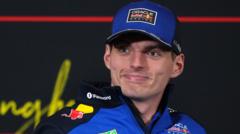
Max Verstappen is winning, but he isn’t having a good time. The three-time world champion has spent the last two seasons systematically dismantling the competition, yet his public rhetoric has shifted from the fire of a challenger to the weary sighs of a man trapped in a golden cage. While Formula 1 executives point to record-breaking revenue and a global explosion in viewership, the sport’s most dominant figure is flagging the one thing money cannot buy: the soul of the race.
The disconnect between the commercial success of the Liberty Media era and the visceral experience of the drivers has reached a breaking point. Verstappen’s recent complaints about the "fun" factor aren't just the spoiled grievances of a winner; they are a systemic warning. The current technical regulations and the relentless expansion of the calendar have transformed racing from a high-stakes duel into a grueling logistical exercise. If the fastest man on Earth is looking at the exit door, the sport has a fundamental problem with its product.
The Aerodynamic Trap
The 2022 technical overhaul was sold as a solution to the "dirty air" problem. By utilizing ground-effect aerodynamics, the FIA promised that cars could follow each other closely, fostering wheel-to-wheel combat. On paper, it worked. In reality, it created a different kind of monster.
These cars are heavy. They are stiff. To make the floor generate the necessary downforce, the suspension must be tuned to a degree of rigidity that punishes the human body. Verstappen and his peers are no longer driving nimble, reactive machines that dance on the limit. They are piloting high-speed trains that require a specific, often monotonous, driving style to remain efficient.
When Verstappen talks about the lack of fun, he is referring to the loss of the "edge." The current cars are sensitive to wind, track temperature, and curb strikes in a way that discourages flair. If a driver pushes $101%$ to find a tenth of a second, the ground-effect seal might break, sending the car into a spin. Consequently, the world’s best drivers are spending $90%$ of a Grand Prix managing tires and protecting floors rather than attacking corners.
The Weight of the Calendar
Formula 1 has ballooned to a 24-race schedule. For the commercial rights holders, this is a victory of volume. For the people inside the paddock, it is a war of attrition.
Verstappen’s discontent stems from the dilution of the "event" feel. When there were 16 or 17 races, every Sunday felt like a world-stopping moment. Now, the circus moves so fast that the individual races blend into a blur of jet lag and hotel lobbies. The introduction of Sprint weekends has only compounded this fatigue. By removing practice time and adding a "mini-race" on Saturdays, the sport has stripped away the mystery of the main event. By the time the lights go out on Sunday, the teams already know exactly how the tires will behave and where everyone stands. The spontaneity is gone.
For a pure racer like Verstappen, the "show" elements—the pre-race driver introductions in Miami, the glitz of Las Vegas, the endless media commitments—are chores that distract from the cockpit. He is a man who would likely be happier racing a GT3 car in front of a few thousand die-hards than standing on a podium under a shower of neon lights if the racing itself felt more authentic.
The Simulation Stalemate
Technology has become a double-edged sword. In the past, a driver’s intuition could overcome a sub-optimal car setup. Today, the simulations are so accurate that the "window" for performance is microscopic.
The Death of Intuition
- Data Dominance: Engineers at the factory can see a vibration in a sensor before the driver even feels it in the steering wheel.
- Prescriptive Racing: Drivers are coached through every corner on how to save energy, manage the battery, and clip the apex to avoid overheating the rubber.
- Predictability: The gap between the fastest car and the slowest has shrunk in terms of percentage, but the hierarchy is more rigid than ever.
This predictability is the enemy of excitement. Verstappen’s dominance is a testament to his brilliance, but even he seems tired of the foregone conclusion. When the result is decided by a supercomputer in Milton Keynes three days before the race starts, the act of driving becomes a procedural formality.
The Identity Crisis of the FIA
The governing body is caught between two masters. On one hand, they must satisfy the manufacturers who demand "road relevance" and hybrid efficiency. On the other, they have a fanbase—and a reigning champion—screaming for lighter cars and louder engines.
The 2026 regulations are intended to fix some of these issues, but early reports from the simulators are concerning. There are whispers of "active aero" being used to compensate for a lack of straight-line power, potentially leading to cars that behave unpredictably on long straights. If the FIA doubles down on complexity to solve the problems caused by complexity, the "fun" Verstappen craves will remain a memory.
Verstappen isn't asking for a return to the 1970s where drivers died every other weekend. He is asking for a car that rewards bravery over battery management. He is asking for a schedule that allows for a personal life. Most importantly, he is asking for a sport that remembers it is a sport first and a content platform second.
The Looming Threat of Early Retirement
Verstappen is not bluffing. Unlike previous champions who stayed for the paycheck or the fame, Max has a genuine detachment from the F1 bubble. He has already achieved everything there is to achieve. His interest in endurance racing and sim-racing is well-documented; these are avenues where the "fun" hasn't been sterilized by a billion-dollar marketing machine.
If Formula 1 loses its greatest current talent because the technical and emotional toll of the sport has become too "boring," it will be a catastrophic failure of leadership. The sport needs to decide if it wants to be a technical showcase for engineers or a theater for the world's most daring athletes.
The fix isn't complicated, but it is difficult. It requires reducing the weight of the cars by a significant margin—likely by simplifying the power unit. It requires a calendar that prioritizes quality over quantity. And it requires giving the drivers back the "tools" to make a difference on track without a radio technician whispering in their ear.
You should watch the lap times in the final sector of the next race. Notice how many drivers are backing off, not because they can't go faster, but because the "system" tells them it's not optimal. That is the sound of a sport losing its way.
Would you like me to analyze the specific technical weight-reduction proposals for the 2026 engine regulations to see if they actually address these driver concerns?