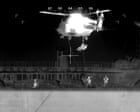
For years, the European approach to Vladimir Putin’s "shadow fleet"—the ragtag collection of aging, uninsured tankers keeping the Kremlin’s war machine solvent—was a game of paperwork. Regulators sat in Brussels or London, adding names to spreadsheets while hundreds of millions of barrels of oil continued to flow through the English Channel and the North Sea. On Sunday, that era of polite bureaucracy ended with the roar of NH90 helicopter rotors and the boots of Belgian special forces hitting the deck of the Ethera.
Operation Blue Intruder, a joint strike by Belgian and French forces, resulted in the high-stakes seizure of the Ethera within Belgium’s exclusive economic zone. The vessel, a 2008-built tanker capable of carrying 100,000 tons of crude, was intercepted in the early hours of March 1, 2026. It is now being escorted to the port of Zeebrugge for formal confiscation. While the headlines focus on the drama of the boarding, the real story is a fundamental shift in maritime enforcement. Western powers are finally moving from "monitoring" to "interdiction," and the legal loophole Russia has used to bankroll its invasion of Ukraine is being physically closed.
The Myth of the Sovereign Flag
The Ethera was flying the flag of Guinea, but Belgian federal prosecutors were quick to confirm that the documentation was a sham. This is the shadow fleet’s primary survival mechanism: "flag-hopping" and identity theft. By operating under fraudulent registries or using flags of convenience from countries with little oversight, these vessels claim the protection of international maritime law to avoid inspections.
However, a ship without a valid flag is effectively "stateless." Under the United Nations Convention on the Law of the Sea (UNCLOS), stateless vessels have no protection from boarding by any nation’s navy. This is the "why" behind the sudden increase in seizures. A coalition of 14 Baltic and North Sea nations recently issued a joint declaration stating they will no longer recognize tankers with suspect documentation or disabled transponders. They aren't just looking for sanctions violations anymore; they are treating these ships as unidentified maritime hazards.
The Ethera wasn't just a random target. It had been on EU, UK, and US sanctions lists for months. Yet, until this weekend, it continued to operate with impunity. The decision to send in commandos signifies that the West has lost patience with the "cat and mouse" game of shell companies.
Environmental Suicide and Hybrid Warfare
Beyond the billions in revenue these ships generate for Moscow, the North Sea is facing an unprecedented ecological threat. The shadow fleet is composed of "vintage" hulls—ships that would normally be sold for scrap. They operate without top-tier Western insurance (P&I clubs), meaning that if one of these tankers were to break apart in the treacherous currents of the North Sea, there is no one to pay for the cleanup.
Western intelligence services are also looking at these ships as more than just oil carriers. There is growing evidence that the shadow fleet serves as a platform for Russian hybrid warfare.
- Sabotage: In late 2024, the tanker Eagle S was linked to the severing of underwater data cables between Finland and Estonia.
- Espionage: Multiple vessels have been observed lingering near offshore wind farms and military installations under the guise of "engine trouble."
- Electronic Warfare: Reports suggest some of these tankers carry equipment capable of jamming GPS signals and interfering with regional aviation.
When Belgian forces boarded the Ethera, they weren't just looking for oil. They were looking for the "minders"—Russian nationals often embedded in these crews to ensure the cargo reaches its destination and to conduct intelligence gathering. On a similar vessel seized by France earlier this year, investigators found two Russian nationals with ties to private security firms who were tasked with monitoring the crew and surroundings.
The Logistics of Seizure
Seizing a ship is easy; keeping it is a nightmare. This is the overlooked factor that has prevented more aggressive action until now. Once the Ethera is docked in Zeebrugge, the Belgian government becomes responsible for its maintenance, its crew, and its volatile cargo. The costs are staggering.
Maintaining a state-of-the-art seized yacht can cost millions; maintaining a 15-year-old, poorly serviced oil tanker is a liability that most nations would rather avoid. There is also the question of the cargo. Selling sanctioned Russian oil presents a legal quagmire. Does the money go to the seizing state, or is it placed in a fund for Ukrainian reconstruction?
If the West intends to make this the "new normal," as French President Emmanuel Macron suggested, they need more than helicopters. they need a standardized legal framework for the permanent disposal of these assets. Currently, most seized tankers are eventually released after their owners pay a fine. Moscow treats these fines as a mere tax on doing business. For the shadow fleet to be truly dismantled, the ships must be scrapped, and the oil confiscated.
The Kremlin’s Response
The Russian Embassy has already characterized the seizure of the Ethera as "economic terrorism" and "piracy." This is standard rhetoric, but the threat of escalation is real. Moscow has hinted at deploying its own naval assets to protect its commercial interests in international waters.
However, the Kremlin is in a weak position. The North Sea and the Baltic are effectively "NATO lakes." If Russia attempts to escort its shadow fleet with warships, it risks a direct confrontation that it cannot win. Instead, we are likely to see an increase in asymmetric retaliation: cyberattacks on Belgian port infrastructure or further "accidental" damage to undersea cables.
A Hardening of the Line
The boarding of the Ethera proves that the era of "strategic patience" is over. The West has realized that as long as the shadow fleet exists, sanctions are a suggestion, not a deterrent. The operation was a calculated risk, intended to signal to the shadowy brokers in Dubai, Hong Kong, and Istanbul that the North Sea is no longer a safe corridor for illicit trade.
This is no longer just a trade dispute or a regulatory hurdle. It is a kinetic confrontation on the high seas. The Ethera is currently being searched for evidence of document forgery and sanctions evasion, but the real evidence is already clear: the West has finally decided to start fighting back where it hurts most.
The next step is for the G7 to establish a permanent maritime task force dedicated specifically to the physical interdiction of every sanctioned hull that enters European waters.