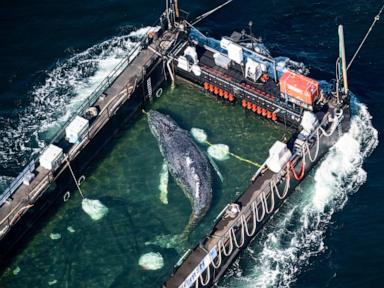
The recent release of a humpback whale nicknamed Timmy into the North Sea after weeks of being stranded off the German coast is being hailed as a triumph of marine conservation. It is a feel-good story designed for social media feeds and evening news cycles. However, the celebration masks a much darker reality about the state of our oceans and the actual survival rates of these massive mammals once the cameras stop rolling. While the rescue operation was a logistical marvel involving dozens of experts and specialized equipment, it serves as a band-aid on a gaping wound.
The North Sea is becoming a lethal trap for deep-water species. It is shallow, noisy, and increasingly crowded with industrial activity that disrupts the very biological mechanisms whales rely on for survival. To understand why Timmy ended up in the Wadden Sea—a treacherous labyrinth of sandbanks and tidal flats—we have to look past the heartwarming footage and examine the systemic failures of marine management and the physiological toll of human-driven ocean noise.
A Shallow Grave for Giants
Humpback whales are built for the deep. Their internal navigation systems are honed for the vast expanses of the Atlantic, not the shallow, shifting basins of the North Sea. When a whale enters these waters, it isn't just taking a wrong turn; it is entering a sensory vacuum. The North Sea averages a depth of only 95 meters. For a creature that regularly dives to depths of several hundred meters, this is the equivalent of a human trying to navigate a pitch-black room with a ceiling only four feet high.
The primary culprit in these strandings is often acoustic interference. We have filled the ocean with a relentless cacophony of shipping engines, seismic surveys for oil and gas, and the high-frequency pulses of sonar. For a whale, sound is vision.
When that sound is drowned out by industrial noise, the whale loses its ability to map its surroundings. It becomes disoriented. It follows schools of prey into narrowing channels, unaware that the tide is retreating until the weight of its own body begins to crush its internal organs against the sand. By the time a whale like Timmy is spotted, the damage is often already done.
The Physical Toll of Stranding
The public sees a whale resting on a beach and thinks of it as a fish out of water. The reality is far more gruesome. A humpback whale can weigh up to 30 tons. In the ocean, buoyancy supports that mass. On land, gravity becomes an enemy. The sheer weight of the animal compresses the lungs, making every breath a Herculean struggle. Blood flow to the extremities is cut off, and toxins begin to build up in the muscle tissue, a condition known as capture myopathy.
Even if the whale is kept wet and eventually floated back to sea, these internal injuries persist. The rescue of Timmy involved weeks of monitoring and wait-and-see tactics. During this time, the whale was not feeding. Humpbacks require massive caloric intake to maintain the blubber layers that regulate their temperature. A stranded whale is a starving whale, burning through its energy reserves just to stay alive while its body slowly poisons itself from the inside out.
Rescue teams in Germany used specialized slings and pontoons to move the animal, but the physical stress of the move itself can be fatal. We are effectively putting a heart attack victim through a marathon and hoping they survive the finish line. The "success" of a release is often measured by the whale swimming away from the shore, but without long-term satellite tracking, we have no idea if that animal survives the week or simply sinks to the bottom ten miles out.
The Logistics of Hope
The operation to save Timmy was an expensive, high-stakes gamble. It required coordination between the Society for the Rescue of Dolphins, local environmental ministries, and specialized maritime salvage crews. This level of intervention is rare because it is prohibitively costly. Critics argue that the hundreds of thousands of Euros spent on a single high-profile rescue would be better utilized in systemic habitat protection.
However, the optics of letting a whale die on a public beach are a nightmare for politicians. There is a "charismatic megafauna" bias at play here. We will move mountains to save one whale with a name, while simultaneously ignoring the silent disappearance of less photogenic species or the destruction of the seagrass meadows that underpin the entire ecosystem.
The German coast, particularly the area around the Elbe estuary and the Wadden Sea, is one of the busiest shipping lanes in the world. The constant vibration from massive container ships creates a "wall of sound" that can drive whales into the shallows. If we are serious about preventing these strandings, we shouldn't be talking about better slings or faster rescue boats. We should be talking about ship speed limits and mandatory quiet-engine technology.
The Shadow of Climate Change
The presence of humpback whales in the North Sea is, in itself, a red flag. Historically, these whales moved along the shelf edge of the Atlantic. Shifts in ocean currents and the warming of Arctic waters are pushing prey species—like sand eels and herring—into new territories. The whales follow the food.
As the "conveyor belt" of the Atlantic Meridional Overturning Circulation (AMOC) weakens, we are seeing unprecedented changes in water temperature and salinity. This disrupts the timing of plankton blooms, forcing whales to hunt in areas they would traditionally avoid. The North Sea is becoming a desperate hunting ground for animals that are finding their traditional larders empty.
The Failures of Monitoring
We are flying blind when it comes to post-release survival. Most rescued whales are not fitted with high-end satellite tags because the priority is getting them back into the water as quickly as possible. This creates a data vacuum. We celebrate the release, but we fail to document the outcome. Without this data, we cannot know if the rescue protocols are actually working or if we are simply prolonging the animal's suffering for the sake of a positive headline.
The "rescue" industry is built on a foundation of empathy, but it lacks the cold, hard metrics required for effective conservation. We need to move toward a model of "preventative oceanography." This means using real-time acoustic monitoring to detect whales entering dangerous areas and using "acoustic deterrents"—sounds that whales find unpleasant—to turn them back toward deeper water before they ever reach the sandbanks.
The Industrial Conflict
The North Sea is currently the front line of the green energy transition. Offshore wind farms are being constructed at a record pace. While wind energy is vital for the planet, the construction process involves "pile driving"—hammering massive steel foundations into the seabed. The noise levels from pile driving are high enough to cause permanent hearing loss in cetaceans.
Current regulations require the use of "bubble curtains"—perforated hoses that pump air around the construction site to dampen the sound. While effective to a degree, they are not a silver bullet. If a whale is already disoriented by shipping noise, the added stress of construction can be the final straw. We are effectively building a green future on the backs of the species we claim to be protecting.
Beyond the Feel-Good Narrative
The story of Timmy the whale should not be viewed as a closed chapter with a happy ending. It should be seen as a warning. Every time a deep-water whale ends up on a German beach, it is a signal that the ocean's internal clock is broken. The rescue was a feat of human compassion and engineering, but it is a poor substitute for a healthy habitat.
We must demand more than just rescue photos. We need to demand a reduction in ocean noise, stricter controls on shipping lanes, and a serious re-evaluation of how we balance industrial growth with marine safety. If we don't, the North Sea will continue to be a graveyard for the giants of the deep, and no amount of specialized slings or dedicated volunteers will be able to stop it.
The survival of these species depends on our willingness to be quiet. We have turned the oceans into a construction site and a highway, then act surprised when the residents can no longer find their way home. The next time a whale is released, don't just look at the splashing tail; look at the empty horizon and ask how long it has to swim before it finds a place where it can finally hear itself think. Stop cheering for the rescue and start questioning the environment that made the rescue necessary.