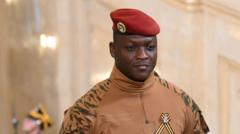
The international press loves a predictable breakup narrative. When Burkina Faso severed its diplomatic ties with France, the commentary machine instantly cranked out the usual scripts. West Africa is falling apart. A democratic regression is underway. Moscow pulled the strings. Paris lost its grip.
It is a comfortable, lazy consensus. It is also entirely wrong.
The mainstream coverage treats this geopolitical divorce as a sudden, emotional spasm driven by military juntas and foreign manipulation. They frame it as a tragedy of lost stability. But if you have spent years tracking capital flows, military logistical supply chains, and sovereign bond yields in the Sahel, you know the truth is far colder. This was not a sudden emotional rupture. It was a calculated liquidation of a bankrupt business model.
France did not get kicked out because of a sudden wave of anti-colonial sentiment. France got evicted because its security and economic products failed to deliver a return on investment. For over a decade, Paris pitched itself as the ultimate security guarantor in the region through operations like Barkhane. The data tells a different story. Year after year, violent extremism expanded, trade corridors shrunk, and local mining operations faced soaring security costs.
When a vendor charges a premium and the factory still burns down, you fire the vendor. That is not ideology. That is basic risk management.
The Flawed Premise of the Fragile State
Global analysts obsess over the wrong question: "How can the West stabilize Burkina Faso?"
This question assumes that the pre-existing arrangement was stable. It mistakes the preservation of elite structures in Ouagadougou for actual systemic health. For decades, the post-colonial framework known as Françafrique operated on a simple transaction: France secured the regime; the regime secured French commercial priorities, particularly in resource extraction and monetary alignment through the CFA franc.
This arrangement created a profound moral hazard. Local elites had little incentive to build deep, resilient institutional legitimacy or functional domestic defense architectures because they knew French bayonets were always available to backstop the status quo.
Consider the mechanics of the gold mining sector, which drives Burkina Faso's export economy. The standard media narrative suggests that cutting ties with the West will scare away capital and collapse the industry. Look closer at the risk profiles. Mining operations in regions like Sahel or Est were already spending up to 15 percent of their operational budgets on private security details, armored convoys, and risk mitigation because the French-backed security apparatus could not guarantee physical safety outside a few urban hubs.
The sovereign state did not collapse because it broke with France. The break happened because the state realized it was paying a premium for an insurance policy that never paid out when the crisis hit.
Dismantling the Moscow Puppet Narrative
The most pervasive myth is that Burkina Faso is simply swapping a master in Paris for a master in Moscow. It makes for great headlines, but it fundamentally misunderstands the strategy of the shifting regime.
The current leadership in Ouagadougou is playing a classic diversification game. When you run a distressed asset, relying on a single, monopolistic supplier is suicide. By opening up security procurement to Russian private military contractors, Turkish drone manufacturers, and Chinese infrastructure groups, Burkina Faso is attempting to commoditize its foreign dependency.
| Supplier | Provided Asset | Strategic Leverage |
|---|---|---|
| France (Historical) | Conventional infantry, institutional oversight | High sovereign interference, rigid conditionalities |
| Russia | Kinetic combat support, deniable security personnel | Low political oversight, high transactional costs |
| Turkey | Unmanned Aerial Vehicles (Bayraktar TB2) | Purely commercial, rapid deployment, no ideological strings |
| China | Critical infrastructure financing, industrial machinery | Debt-driven, long-term asset alignment |
This approach carries massive downsides. Russian security assets do not come cheap; they demand payment in mineral concessions, often distorting local mining rights and creating localized governance vacuums. Furthermore, mercenaries excel at regime survival, not comprehensive counter-insurgency. They treat the symptoms of instability with brutal kinetic force while leaving the underlying socio-economic drivers to rot.
But viewing this transition purely through the lens of a new Cold War misses the operational reality. The Burkinabè leadership is not looking for a new colonial supervisor. They are running an aggressive, high-risk procurement auction. They are leveraging geopolitical rivalries to buy time, weapon systems, and political cover.
The CFA Franc and the Illusion of Monetary Stability
You cannot understand the geopolitical rupture without analyzing the monetary architecture. Critics of the current regime argue that breaking away from French alignment threatens the stability of the West African CFA franc—a currency pegged to the Euro and historically guaranteed by the French treasury.
The conventional economic defense of the CFA franc is that it prevents hyperinflation. It provides a stable monetary environment that attracts foreign direct investment. That sounds excellent in a central bank presentation in Paris or Washington. On the ground in West Africa, the reality is starkly different.
A currency pegged to a hard valuation like the Euro overvalued local economies. It made domestic exports structurally uncompetitive. It restricted local central banks from using aggressive monetary policy to stimulate domestic credit markets. The requirement to deposit a significant portion of foreign exchange reserves in the French treasury was not just a psychological insult; it was a structural drain on liquidity that could have been deployed for internal development.
The defense of the system relies on a flawed metric. Inflation remained low, yes, but at the cost of structural economic stagnation. Wealth accumulation occurred primarily in the import-export enclaves controlled by foreign conglomerates, while the domestic entrepreneurial class faced double-digit interest rates from local commercial banks.
Dismantling this monetary arrangement is incredibly dangerous. A complete, unmanaged exit from the CFA framework risks capital flight, currency devaluation, and a sudden spike in the cost of imported goods. If Ouagadougou attempts to launch a purely national currency without substantial gold reserves or a diversified manufacturing base to back it, they risk entering Zimbabwe or Venezuela territory.
Yet, staying inside the old framework guarantees a slow, predictable economic suffocation. The current regime is betting that the pain of a messy financial restructuring is preferable to the certainty of permanent economic vassalage.
The Operational Reality of Counter-Insurgency
The ultimate test of Burkina Faso's new direction will not be measured in diplomatic communiqués or speeches at the United Nations. It will be decided in the rural villages of the northern and eastern provinces, where jihadist coalitions control vast swathes of territory.
The old French strategy relied on high-tech, footprint-light intervention. It used elite special forces, advanced satellite intelligence, and targeted airstrikes to eliminate high-value targets. It looked impressive on paper. It killed plenty of insurgent commanders. But it completely failed to halt the recruitment pipelines of groups like the Group for the Support of Islam and Muslims (JNIM).
Why? Because the insurgency is not a military problem with a military solution. It is a competition for local governance. The state had retreated from the periphery, leaving rural populations without courts, without security, and without economic viability. The French military could clear a zone, but they could not build a functional school or a fair local justice system. As soon as the helicopters flew away, the insurgents walked back in.
The current Burkinabè approach is radically different, highly controversial, and deeply bloody. By mobilizing tens of thousands of civilian volunteers under the Volunteers for the Defense of the Homeland (VDP) program, the regime has effectively democratized and militarized the conflict. They are trying to overwhelm the insurgency through sheer mass and local presence.
The risks of this strategy are catastrophic. Arming poorly trained civilian militias along ethnic and communal lines is a recipe for cycle-of-revenge massacres. It strips the state of its monopoly on violence and sows the seeds for a fragmented civil war that could last for a generation.
But from the perspective of a besieged state apparatus in Ouagadougou, the French method offered a slow, elegant death. The VDP strategy offers a chaotic, violent chance at survival.
Stop Asking the Wrong Questions
The global community keeps wondering when Burkina Faso will return to the "rules-based international order." They are waiting for a return to normalcy that is never going to happen.
The old arrangement was fundamentally unsustainable. It relied on an external power providing a security product it could no longer deliver, backed by a monetary system that stifled domestic growth, supporting a political class that lacked rural legitimacy.
The severing of ties with France is not a temporary aberration or a minor diplomatic spat. It is the definitive liquidation of the post-colonial management model in West Africa. What comes next will be volatile, messy, and frequently brutal. But pretending that the previous status quo was a viable alternative is an intellectual luxury that the people living in the Sahel can no longer afford.