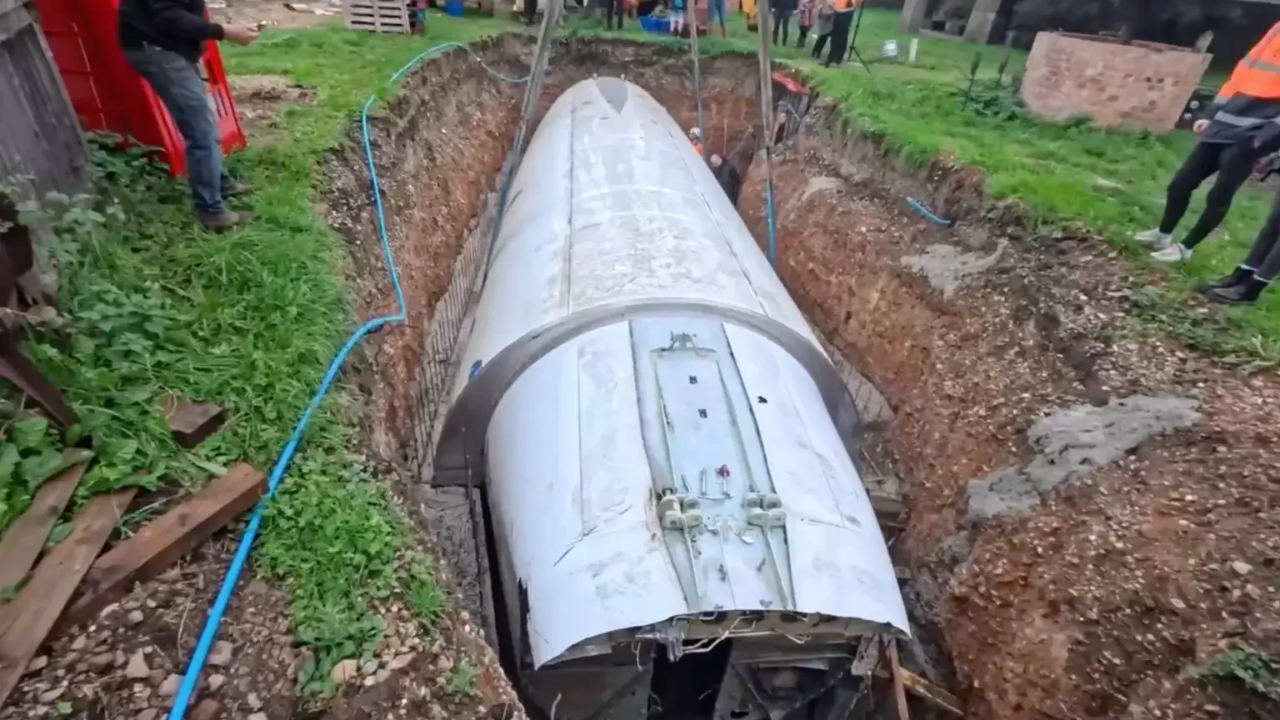
Buying a stripped-out Boeing 737 fuselage for £4,000 on Facebook and dropping it into a back-garden trench is peak internet gold. Dave Billings in Hilton, Derbyshire, lowered a 1993 Boeing 737-500 hull into a roughly 14-foot-deep hole with plans for a party lounge, a red-phone-box lift, connecting tunnels, and enough supplies for three to six months off-grid. Honestly, I love the sheer nerve of it. Most folks buy a hot tub or a garden shed, and Dave went straight for an old holiday jet that once flew from East Midlands Airport to southern Europe.
Here is the catch nobody glamorizes in headline summaries. A four-grand airframe is just the ticket in. Concrete, reinforcing mesh, insulation, crane work, excavation, drainage, and utilities turn a bargain hull into a serious money pit.
Why burying a Boeing 737 is an engineering puzzle
Airliners are built to hold air inside while flying through thin, cold upper atmosphere. Put them underground and the forces flip. Earth, water, and top loads press inward against a thin aluminum shell that was engineered for light weight and internal cabin pressure rather than heavy soil overburden.
A 737 fuselage uses a semi-monocoque aluminum structure made of skin panels stiffened by circumferential frames and longitudinal stringers. It is remarkably clever for flight. Left unreinforced under wet soil or heavy machinery, though, a curved aluminum tube can ovalize, buckle, or dent if external loads exceed what the bare frames can handle.
Water brings two more headaches that catch DIY builders off guard:
- Buoyancy: A hollow, sealed tube sitting in waterlogged ground wants to float upward, just like an empty boat. If the hull is lighter than the water and soil it displaces during heavy rain or a rising water table, uplift forces can shift or crack the structure.
- Corrosion: Aluminum buried directly in damp soil or wet concrete without proper isolation, drainage, and moisture barriers faces galvanic and chemical corrosion over time.
Dave's plan to surround and cover the hull with concrete, rebar, and insulation aims right at those realities. Even then, pouring concrete around a thin-walled shell requires care so wet concrete pressure and curing heat do not warp what you are trying to save.
Look at that cross-section and picture what happens inside once walls, insulation, and floor framing go in. A 737 cabin is roughly 12 feet 4 inches wide externally, with about 86.3 inches of interior cabin height above the floor before trim and linings. That feels roomy enough for a quirky party cabin, bar, or lounge, yet tight enough that ductwork and insulation eat inches fast.
The real bill behind a cheap fuselage
Four thousand pounds buys you a conversation starter, not a finished underground room. Transporting a wide, hollow fuselage on a low loader, digging a deep trench, bringing in a crane, and hauling away spoil eat up cash before you even touch interior finishes.
In Dave's case, reports put project spending already around £50,000, with further estimates around £8,000 for concrete, £3,000 for reinforcing mesh, and £2,000 for insulation—on top of the £4,000 fuselage. That is a classic pattern with novelty builds. The headline number sounds tiny. The supporting infrastructure does the heavy lifting on your bank account.
Party lounge or fallout shelter
Let's be real about the "bunker" label. A buried fuselage with solar panels, borehole water, a septic-connected toilet, ventilation, and months of food and drink can work as a fun off-grid hangout or a basic retreat. Calling every underground novelty space a true military-grade blast or fallout shelter is a stretch, though.
Real civil-defense or blast protection depends on earth cover depth, blast doors, radiation filtration, structural redundancy, and independent power and air systems tested for prolonged isolation. As Dave himself has noted, he is building this primarily for fun and family gatherings rather than living like a hardcore doomsday prepper. That distinction matters. Treating a party-and-retreat build as a weekend project keeps expectations grounded; pretending a DIY tube is an invincible fortress invites disappointment.
Planning rules and neighbor realities
Digging a massive hole in your back garden does not exempt you from local planning rules or safety checks. In the UK, major excavation, engineering works, drainage, and changes to land use can trigger planning scrutiny, even when someone plans to apply for retrospective planning permission later.
Retrospective permission is never a guaranteed rubber stamp. If a structure affects drainage, boundaries, ground stability, or local amenity, councils can push back or require changes. Add confined-space hazards during construction—deep trenches, poor airflow, heavy lifting—and smart builders treat safety protocols as non-negotiable from day one.
That braced excavation shot shows why ground support matters so much whenever you open up the earth. Trenches collapse fast when soil gets wet or heavy plant rolls near the edge.
Practical steps if you ever chase a crazy build
If you see a cheap aircraft hull, shipping container, or vintage bus and feel that familiar itch to build something unforgettable, take a breath and do this first:
- Price the shell as 10% of the budget. Quote excavation, crane hire, concrete, steel reinforcement, waterproofing, and ventilation before sending a deposit.
- Check soil and water conditions early. Know your water table and ground type so you can plan drainage, anchoring, and wall loads properly.
- Verify local planning rules upfront. Talk to local planning and building control contacts early rather than hoping retrospective approval saves you later.
- Lock in real ventilation and egress. Never build an underground room without reliable fresh air exchange and safe, unobstructed exits.
- Set a hard deadline and partner buy-in. Big backyard obsessions strain relationships fast unless everyone shares a clear timeline and budget cap.