Waiting.
That is the hardest part of living beneath a flight path, long before the engines roar overhead and long before the sirens begin their hollow, rising wail. If you have ever sat at a kitchen table in northern Israel or eastern Tehran with a radio turned low, listening to the static between hourly news bulletins, you know that geopolitics does not feel like a chessboard. It feels like holding your breath until your ribs ache, watching the second hand sweep across a clock face while men thousands of miles away argue over which month is convenient for a war.
According to reporting by Axios, Israeli Prime Minister Benjamin Netanyahu has been pressing former President Donald Trump—and the political orbit preparing for a potential return to power or influence—to back military strikes against Iran's nuclear facilities immediately following the U.S. midterm elections.
Read that sentence again, slowly, and notice where the weight falls. Not on the physics of uranium enrichment. Not on the durability of reinforced concrete buried beneath a mountain in Fordow. The weight falls on a domestic American calendar. Specifically, the Tuesday in early November when suburban voters in Pennsylvania, Michigan, and Arizona finish casting ballots for the House and Senate.
Why does a decision that could redraw the map of the Middle East, send global oil prices spiraling, and alter the lives of millions hinge on the timing of an American election cycle?
To understand the quiet urgency behind Netanyahu’s reported push, you have to step out of the briefing rooms in Washington and Jerusalem and look at the invisible machinery that connects ballot boxes to bunker-busters.
The Architecture of a Window
In diplomacy, leaders rarely speak of "convenience." They speak of "windows of opportunity" and "strategic alignment." Yet strip away the sanitized vocabulary of statecraft, and a stark political truth emerges.
Consider a hypothetical scenario—a composite of how Washington decision-makers actually weigh military action during an election year. Picture a senior campaign strategist sitting in a glass-walled conference room in Arlington, Virginia, three weeks before Election Day. On the wall is a map of swing districts. On the television in the corner, muted, is cable news footage of rising gasoline prices. To that strategist, an airstrike in the Persian Gulf in October is not merely a foreign policy event; it is an economic shockwave delivered directly to the gas pump forty-eight hours before polls open. A spike of fifty cents a gallon in Ohio or Nevada can erase a three-point lead in a Senate race faster than any attack ad.
Now, advance the clock to the Wednesday morning after the midterms.
The yard signs are coming down. The television ad buys have expired. For the next two years, the immediate pressure of the ballot box vanishes. In the cold calculus of political survival, the pain of short-term economic disruption—a sudden jump in crude oil, a dip in the stock market, the anxiety of retaliation—becomes survivable. The political penalty is delayed long enough for the dust to settle.
Axios reports that this exact post-midterm window is what Netanyahu has been eyeing. For decades, the Israeli prime minister has framed Iran’s nuclear program not as a distant diplomatic puzzle, but as an existential countdown. From his perspective, every month of delay allows Tehran to move centrifuges deeper underground, accumulate higher-enriched uranium, and inch closer to a threshold where military deterrence becomes obsolete.
Yet Israel faces a brutal operational reality. While the Israeli Air Force possesses extraordinary precision and reach, the deepest hardened sites in Iran—facilities like Fordow, tunneled beneath hundreds of feet of solid rock—present a unique engineering challenge. Military analysts and defense planners have long noted that penetrating such fortifications requires massive, specialized ordnance, such as the American GBU-57 Massive Ordnance Penetrator, alongside heavy bombers capable of carrying them and aerial refueling fleets capable of sustaining long-range sorties.
In short, an effective strike is exponentially harder—and riskier—without American backing, American munitions, or at least an explicit American green light.
The View From the Ground
It is easy to talk about bunker-busters and midterm calendars when they are abstract nouns on a screen. It is much harder when you translate them into human scale.
Think of this as an analogy: two neighbors living in wooden houses separated by a narrow alley, watching one of them stockpile gasoline cans in the basement while the other argues with the local fire marshal about when it is politically safe to kick down the door. The argument isn't about whether the gasoline is dangerous. The argument is about whether the commotion will ruin the neighborhood block party scheduled for Tuesday.
For ordinary people in the region, the stakes are never theoretical.
In Haifa, a nurse finishing a night shift checks her phone before walking to her car, scanning civil defense alerts to see whether the northern border has flared up overnight. She knows the sound of interceptor missiles shattering the sky above the Mediterranean. She knows that any strike on Iran would almost certainly trigger a coordinated response from Hezbollah in Lebanon, Houthi forces in Yemen, and Iranian ballistic missile units—turning every major city in Israel into a potential target within minutes.
Meanwhile, in a cramped apartment in Isfahan, a retired schoolteacher counts out depreciated rials to buy cooking oil and bread. Years of international sanctions and economic mismanagement have already hollowed out the Iranian middle class. For families like hers, the prospect of bombs falling on nuclear and military infrastructure does not feel like an abstract geopolitical reset; it feels like the collapse of the power grid, the rationing of water, and the terrifying certainty that ordinary citizens will absorb the shockwaves of decisions made by clerics and generals they never freely chose.
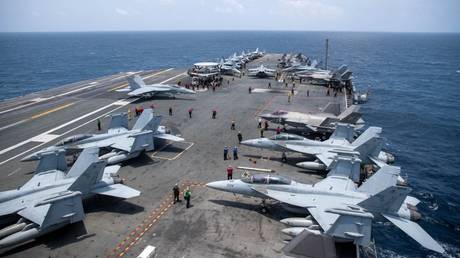
And in Norfolk, Virginia, or on an aircraft carrier steaming through the warm, humid waters of the Persian Gulf, a twenty-two-year-old sailor stands watch on the flight deck. When leaders in Jerusalem and Washington discuss "post-midterm options," that sailor is the human mechanism through which those options are executed.
Echoes of Past Countdowns
We have stood on this precipice before, which is why the current moment carries such a heavy sense of déjà vu—and such profound uncertainty.
History rarely repeats itself cleanly, but in the long shadow of the Iranian nuclear standoff, the patterns are unmistakable. In 2012, during another tense U.S. election cycle, Netanyahu famously stood before the United Nations General Assembly holding a cartoon diagram of a bomb, drawing a literal red line with a marker to illustrate how close Iran was to enrichment thresholds. Back then, intense behind-the-scenes friction played out between Jerusalem and the Obama administration over whether Israel would launch a unilateral strike before November.
The strike never came. Instead, diplomacy yielded the 2015 Joint Comprehensive Plan of Action, which curtailed Iran’s nuclear activities in exchange for sanctions relief—an agreement that Trump subsequently withdrew from in 2018, launching a "maximum pressure" campaign that fractured diplomatic channels and prompted Tehran to steadily expand its enrichment capacity far beyond the deal's original limits.
Each cycle has ratcheted the tension higher while shrinking the margin for error.
What makes the reporting around Netanyahu’s current push distinct is the convergence of three volatile forces: an Iranian nuclear program closer to weapons-grade material than ever before, a Middle East already destabilized by multi-front regional conflict, and an American political system deeply divided over foreign entanglements.
The Illusion of a Clean Strike
Here is the part that keeps seasoned intelligence officials and military planners awake at night, and the part that is easiest to gloss over when reducing war to a calendar date: nobody knows what happens on Day Two.
Proponents of decisive military action argue that a crippling blow to Iran’s nuclear infrastructure would set the program back by years, restore deterrence, and remove a looming nuclear shadow over the entire Middle East. They point to Israel’s 1981 strike on Iraq’s Osirak reactor and its 2007 strike on Syria’s al-Kibar facility as proof that bold, preemptive action can permanently alter the strategic reality without triggering an endless regional war.
Critics and veteran defense officials counter with a sobering reality check. Iran is neither 1981 Iraq nor 2007 Syria. Its nuclear knowledge is dispersed across thousands of scientists, its facilities are hardened and redundant, and its regional network of armed proxies spans multiple countries. Worse, intelligence assessments have long warned that an attack on nuclear sites could convince Tehran’s leadership that the only way to guarantee regime survival is to sprint toward an actual nuclear weapon in secret, kicking out international inspectors forever.
There is also the Strait of Hormuz—a narrow waterway just twenty-one miles wide at its tightest point, through which roughly a fifth of the world’s petroleum passes. Even a temporary disruption in that channel would send shockwaves through global supply chains, hitting food prices, shipping lanes, and household budgets from Tokyo to Chicago.
Waiting until after the midterms might insulate American politicians from the immediate anger of voters at the ballot box. It does nothing to insulate the global economy, or the people living under the flight paths, from the consequences once the first bomb drops.
The Human Equation
When you strip away the diplomatic cables, the leaked briefings, and the electoral math, what remains is a deeply unsettling tension between two incompatible timelines.
On one side is the political timeline—measured in polling cycles, fundraising quarters, and the Tuesday after the first Monday in November. It is a timeline built on calculation, delay, and the management of public perception.
On the other side is the human timeline—measured in the steady hum of centrifuges spinning underground, the quiet anxiety of families checking emergency kits in hallway closets, and the fragile peace that holds together millions of ordinary lives between one news cycle and the next.
Eventually, the campaign signs in America will come down. The ballots will be counted, the speeches will be given, and the political calendar will turn to a blank page in November. And somewhere, in a room without windows, men will look at that blank page and decide whether the waiting is finally over.


