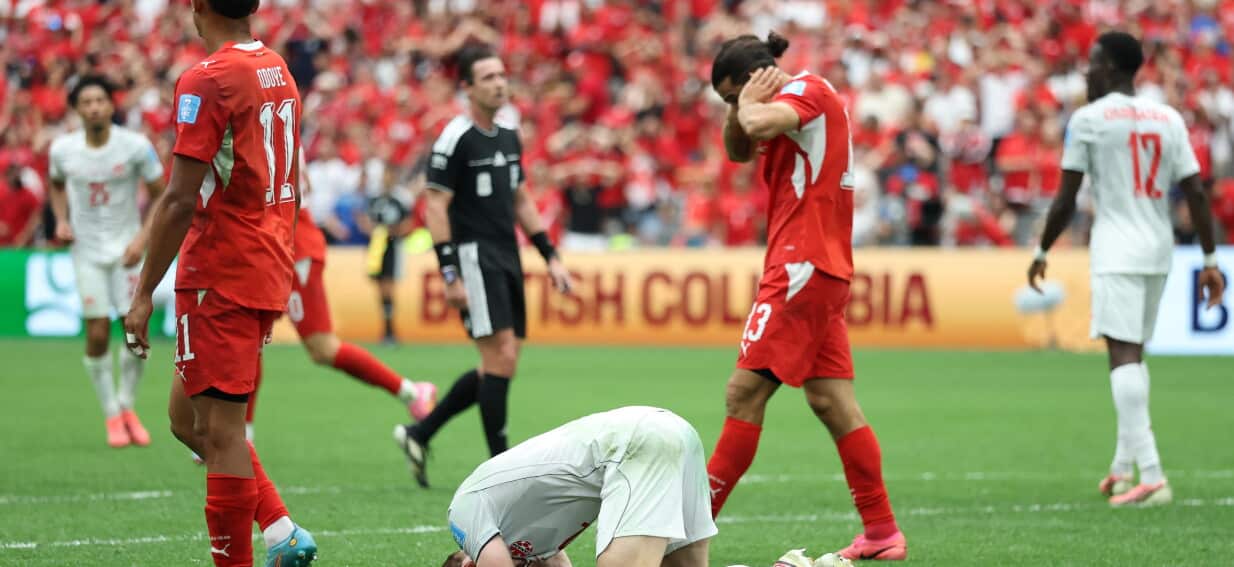
Jesse Marsch tried to play poker with a master tactician, and he lost. Wrapping up the group stage with a 2-1 defeat to Switzerland at BC Place wasn't a total disaster for Canada since they still advanced to the Round of 32 for the first time ever. But let's be totally honest. It was a massive reality check. By failing to secure the draw they needed to top Group B, Les Rouges surrendered their home-field advantage and now have to pack their bags for Los Angeles.
The biggest talking point before the opening whistle revolved around Alphonso Davies. Marsch guaranteed his star man would play, but Davies sat out the entire match. Marsch admitted afterward that it was a total bluff, an attempt to act as a decoy and force Swiss manager Murat Yakin to spend his week overthinking.
It didn't work. The Swiss didn't care. They stuck to their script, exposed Canada's temporary structural flaws, and comfortably booked their stay in Vancouver for the next round. If Canada want to survive in the knockout stages, they need to fix the errors that plagued them during those fatal twelve minutes in the second half.
The Tactician Who Didn't Blink
Murat Yakin knows exactly what his team is. Switzerland don't blow opponents away with frantic pressing, nor do they dominate possession just for the sake of it. They are a collection of cold, calculating tournament specialists who wait for you to screw up.
When Marsch threw Nathan Saliba and Mathieu Choinière into the midfield engine room because Stephen Eustáquio wasn't fit enough to start, the Swiss smelled blood. They let Canada have the ball in harmless areas during a turgid, cagey first half.
The initial forty-five minutes felt like a classic tactical chess match where neither side wanted to show their cards. Granit Xhaka anchored the Swiss midfield with his usual snarl, even picking up a cheap yellow card alongside Cyle Larin after a brief confrontation.
Canada looked tentative. They weren't sprinting into spaces. They lacked the sheer bravery that defined their previous 6-0 thrashing of Qatar. Without Ismaël Koné, who watched from a wheelchair after breaking his leg last week, the midfield lacked that progressive spark.
Group B Final Standings
Switzerland: 7 points (+4 GD)
Canada: 4 points (+5 GD)
Bosnia-Herzegovina: 4 points (-1 GD)
Qatar: 1 point (-8 GD)
Twelve Minutes of Pure Chaos
Whatever Yakin said to his team at halftime completely changed the tempo. Within forty seconds of the restart, the Swiss sliced Canada open.
Johan Manzambi made a direct run down the left flank, exposing Alistair Johnston who had drifted too far inside. Manzambi fired a sharp ball across the box to the back post. Rubén Vargas was waiting. He had all the time in the world to settle himself and beat Maxime Crépeau at the near post.
Before Canada could even clear their heads, the Swiss struck again. In the fifty-seventh minute, Breel Embolo held up the ball perfectly in the center of the penalty area, drawing both Canadian center-backs toward him. He laid it off simply for the twenty-year-old Manzambi. The youngster didn't hesitate, drilling a low strike beneath Crépeau to make it 2-0.
It was a defensive collapse that exposed Canada's lack of elite-level tournament experience. When things go wrong against European opposition, you cannot afford to chase the game blindly. You have to lock things down. Marsch even admitted later that he regretted not shifting to a five-man backline at halftime to secure the draw.
The Promise David Spark
The silver lining for Canadian fans arrived in the seventy-sixth minute. Marsch threw on Promise David, and the forward made an immediate impact. Just seventy-three seconds after stepping onto the pitch, David latched onto a precise pass from Nathan Saliba and beautifully guided a volley into the corner of the net.
BC Place erupted. Suddenly, the dream of staying in Vancouver was alive again. Canada pushed hard in the final ten minutes, throwing everyone forward.
Tani Oluwaseyi headed a golden chance just wide of the post. In stoppage time, Alistair Johnston got his head to a flat cross from Jacob Shaffelburg, but it went straight into the waiting arms of Gregor Kobel. The Swiss goalkeeper stood tall, showing why he plays at the highest level in Europe. Switzerland weathered the storm because they've been in these situations a hundred times before.
What Canada Must Fix Immediately
The road doesn't get any easier from here. Canada must travel to California to face South Korea in the Round of 32. To get past a highly disciplined Asian side, Marsch has to address three glaring issues.
First, the midfield configuration requires stability. Relying on young players to match the intensity of international veterans is a massive ask when Eustáquio is sidelined. The squad needs a clearer defensive shield when transitioning from attack to defense.
Second, the dependence on psychological tricks has to stop. The Davies decoy strategy didn't just fail to distract the Swiss, it seemed to leave Canada's own lineup feeling unsettled. If your best player isn't ready to go, accept it and build a concrete plan around the available personnel instead of hoping the opponent panics.
Finally, the defensive communication during the opening minutes of the second half was unacceptable. Johnston and Derek Cornelius got sucked out of position far too easily. At this level, elite attackers will punish a single yard of empty space every time.
Canada made history by reaching the knockout rounds. That's a massive achievement that nobody can take away from them. But if they want to keep electrifying the home crowd from afar, the learning curve has to accelerate right now. Pack the bags, forget the Vancouver sauna, and get ready for a dogfight in Los Angeles.