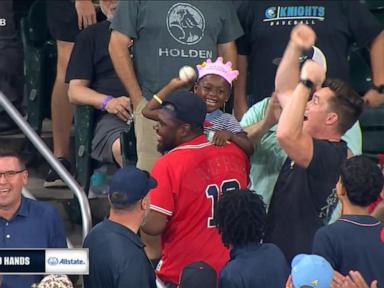
Baseball doesn't care about your calendar. It doesn't know it is your birthday. It doesn't care if you wore your lucky jersey or brought a pristine leather glove. Yet, every single season, the baseball gods conspire to hand ordinary fans moments of pure, unfiltered cinematic magic.
Picture the scene. You are sitting somewhere in the lower bowl at Truist Park. The roar of the crowd washes over you. The smell of grilled peanuts and hot dogs hangs thick in the humid Georgia air. Someone connects. You hear that distinct crack of the bat—that sharp acoustic pop that triggers every primal instinct in a sports fan. The ball isn't just traveling; it is screaming toward your exact section.
Most people freeze. They duck behind a seat or raise a flimsy paper plate of nachos as an impromptu shield. But once in a blue moon, someone doesn't flinch. When that someone happens to be celebrating another trip around the sun, the stadium transforms into an arena of pure celebration.
The Split-Second Geometry of a Crowd Catch
Let's talk about what actually happens in the three seconds between a home run being struck and it landing in the stands. It looks effortless on television. A player swings, the ball launches into the upper atmosphere, and some lucky fan casually reaches out a hand to pluck it out of the air like they are plucking an apple from a tree.
Reality is violent and chaotic.
A batted ball travelling at over one hundred miles per hour covers distance terrifyingly fast. By the time your brain registers the angle off the bat, calculates wind resistance, factors in the overhang of the second deck, and adjusts for the screaming mass of humanity shifting around you, the window for action has already shrunk to milliseconds.
Depth perception in a stadium is notoriously deceptive. From ground level, a fly ball looks like a pop-up until it suddenly spikes upward and starts dropping with terminal velocity. Fans standing three rows away suddenly become human obstacles. Arms flail. Cups spill. Phones drop.
When a fan manages to track that trajectory, extend an arm, and absorb the kinetic energy of a Rawlings baseball without dropping their drink or breaking a finger, they have performed an elite athletic feat disguised as dumb luck. Add a birthday sash, a homemade sign, or a customized jersey into the mix, and the stakes skyrocket. You are no longer just a spectator. You are the main character of the afternoon.
The Truist Park Effect
Location matters. Catching a home run at an Atlanta Braves game carries its own unique cultural weight. The energy inside Truist Park is different from almost anywhere else in Major League Baseball. The Battery outside pulses with pre-game electricity, and once you pass through the turnstiles, the crowd operates with a singular, infectious rhythm.
When the Chop echoes through the concrete bowls, it creates a psychological tidal wave. Fans are hyper-engaged. They are standing, cheering, and watching every pitch with intense focus. That collective attention creates a shared radar system across the entire section.
If you are sitting in the bleachers or the outfield seats, you aren't just watching the game; you are part of an outfield defense committee. Everyone around you knows where every glove is, who brought kids, and whose birthday is written on the foam board sign resting against the cupholder. When a home run comes screaming into that specific micro-ecosystem, the neighborhood rallies. If the birthday girl or boy actually comes down with the ball, the surrounding strangers instantly become your lifelong best friends, pounding your back and screaming until their voices crack.
Why We Love the Accidental Hero
Sports fandom is built on vicarious living. Most of us will never step foot inside a major league batter's box. We will never feel the sting of a ninety-five-mile-per-hour fastball or hear the roar of forty thousand people chanting our name after a walk-off hit.
That is why fan catches resonate so deeply on social media and local broadcasts. It is the ultimate democratizing force in professional sports. For five seconds, an accountant, a teacher, or a student gets to experience the exact same euphoria as an All-Star outfielder robbing a grand slam at the wall.
When cameras catch a birthday celebrant showing off their arm after a clean grab, it triggers universal joy. It is pure sports theater without the billion-dollar contracts or corporate sponsorships. It is just a human being reacting to pure, unadulterated luck meeting sharp execution.
The immediate flex—the classic post-catch pose, holding the ball aloft, flexing the bicep, or spinning around to soak in the ovation—is mandatory ritual. You earned those fifteen minutes of fame. You survived the scramble. You kept your composure while a five-ounce stitched sphere came hurtling toward your face. Show off the arm. You earned it.
The Psychology of the Crowd Roar
There is a distinct acoustic signature to a stadium crowd when something extraordinary happens in the stands. It is different from the roar of a walk-off home run on the field. That sound is a deep, rolling thunder of collective triumph. A stands catch, however, generates a sharp, high-pitched explosion of amusement and communal delight.
When a fan makes an acrobatic catch—especially one celebrating a birthday—the entire section experiences a miniature dopamine spike. For a few fleeting moments, the game on the diamond takes a backseat to the drama unfolding in row twelve. Strangers high-five. Concession workers pause their tray deliveries to watch the replay on the concourse monitors.
This shared psychological lift transforms passive spectators into active participants. In an era where modern entertainment often feels hyper-isolated behind glowing glass screens, live sports offer rare moments of unscripted, synchronous human connection. That is why viral clips of fans making incredible catches capture millions of views overnight. They remind us of the simple, joyful absurdity of being alive and in the right place at the exact right second.
The Unwritten Rules of Bleacher Etiquette
If you are planning to hunt for home run balls at your next game, or if you find yourself thrust into the spotlight on your special day, understanding the unwritten codes of the outfield stands is vital.
First, respect the kids. If a child is standing near you with a glove outstretched, social convention dictates you yield or help them secure the memory of a lifetime—unless it is your milestone birthday and you brought your own glove. Even then, the crowd can be a harsh judge. Context matters.
Second, the glove debate. Purists argue that catching a major league home run barehanded is the only true mark of honor. They point to stinging palms and bruised thumbs as badges of courage. Realists—especially anyone who has taken a foul tip straight off the knuckle—know that a properly broken-in leather mitt is the difference between a triumphant celebration and an immediate trip to the stadium first-aid station.
Third, the trade. If you catch a milestone ball—say, a player's first career home run or a historic franchise record—security and team officials will descend upon your section within ninety seconds. They won't confiscate it, but they will negotiate. You will likely be offered signed memorabilia, authenticated gear, or game-used equipment in exchange for the sacred sphere. But for a standard regular-season home run on your birthday? That ball is your permanent trophy. Put it on the mantelpiece next to the cake candles.
How to Position Yourself for Ballhawk Success
You can't control where the ball goes, but you can tilt the odds heavily in your favor. If you want to increase your chances of snagging a souvenir during your next ballpark outing, you have to stop treating seating charts like an afterthought.
Study the spray charts. Left-handed power hitters pull the ball with ferocious consistency toward right field. Right-handed sluggers spray missiles toward the left-field seats. If you want action, buy tickets in the sections immediately behind the bullpens or past the outfield wall where outfielders often toss up third-out balls to friendly fans.
Keep your head on a swivel. The single biggest mistake fans make is staring at their phones between pitches or chatting endlessly with seatmates until the crack of the bat startles them. Major league hitters generate exit velocities that leave zero reaction time if you are distracted. Put the smartphone away when the ball is live.
Bring the right gear. A deep-pockets glove, comfortable clothing, and zero hesitation. If the ball is in your airspace, commit immediately. Hesitation in the stands results in dropped catches, spilled beer, and missed opportunities.
Making Memories Beyond the Box Score
At the end of the day, professional sports are entertainment, but they are also memory factories. You can watch games on high-definition screens at home with perfect camera angles and instant replays, but you can't replicate the kinetic buzz of sitting in the open air when a baseball defies physics and lands in your lap.
When a birthday celebration intersects with a live home run catch, it creates an unforgettable anchor point in your personal history. Years from now, nobody will remember the final score of that game or who pitched the eighth inning. But they will remember the sound of the bat, the flight of the white sphere, the sting of the leather, and the roar of strangers celebrating your existence.
So the next time you head out to the ballpark, wear your birthday pin, bring your glove, and keep your eyes glued to the plate. You never know when the universe is going to pitch you a memory.