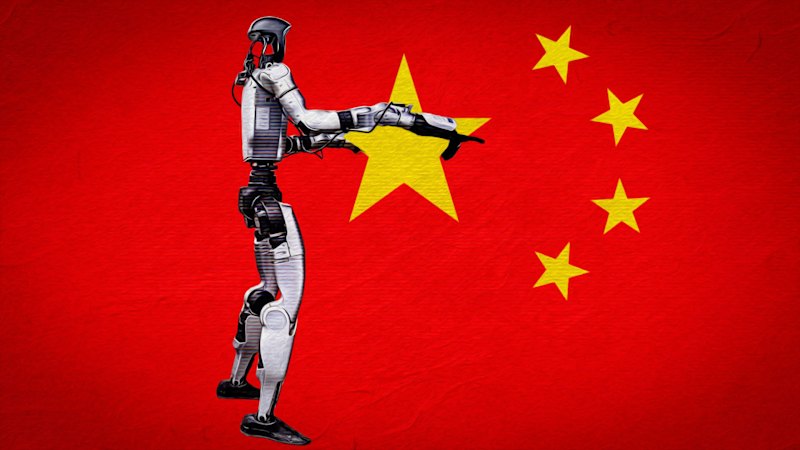
Everybody loves a clean narrative. The lazy consensus goes like this: China crushed the West in electric vehicles, flooded global markets with cheap batteries, and now the exact same state-capitalist playbook is coming for humanoid robots. Factories in Shenzhen will churn out bipedal mechanics at a fraction of the cost, undercut Boston Dynamics and Tesla, and colonize global warehouses.
It sounds terrifying if you are an American manufacturer, and it makes for great headlines if you write about macroeconomics from a coffee shop in Brooklyn.
It is also completely wrong.
I have spent the last decade watching hardware startups burn through capital because they assumed manufacturing scale equals market dominance. Scale matters when you are stamping out lithium-ion cells or bending aluminum for sedans. It is entirely irrelevant when you are building a product that requires dynamic physical intelligence in unpredictable, unstructured human spaces.
China is not about to dominate the global robotics market. In fact, they are walking straight into a structural trap of their own making.
The Factory Fallacy
To understand why the electric vehicle triumph cannot be replicated in robotics, you have to look at what an electric vehicle actually is. A car is a rigid box on wheels governed by linear physics and strict regulatory envelopes. The road is paved. The lanes are painted. The operating domain is heavily constrained. Once you master battery chemistry and stamping presses, scaling production is a logistical engineering problem.
Humanoid robots are the exact opposite. They are software wrapped in a fragile, high-maintenance cage of actuators, harmonic drives, and sensors.
The lazy narrative treats robots like consumer electronics or cars. They are not. A smartphone works out of the box because the internet protocol is standardized and the screen is flat. A car works because the infrastructure of the modern world was literally paved to accommodate it.
A humanoid robot has to operate in a world built for humans, which means it has to deal with stairs that are slightly out of code, messy drywall, misplaced coffee mugs, and chaotic human behavior. If your robot trips over a rogue extension cord in a Detroit warehouse, your hardware cost advantage in Sichuan ceases to matter.
The Software Chasm
Hardware is cheap. Intelligence is expensive. This is the part of the equation that the supply-chain fetishists consistently ignore.
China has mastered the art of hardware iteration. Give a cluster of engineers in Guangdong a CAD file, and they will machine a prototype by Tuesday morning. Their supply chain for actuators, brushless motors, and structural carbon fiber is unmatched anywhere on Earth. If the game were purely about mechanical housing and joint torque density, the game would already be over.
Hardware without software is just an expensive coat rack.
The bottleneck in robotics is not whether a knee joint can withstand a million flexion cycles. The bottleneck is spatial reasoning, tactile feedback integration, and edge-case handling. It is the real-time inference loop that tells a machine how much force to apply when picking up an egg versus a wrench.
Right now, the foundational models driving physical intelligence are overwhelmingly built in the West, or by researchers operating within Western open-source ecosystems. Heavy state subsidies can build factories, but they cannot legislate algorithmic breakthroughs. You cannot throw billions of dollars at a state-backed research institute and magically bypass the foundational trial-and-error required to train robust neural networks for physical manipulation.
The Demographic Mirage
The standard justification for China's robotics push is demographic desperation. The population is aging rapidly, the labor force is shrinking, and factories are running out of cheap young workers to pull assembly line shifts. Therefore, the state must automate or die.
The logic is sound at macro level, but it breaks down at the point of deployment.
An aging population creates an immense demand for caregiving, elder assistance, and service labor. These are the hardest possible environments for a humanoid robot. A factory floor is structured, predictable, and monitored. An elderly care home is a chaotic nightmare of soft tissues, sudden movements, unpredictable environments, and high liability.
If a factory robot drops a transmission, a company loses a few hundred dollars in scrap. If a care robot misjudges the friction on a linoleum floor and drops an elderly patient, you are looking at catastrophic legal and ethical liability.
Western markets, particularly the United States and parts of Europe, have far more mature regulatory frameworks for liability and tort law, ironically creating a safer sandbox for incremental deployment. China's top-down push forces rapid deployment into controlled industrial settings, but it leaves domestic manufacturers ill-equipped to handle the messy, litigious, hyper-variable consumer and service sectors where the real long-term value of general-purpose robotics lies.
The Data Deficit
There is another inconvenient truth about the race for physical intelligence: data gravity.
Tesla is winning the autonomy race not because their cars have better cameras, but because millions of vehicles are feeding edge-case driving data back to a central training cluster every single day. Fleet learning is the only moat that matters in artificial intelligence.
Chinese robotics companies are building impressive hardware demos for trade shows in Shanghai and Beijing. They can do backflips. They can sort boxes in pristine, well-lit laboratory settings. But they lack access to the distributed, heterogeneous operational data required to make a robot smart enough to handle the chaotic variance of the global market.
If your training data comes entirely from state-subsidized automotive plants in Changchun, your robot will be brilliant at building cars in Changchun. Drop it into a cluttered hospital in London or a messy logistics hub in Chicago, and it will freeze like a deer in headlights.
The Subsidized Dead End
State backing is a double-edged sword. When Beijing decides an industry is strategic, capital floods in. Thousands of companies spin up overnight, all chasing government grants and municipal tax breaks.
This creates a hyper-competitive domestic bloodbath characterized by destructive price wars. It works wonders for commoditized hardware like solar panels or basic EVs, where the goal is low-cost parity. In deep-tech fields like general-purpose robotics, it creates a graveyard of zombie companies making slight variations of the same mediocre bipedal chassis, all starving for the actual talent required to crack physical AI.
When the subsidies inevitably shift to the next shiny state priority, the weak balance sheets collapse. What remains is not a globally dominant titan, but a fragmented landscape of heavily indebted manufacturers who spent years optimizing for government procurement checklists rather than actual market utility.
Stop Preparing for the Wrong Invasion
If you are a Western enterprise executive losing sleep over an imminent wave of cheap Chinese humanoid robots invading your supply chain, you are worrying about the wrong threat.
The threat is not that a cheap mechanical copycat will undercut your margins. The threat is that the entire industry is collectively overestimating the readiness of general-purpose hardware while underestimating the software moat being built by agile, software-first operators who treat the robot body as a peripheral device rather than the main event.
Do not look at the company with the flashiest video of a robot doing gymnastics in a sterile warehouse. Look at the company solving the long-tail problem of tactile manipulation in the dark.
The future of robotics will not belong to the nation that can stamp out the most titanium joints. It will belong to the entity that figures out how to make a machine understand the physical world without crashing into a wall. And on that front, the race is still entirely wide open.