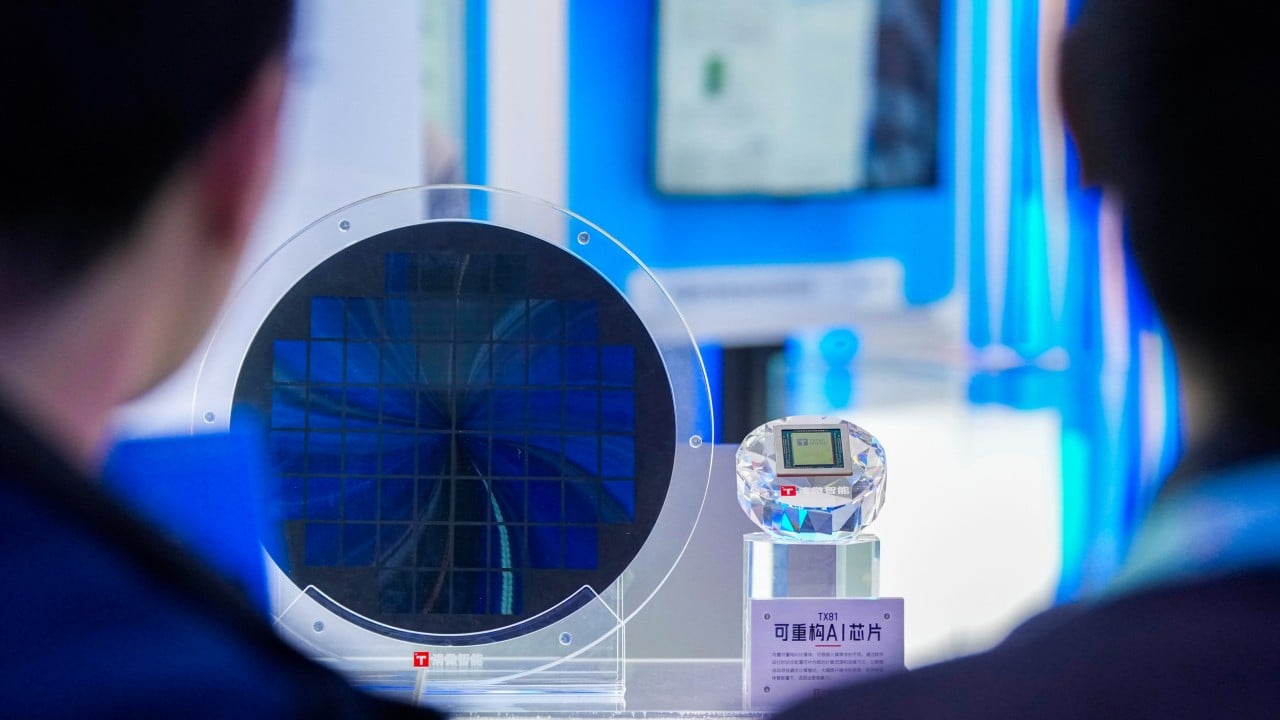
Profits inside China's domestic semiconductor sector rocketed by an astonishing 2500 percent during the first half of the year, driven primarily by an aggressive pivot toward domestic artificial intelligence hardware. Financial reports from state-backed foundries, specialized equipment manufacturers, and mature-node logic producers point to an unprecedented fiscal windfall. Beijing pumped billions into domestic substitution initiatives, forcing state-owned enterprises, cloud providers, and automotive giants to rip foreign silicon out of their supply chains.
That staggering percentage sounds like a triumph.
It is actually a symptom of a deeply distorted market. When baseline profitability sits near zero due to historical subsidies, inefficient capacity, and severe technological lag, a modest absolute increase in earnings produces a monstrous relative spike. The headline numbers obscure a fragile industrial apparatus operating under immense political pressure, choked off from extreme ultraviolet lithography, and reliant on heavily subsidized equipment that cannot yet compete globally on pure economic efficiency.
Understanding this boom requires looking past the propaganda spreadsheets distributed by municipal authorities in Shenzhen and Shanghai. The real story involves state-directed capital allocation, forced local adoption, and the quiet scramble to secure legacy manufacturing lines before export controls tighten further.
The Mathematics of Low Baselines
Percentages lie when the starting point touches the floor. If a foundry loses fifty million dollars in a given period and posts a two million dollar profit the next, the proportional leap defies normal financial logic.
That arithmetic explains much of the current Chinese semiconductor earnings explosion. For years, domestic firms bled cash attempting to break into a market dominated by Taiwan Semiconductor Manufacturing Company, Samsung, and Intel. They faced low yields, astronomical capital expenditures, and fierce price competition on standard logic nodes.
When international restrictions slammed shut on advanced accelerators, Beijing restructured the financial incentives. Subsidies arrived not as general research grants, but as guaranteed purchase orders and low-interest capital injections tied to domestic sourcing quotas.
Local tech giants like Alibaba, Tencent, and Baidu faced an unambiguous choice. Buy domestically produced accelerators or risk losing state contracts, regulatory favor, and cloud infrastructure subsidies. They began stocking up on alternative silicon.
Production lines that sat idle or operated at a loss suddenly found steady demand. Margins expanded because the state absorbed the underlying development costs while guaranteeing a captive customer base willing to accept lower performance metrics in exchange for supply chain security.
The Mature Node Trap
Western analysts often obsess over extreme ultraviolet lithography and three-nanometer nodes. That obsession misses the ground-level reality of industrial policy inside the mainland.
The vast majority of the profit surge is happening on mature nodes. We are talking about twenty-eight nanometers, forty nanometers, and even older legacy architectures.
These chips do not power cutting-edge generative intelligence models directly at the frontier. Instead, they drive everything else. Automotive control units, power management integrated circuits, internet-of-things sensors, and secondary inference processors all rely on these older lines.
By aggressively expanding mature node capacity, local fabricators achieved massive economies of scale within domestic boundaries. Automobile manufacturers in Wuhan and Hefei stopped importing foreign microcontrollers, routing their procurement directly to domestic foundries.
This creates a peculiar dynamic. While foreign markets worry about an oversupply of legacy chips flooding global channels at predatory prices, domestic producers are pocketing windfall margins inside a protected domestic ecosystem.
Fab utilization rates climbed past ninety percent for many major players. Fixed costs distribution improved dramatically. Every wafer processed past the break-even threshold dropped straight to the bottom line, inflating earnings reports across the board.
The Invisible Cost of Substitution
Financial statements do not capture technical debt.
When an artificial intelligence cluster deploys alternative domestic accelerators instead of industry-standard alternatives, the energy consumption per floating-point operation frequently spikes. Software optimization requires massive engineering hours to rewrite kernels that were originally tailored for mature CUDA frameworks.
Engineers working inside major cloud service providers spend sleepless weeks debugging compilation errors and hardware bottlenecks. The cost does not appear on the foundry balance sheet as a line item. It is absorbed by the end user in the form of lower training efficiency, higher electricity bills, and constrained cluster scalability.
State media hails the earnings growth as proof of technological self-reliance. Industry veterans know a different truth. It is an expensive insurance policy paid for by consumers and tech firms who must accept sub-optimal performance to satisfy geopolitical imperatives.
The state can mandate purchases. It cannot legislate away the laws of physics. Without access to advanced packaging technologies like high-density fan-out wafer-level packaging and silicon interposers from foreign vendors, assembling dense clusters of domestic accelerators remains an exercise in brute-force engineering. Yields on multi-die packages lag far behind global standards, meaning a significant percentage of manufactured silicon ends up discarded before deployment.
The Equipment Paradox
The profit explosion extends beyond chip designers and foundries into the tool-building sector. Domestic lithography, etching, and deposition companies reported record revenues as they scrambled to equip new fabrication plants springing up across second-tier provinces.
Local governments view semiconductor fabs the way nineteenth-century cities viewed railway terminals. Economic salvation, prestige, and employment rolled into one concrete package.
Municipal investment funds financed factory shells before equipment even cleared customs. When international tool vendors like ASML, Applied Materials, and Lam Research faced tightening export restrictions, domestic equipment makers stepped into the vacuum.
Companies specializing in cleaning tools and chemical vapor deposition saw order books swell for multiple quarters ahead. Their gross margins expanded as pricing power shifted in their favor. Buyers had nowhere else to turn.
Yet, beneath those margins lies a reliance on imported sub-components. Precision optics, specialized motion controllers, and high-purity chemical precursors often still originate from Japan, Germany, or the United States.
If those secondary choke points tighten, the domestic equipment boom could stall instantly, turning high-flying suppliers into high-inventory liabilities. The supply chain is robust only until the next administrative restriction takes effect.
Capital Distortion and the Next Correction
No market can sustain a twenty-five-fold profit expansion on artificial engineering demand indefinitely without facing a reckoning.
Venture capital and private equity funding in the sector are already showing signs of fatigue. Too many regional startups chased the artificial intelligence hardware gold rush, building redundant design houses that produce minor variations of the same basic architecture.
Consolidation is coming. State planners are quietly signaling that the era of blank-check funding for any team with a chip design concept has ended. The focus is shifting from raw expansion to operational efficiency and actual silicon performance.
When the state eventually dials back guaranteed procurement mandates, or when domestic cloud providers finish their initial inventory stocking cycles, earnings volatility will return with a vengeance. Margins built on regulatory capture rarely survive long-term exposure to global competitive pressures.
The current financial reports tell a story of extraordinary growth, but they capture only a single snapshot in a high-stakes industrial war. The real test for the sector will not be how much profit it records while the market is artificially walled off, but whether those profits can be reinvested into genuine, self-sustaining technological breakthroughs before the subsidies run dry.