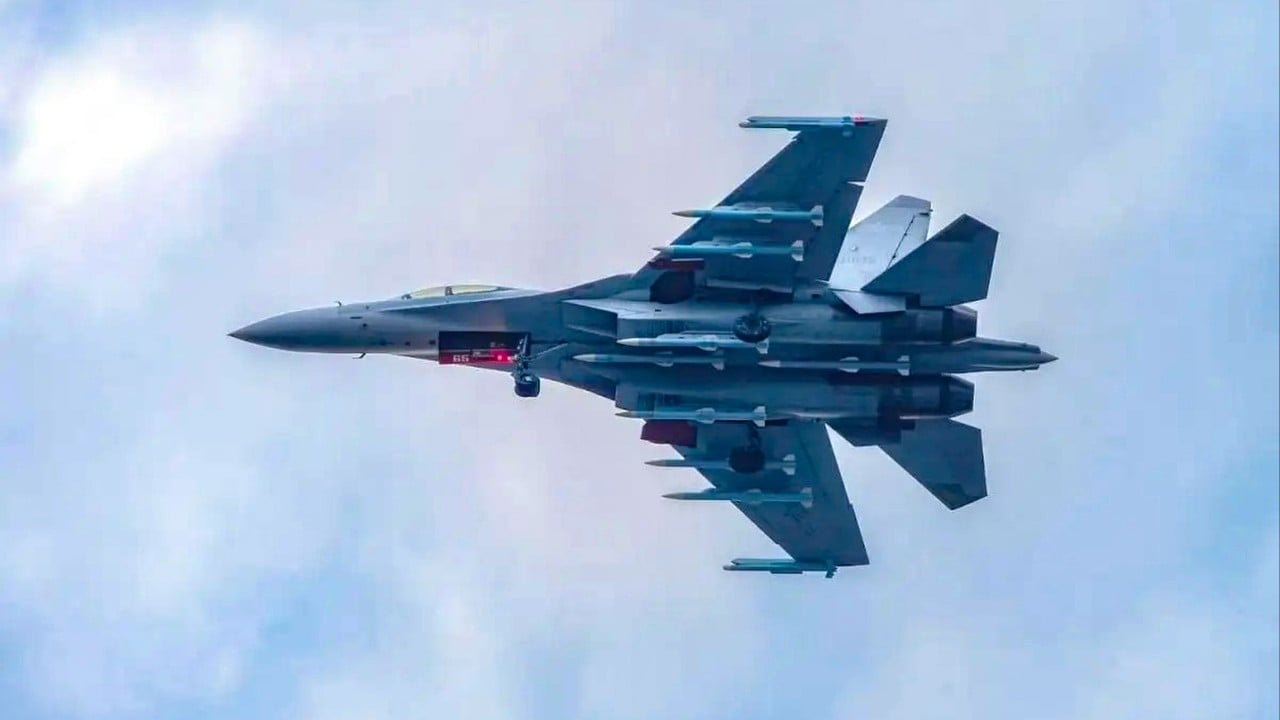
Military analysts love talking about stealth. They obsess over radar cross-sections and internal weapons bays. But a recent image bouncing around Chinese social media reminds us that sometimes, brute force matters more than hiding. A People's Liberation Army Air Force (PLAAF) J-16 fighter jet was spotted flying in a heavy load configuration. The internet calls it beast mode.
This is not just for show. The aircraft carried eight PL-15 long-range air-to-air missiles and two PL-10 short-range missiles. That is ten missiles on a single airframe. For a fleet that now numbers roughly 400 airframes, this heavy configuration signals a major strategic shift in how China intends to control the skies during a conflict. It moves the conversation from tactical defense to offensive missile saturation.
The Reality of Chinas J-16 Fighter Jet in Beast Mode
To understand why this loadout matters, you have to look at the airframe itself. The Shenyang J-16 is a twin-engine, tandem-seat multirole strike fighter. It evolved from the Russian Sukhoi Su-27 Flanker design, but Chinas engineers did not just copy the Russian homework. They rebuilt it using lightweight composite materials, coated it in radar-absorbent paint, and packed it with an advanced Active Electronically Scanned Array (AESA) radar.
When you put Chinas J-16 fighter jet in beast mode, you turn a highly maneuverable strike fighter into a flying magazine. It becomes a missile truck. Stealth fighters like the J-20 have to hide their weapons inside internal bays to keep their radar signatures low. That limits their capacity. A J-20 typically carries four to 6 missiles internally. The J-16 does not care about hiding. It uses its twelve external hardpoints to carry a staggering payload.
The specific combination seen in the recent footage from the 6th Air Brigade in Suixi, Guangdong province, is lethal.
- Eight PL-15 Missiles: These are active radar-guided, long-range weapons with a dual-pulse solid rocket motor. They hit targets over 200 kilometers away.
- Two PL-10 Missiles: These are infrared-guided, short-range weapons used for visual-range dogfighting. Analysts acknowledge they outclass many Western equivalents in kinematic performance.
Smashing the Western Support System
Why run regular patrols with such a drag-heavy, unstealthy configuration? The answer lies in Western military vulnerabilities. The United States and its allies rely heavily on large, slow support aircraft to fight over long distances. Think of airborne warning and control systems (AWACS) like the E-3 Sentry or refueling tankers like the KC-46 Pegasus. Without these flying lifelines, Western stealth fighters run out of fuel and lack the radar picture to fight effectively.
A J-16 in beast mode does not need to hunt agile F-35s. It targets the big fish. By firing a volley of eight PL-15 missiles from distance, a single J-16 can force Western support assets to pull back hundreds of miles. If the tankers and AWACS retreat, the entire operational framework of Western air power in the Taiwan Strait crumbles.
Missile Saturation as a Hard Tactical Truth
Air combat is a numbers game. Even the best modern air defense systems or electronic warfare suites can get overwhelmed. If Chinas J-16 fighter jet can carry eight long-range missiles simultaneously, a small formation of four jets can put thirty-two high-end radar-guided threats into the air at once.
This creates a saturation wall. Defending aircraft spend all their energy, chaff, and kinetic maneuvers dodging missiles rather than executing their primary mission. The PL-15 also utilizes its own built-in AESA radar seeker during its terminal phase, making it incredibly resistant to electronic jamming. You cannot just trick it with older electronic countermeasures.
How the PLAAF Pairs Stealth with Raw Power
The J-16 does not operate in a vacuum. The real danger comes from how China networks its fleet. Think of the J-20 stealth fighter as the scout. It sneaks forward undetected, using its passive sensors to spot enemy targets without turning on its own radar.
Once the J-20 finds the target, it relays the coordinates via data link to the J-16 trailing far behind. The J-16 fires the PL-15 from its external racks. The enemy looks for the source of the radar lock but only sees a massive missile truck firing from safety. This synergy maximizes the strengths of both platforms while minimizing their weaknesses.
The Electronic Warfare Twin
We also have to factor in the J-16D. This is the dedicated electronic warfare variant of the jet. It swaps out the internal cannon and wingtip missile rails for massive jamming pods. When a strike package includes J-16s in beast mode alongside J-16D jamming platforms, the defensive challenge doubles. The electronic warfare variants blind enemy radars while the missile trucks empty their racks.
Geopolitical Friction in the Indo-Pacific
This heavy loadout configuration directly influences daily PLAAF patrols. We regularly see J-16s crossing the median line of the Taiwan Strait and entering Taiwans air defense identification zone (ADIZ). Flying these routes in beast mode sends a clear message to regional neighbors and Washington. It proves that China can generate immense firepower without relying on long, vulnerable supply chains from the mainland.
The Suixi airbase location is telling. Positioned in Guangdong, it sits right next to the South China Sea and within striking distance of Taiwan. Deploying high-payload J-16s here gives Beijing an immediate hammer to drop on maritime choke points.
What Military Planners Should Watch Next
If you watch this space closely, stop looking at airframe production numbers alone. Start looking at missile inventories and deployment patterns. The presence of beast mode configurations tells us that China has moved past the phase of proving its jets can fly. They are now refining mass-firepower tactics.
Watch for joint exercises where J-16s practice rapid hot-rearming cycles on austere airfields. That will tell you how fast they can generate these massive missile salvos in a real conflict. Track the integration of the even larger PL-17 missile, an ultra-long-range weapon designed specifically to kill support aircraft from 400 kilometers away. The payload capability is there, the intent is clear, and the tactical math over the Pacific has officially changed.