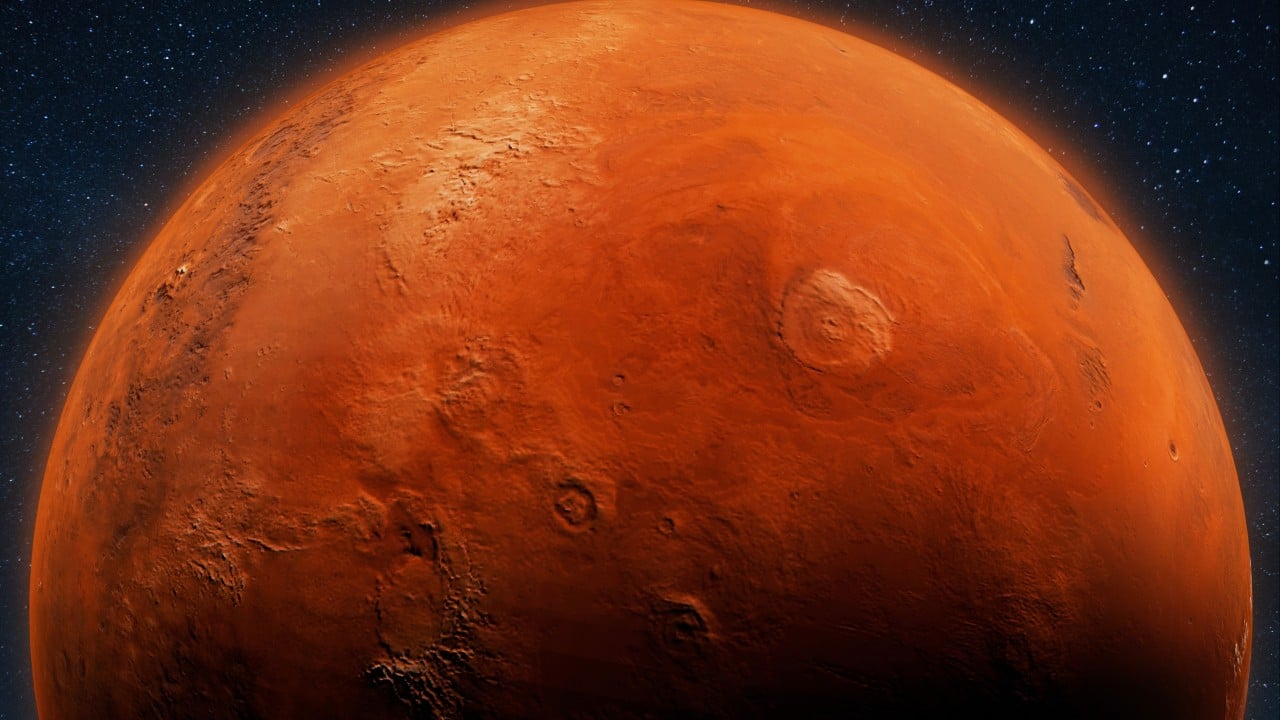
Getting off Mars is a math problem that makes rocket engineers lose sleep.
You can't just pack a return tank of propellant when you launch from Earth. Rocket fuel is absurdly heavy, and every extra pound you haul across 140 million miles of deep space demands exponentially more fuel just to get off the launchpad in Florida or Jiuquan. If humans ever want to visit the Red Planet and actually come home, we have to brew the return fuel using whatever is lying around on the Martian surface. Also making news in related news: Synthetic Sympathy and Financial Extraction in Elderly Digital Fraud.
Luckily, Mars is wrapped in a giant blanket of raw chemical ingredients. About 95% of the Martian atmosphere is carbon dioxide.
A team of Chinese researchers recently demonstrated a catalyst that splits that carbon dioxide and water into methane and oxygen—the exact propellant mixture used by modern heavy-lift rockets—with surprising efficiency. Instead of relying on massive, power-hungry industrial reactors that would be impossible to land on another world, their approach uses a specialized metallic catalyst designed to operate under harsh, low-pressure conditions. More details into this topic are covered by TechCrunch.
It’s a massive step forward for in-situ resource utilization, or ISRU. That's the fancy aerospace term for living off the land.
Why Making Fuel on Mars Is So Brutally Hard
People hear "Mars has carbon dioxide" and assume you just hook up a glorified SodaStream to a rocket tank. Reality is much uglier.
The Martian atmosphere is paper-thin. Surface pressure averages about 610 pascals, which is less than one percent of Earth's atmospheric pressure at sea level. Before you can even think about chemical reactions, you have to compress that wispy gas without burning through your entire solar array's power budget.
Then comes the chemistry itself. Carbon dioxide is a remarkably stable molecule. Those two oxygen atoms cling to the carbon atom like their lives depend on it, and breaking them apart takes serious energy.
For decades, the standard plan has been the Sabatier reaction, a chemical process discovered way back in 1897 by French chemist Paul Sabatier. You take carbon dioxide from the air, mix it with hydrogen—usually harvested by splitting subsurface Martian water ice via electrolysis—and heat the whole mess up to around 300 to 400 degrees Celsius over a nickel or ruthenium catalyst.
Out comes methane ($CH_4$) and water ($H_2O$). You recycle the water back into your electrolyzer to get more hydrogen and breathable oxygen, and you liquefy the methane to pump into your rocket.
NASA has already tested a miniature oxygen-only version of this concept. Their MOXIE experiment aboard the Perseverance rover successfully pulled carbon dioxide from the Martian air and converted it into small amounts of pure oxygen across 16 runs between 2021 and 2023. It proved the physics works outside a terrestrial lab.
MOXIE, though, required heating gases to 800 degrees Celsius and only produced a few grams of oxygen per hour—barely enough to keep a small dog breathing, let alone launch a 30-ton ascent vehicle into orbit. Scaling that up without melting your equipment or running out of electricity is where traditional catalysts start failing.
What the Chinese Research Team Actually Did Differently
Traditional catalysts degrade fast. When you push nickel-based catalysts hard enough to produce rocket-grade quantities of methane, carbon atoms start building up on the metal's surface—a process engineers call coking. Once the catalyst gets coated in soot, the reaction stalls out, and your astronauts are stranded.
The breakthrough from the Chinese research teams—building on extensive work from institutions like the University of Science and Technology of China (USTC) and the Chinese Academy of Sciences—centers on atomic-level catalyst engineering.
Rather than using bulky metal particles that easily clog up or lose efficiency, researchers engineered single-atom and nanostructured catalysts anchored onto specialized oxide supports. Think of it like spreading out workers across a massive factory floor instead of cramming everyone into one tiny room. Every single metal atom becomes an active site for the chemical reaction.
Here is why that structural shift matters so much for a Mars mission:
- Lower operating temperatures. Because the active sites are exposed at the atomic level, the energy barrier required to crack the $CO_2$ molecules drops significantly. Less heat means smaller nuclear reactors or fewer solar panels needed on the Martian surface.
- Higher selectivity. A sloppy catalyst creates a messy soup of carbon monoxide, leftover hydrogen, and useless hydrocarbons. Rocket engines hate contaminated fuel. The engineered catalyst pushes the reaction overwhelmingly toward pure methane and water, cutting down the weight of heavy purification columns.
- Resistance to carbon buildup. By tuning the electronic interaction between the metal atoms and their support structure, the catalyst prevents carbon atoms from clumping together into soot, keeping the system running continuously for months without human maintenance.
In 2023, researchers at USTC also made headlines by showing how an AI-powered robotic chemist could synthesize oxygen-producing catalysts directly from Martian meteorites, proving that you might not even need to bring the catalyst from Earth. Combining autonomous catalyst synthesis with high-efficiency methane production changes the entire logistics equation for deep space exploration.
The Hidden Catch Nobody Mentions About Martian Propellant
Before we start booking commercial flights to Olympus Mons, we need to talk about the two massive bottlenecks that a better catalyst alone won't solve.
First, you still need water. Lots of it.
A catalytic reactor can grab carbon and oxygen straight from the sky, but methane ($CH_4$) requires four hydrogen atoms for every single carbon atom. Mars doesn't have free hydrogen floating around in its atmosphere; it escaped into space billions of years ago. That means any methane production plant has to be parked right on top of accessible subsurface water ice.
Digging up frozen dirt mixed with toxic perchlorate salts in sub-zero temperatures is an absolute nightmare for mechanical hardware. Bulldozers break. Drills jam. Dust gets into every rotating seal and grinds it down like sandpaper. A brilliant catalyst sitting inside a sleek stainless-steel reactor is completely useless if the mining rover feeding it water ice breaks an axle on day four.
Second, there is the cryogenic storage problem.
Once your catalyst churns out gaseous methane and oxygen, you have to chill them down to around minus 160 degrees Celsius and minus 183 degrees Celsius respectively to turn them into dense liquids. Keeping cryogenic fluids cold for eighteen months on the Martian surface—where daytime temperatures near the equator can hit a balmy 20 degrees Celsius—requires active zero-boil-off refrigeration systems.
Those refrigerators consume massive amounts of continuous electrical power. If a global Martian dust storm rolls in and blocks out the sun for six weeks, solar-powered fuel plants shut down completely, and your hard-earned rocket fuel starts boiling away into the atmosphere.
Why Methane Beat Hydrogen for Mars Rockets
You might wonder why scientists bother making methane at all. SpaceX's Starship, Blue Origin's New Glenn, and China's upcoming Zhuque-3 and Long March 9 variants have all pivoted toward liquid methane (methalox) engines, moving away from the liquid hydrogen used on the Space Shuttle and NASA's Space Launch System.
Liquid hydrogen actually packs more punch per pound of fuel. In rocket science terms, it has a higher specific impulse.
Hydrogen is also a total diva to handle. It has to be stored at minus 253 degrees Celsius, just twenty degrees above absolute zero. At that temperature, hydrogen molecules are so tiny they literally leak straight through solid metal tank walls, making the steel brittle over time. Worse yet, liquid hydrogen isn't very dense, meaning you need gigantic, heavy fuel tanks just to hold enough of it.
Methane hits the sweet spot. It stays liquid at roughly the same temperature as liquid oxygen, which lets rocket engineers share a common bulkhead between the fuel and oxidizer tanks—saving tons of structural weight. It burns cleanly without leaving heavy soot deposits inside reusable rocket turbopumps. Most importantly, you can synthesize it directly from Martian air and ice using the exact kind of catalytic chemistry Chinese scientists are perfecting right now.
How China's Mars Timeline Fits Into This Research
China isn't funding this catalyst research just to publish flashy papers in Nature or Joule. Their space agency, CNSA, has laid out a clear, aggressive roadmap for Mars that depends heavily on mastering surface chemistry.
Following the success of the Tianwen-1 orbiter and Zhurong rover, China scheduled Tianwen-3 for launch around 2028 to 2030. That mission aims to be the first to bring Martian soil and rock samples back to Earth, beating NASA's delayed and over-budget Mars Sample Return architecture.
Returning a tiny canister of rocks takes a small solid-fuel ascent rocket that can be carried all the way from Earth. Scaling up to crewed missions in the late 2030s or 2040s makes hauling return fuel impossible. By developing high-efficiency $CO_2$ conversion catalysts today, Chinese material scientists are building the foundational tech needed for an automated fuel depot—a robotic factory that lands on Mars two years ahead of astronauts, fills up the return ship's tanks, and confirms the fuel gauge reads full before humans ever leave Earth orbit.
Tracking Real Progress Without the Hype
Space news loves a breathless headline, and chemistry breakthroughs get exaggerated constantly. Whenever you read about a new catalyst for Mars or green energy on Earth, look past the press release and check three specific metrics to see if it actually matters:
- Faradaic or conversion efficiency at low pressure. Lab tests almost always run at standard Earth atmospheric pressure using pure, bottled $CO_2$. If the researchers didn't test their catalyst with simulated Martian gas mixtures containing nitrogen, argon, and trace carbon monoxide at low pressures, the tech is still years away from flight hardware.
- Stability hours. Anyone can make a catalyst work brilliantly for twenty minutes. A Mars fuel plant needs to run nonstop for roughly 500 days to fill a heavy rocket. Look for test runs measured in thousands of hours without significant performance drop-off.
- Energy-to-mass ratio. Calculate how much electrical wattage the system demands per kilogram of fuel produced. Unless nuclear fission reactors like NASA's Kilopower or China's megawatt-class space reactors fly alongside these chemical plants, power generation—not the catalyst—will remain the true bottleneck.
Follow primary preprints on arXiv's chemical physics section and updates from the Chinese Academy of Sciences' Dalian Institute of Chemical Physics to watch how quickly these single-atom catalysts move from benchtop glassware into full-scale Mars simulation chambers.