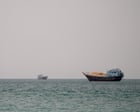
The water in the Strait of Hormuz does not look like a geopolitical fault line. It looks like heavy, green glass. On a humid afternoon, the air hangs so thick it feels like wet wool against your skin. If you stand on the jagged cliffs of Oman’s Musandam Peninsula, you can look out across the twenty-one miles of water and almost convince yourself that this is just another quiet corner of the earth.
Then the supertankers appear.
They move with an eerie, agonizing slowness. Huge, rusted steel monoliths carrying millions of barrels of crude oil, gliding through a shipping lane so narrow that a single misplaced vessel could send global stock markets into a tailspin. One-fifth of the world’s petroleum passes through this tiny throat of water. For decades, the invisible hand guiding these ships, ensuring the lights stay on in Tokyo, London, and New York, belonged largely to Oman.
But there is a quiet, furious shift happening beneath the surface.
Across the water, Iran is watching. For years, Tehran has viewed Oman’s quiet custodianship of the strait not as a stabilizing force, but as an intolerable concession to the West. Now, a silent war of diplomatic friction, naval posturing, and administrative overreach is unfolding. Iran wants to be the sole gatekeeper of the world's most critical maritime chokepoint, and Oman is finding itself pushed against the wall.
The Fisherman and the Leviathan
To understand what is happening here, you have to leave the ministries of Muscat and Tehran behind. You have to stand on a wooden dhow with a fisherman like Ahmed. For three generations, Ahmed’s family has cast nets into these waters. He knows the currents the way a man knows the hallways of his childhood home.
For Ahmed, the strait used to mean predictability. The Omani navy patrolled with a light touch. They kept the peace, monitored the traffic separating the inbound and outbound ships, and let the local maritime economy breathe. Oman’s foreign policy has long been defined by an almost miraculous neutrality—a diplomatic Swiss Army knife in a region defined by absolute binaries.
Lately, though, Ahmed sees more than just cargo ships. He sees the fast-attack craft of Iran’s Islamic Revolutionary Guard Corps (IRGC).
These small, agile boats buzz around the lumbering commercial tankers like wasps. Sometimes they pull alongside. Sometimes they demand to see paperwork that they have no legal right to request.
Consider what happens next when a commercial captain refuses to cooperate. The tension escalates from a minor bureaucratic dispute to an international incident in the span of ninety seconds. When Iran asserts itself in the strait, it is not just playing to the cameras; it is systematically trying to redraw the psychological map of who owns the rights to this water.
The Geography of Friction
The geometry of the Strait of Hormuz is a cruel joke played by geography on global commerce. While the strait itself spans roughly twenty-one miles at its narrowest point, the actual shipping lanes used by massive tankers are only two miles wide in either direction.
To prevent catastrophic collisions, these lanes run directly through the territorial waters of both Oman and Iran. Under international law, specifically the United Nations Convention on the Law of the Sea, ships enjoy the right of "transit passage." This means they can move through these territorial waters unhindered, provided they proceed expeditiously and do not threaten the coastal states.
But law is only as strong as the will to enforce it.
Iran has spent the last decade building a narrative that the current maritime regime is an artificial construct propped up by Western powers. Tehran views Oman’s cooperative relationship with international navies—including the United States Fifth Fleet based just across the gulf in Bahrain—as a direct security threat.
The strategy from the Iranian side is brilliant in its subtlety. They are not launching a full-scale blockade; that would invite a devastating military response. Instead, they are practicing a form of administrative creep. By slowly increasing their regulatory demands, insisting on communication with Iranian maritime authorities, and conducting regular, aggressive naval exercises, they are conditioning the world to accept a new reality.
They want the shipping industry to ask permission from Tehran, not Muscat.
The Burden of Neutrality
Oman finds itself in an agonizing position. The Sultanate has built its modern identity on being the region’s ultimate bridge-builder. When the United States needed a secret channel to negotiate with Iran during the Obama administration, it was Oman that provided the quiet rooms in Muscat. When regional conflicts flare up, Omani diplomats are usually the first to arrive and the last to leave.
But neutrality requires leverage. Without it, being stuck in the middle just means you get squeezed from both sides.
Oman’s military, while highly professional and well-equipped, cannot match the sheer asymmetric scale of Iran’s naval forces. The Omani government knows that if they push back too hard against Iranian encroachments, they risk sparking an incident that could shut the strait entirely. For an economy like Oman's, which relies heavily on maritime stability, a closed strait is a death sentence.
So, Muscat watches. They protest quietly behind closed doors. They track the IRGC vessels on radar. They reassure international shipping companies that the lanes remain safe.
But the real problem lies elsewhere. The international community has a remarkably short memory. As long as the oil keeps flowing and the insurance rates for cargo ships don’t spike too high, Western capitals are content to ignore the slow erosion of Omani authority.
The Micro-Insults of Sovereignty
The competition between these two neighbors rarely manifests as a spectacular explosion. It happens in micro-insults.
It is an Iranian drone hovering just outside Omani airspace, testing radar response times. It is an unannounced missile drill by Tehran that forces commercial air traffic and shipping routes to deviate at the last minute. It is the subtle, regular rewriting of maritime maps in Iranian state media, where the strait is increasingly referred to as an internal Iranian waterway.
For the crews aboard the international tankers, this psychological warfare is exhausting. Imagine navigating a vessel longer than three football fields, loaded with volatile cargo, through a narrow channel while armed speedboats play chicken with your bow. The stress is palpable. Captains report a constant state of hyper-vigilance, never knowing if a sudden radio call from an Iranian station is a routine check or the prelude to an illegal detention.
Oman recognizes that every time an international vessel complies with an unauthorized Iranian demand within the shared strait, Oman's own sovereignty is chipped away. It is a slow, grinding war of attrition where the prize is the right to dictate the terms of global trade.
The Fragile Horizon
The sun sets over the Musandam Peninsula, casting long, dark shadows across the water toward the Iranian coast. The green glass of the strait turns to ink. The lights of the supertankers begin to blink on, forming a glowing chain that stretches toward the open ocean.
This is not a story about a sudden, catastrophic war that will change the world overnight. It is a story about the slow, quiet theft of authority. If Iran succeeds in positioning itself as the sole arbiter of the Strait of Hormuz, the global economy will have to learn to live with a knife permanently held to its throat.
Oman will continue to light the path for the world's ships, using the quiet, steady diplomacy that has kept the peace for decades. But as the Omani patrol boats fade into the twilight, outpaced and outnumbered by the restless gray hulls of the IRGC, you realize that the balance of power in these narrow waters has never been more fragile. The world is watching the ships, but it should be watching the shorelines.