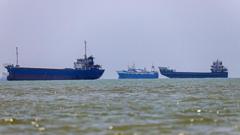
A single rusty tanker crests the horizon, its belly heavy with millions of barrels of crude oil. From the bridge, the captain looks out at a strip of water so narrow that the mountains of Oman and the jagged cliffs of Iran seem to lean in from either side. This is the Strait of Hormuz. It is a geographical throat. Right now, a phantom hand is tightening around it.
When news broke that Tehran threatened to slam this maritime gate shut in response to escalating military conflicts involving Israel and Lebanon, global stock tickers barely blinked at first. Algorithms processed the data in milliseconds. But algorithms do not feel the sudden, icy drop in a merchant sailor’s stomach. They do not understand the terrifying math of global isolation. If you liked this piece, you should check out: this related article.
To understand why a strip of water just twenty-one miles wide matters to a teenager playing video games in Ohio, a commuter sitting in a Tokyo traffic jam, or a baker heating an oven in Paris, you have to look past the geopolitical grandstanding. You have to look at the pressure points of our fragile, hyper-connected existence.
The Liquid Highway
The world runs on a continuous, invisible conveyor belt. One-fifth of the planet’s total petroleum consumption passes through this exact bottleneck every single day. For another perspective on this development, refer to the recent coverage from The Washington Post.
Imagine a massive, global cardiovascular system. The Strait of Hormuz is not just a vein; it is the main artery. If you nick it, the whole body goes into shock.
For the crews aboard these massive vessels, navigating the strait has always been an exercise in controlled anxiety. The shipping lanes are remarkably tight. In bound and outbound traffic lanes are each only two miles wide, separated by a two-mile buffer zone. There is no room for error. When Iranian fast-attack boats buzz past these lumbering giants, the tension on the bridge is thick enough to cut with a knife.
Now, consider a hypothetical merchant captain named Marek. He has spent thirty years at sea. He knows the sounds of his ship like his own heartbeat. When the radio crackles with warnings of naval blockades and escalating drone strikes hundreds of miles away in Lebanon, his calculations change instantly. He is no longer just managing logistics. He is calculating survival.
If the strait closes, Marek’s ship cannot simply take a detour. The alternative routes require sailing all the way around the African continent. Weeks of extra travel. Millions of dollars in fuel. Exponentially higher insurance premiums.
The Domino Effect on the Ground
When a nation like Iran threatens to shutter this gateway, the shockwaves travel faster than the speed of sound. They move at the speed of human panic.
The immediate reaction is often a numbers game played by suits in climate-controlled offices. Oil prices spike. Speculators trade futures. But the real problem lies elsewhere, far beneath the surface of financial spreadsheets.
The true cost filters down to the ordinary, the mundane, and the vulnerable.
- A family in an inflation-weary suburb suddenly finds the cost of groceries jumping another ten percent because the diesel trucks delivering the produce are paying double at the pump.
- A manufacturing plant in South Korea slows its assembly lines because the energy grid is rationing power, delaying the microchips needed for medical devices worldwide.
- A small-scale farmer in an developing nation watches helplessly as fertilizer prices—heavily dependent on petroleum byproducts—skyrocket out of reach, threatening the next harvest.
Geopolitics is never local. It is an intricate web where a missile strike in the Levant alters the price of a loaf of bread in Peru.
The rhetoric coming out of official state television networks can sound clinical. Phrases like "strategic denial of access" or "sovereign maritime enforcement" mask the raw reality of naval mines, anti-ship missiles, and enforced blockades. It turns the sea into a minefield of political leverage.
A History Written in Salt and Iron
This is not the first time the world has stared into this specific abyss. During the Tanker War of the 1980s, the waters of the Persian Gulf burned. More than five hundred merchant vessels were attacked or damaged as Iraq and Iran attempted to suffocate each other's economies.
Back then, the United States navy initiated Operation Earnest Will, escorting reflagged Kuwaiti tankers through the perilous waters. Sailors watched the horizons for the telltale white wake of incoming sea mines. The fear was physical. It tasted like salt and adrenaline.
Today, the technology has evolved, but the underlying vulnerability remains identical. The global economy has spent decades building just-in-time supply chains. We eliminated storage warehouses and massive grain silos in favor of floating inventory—ships constantly on the move, arriving precisely when needed. It was an engineering triumph of efficiency.
It is also an incredible trap.
Because we have no margin for error, a disruption at a single chokepoint does not just cause a delay. It causes a collapse. The psychological impact of a closed strait is almost as devastating as a physical blockade. The moment the maritime insurance companies refuse to cover ships entering the Gulf, the strait is effectively closed, whether a single shot is fired or not.
The Weight of the Horizon
The sun sets over the strait, casting a deep, blood-orange glow across the jagged cliffs of the Musandam Peninsula. On the deck of the tanker, the hum of the engine is a constant, vibrating reminder of the world's dependency.
We like to believe we live in a digital age, an era where wealth is ethereal, stored in clouds and traded in cryptocurrency. We think we have outgrown the tyranny of geography.
But our reality remains stubbornly physical. It is anchored to steel hulls, deep-water channels, and the volatile decisions of governments operating on the edge of conflict. The modern world, with all its glittering achievements and technological marvels, still hangs by a thread. And that thread runs directly through twenty-one miles of dark, uncertain water.