The notification pings at 6:45 PM. It is a sharp, digital chirp that cuts through the hum of a heater struggling against the Saskatchewan winter. In Saskatoon, the cold doesn’t just sit on your skin; it bites. It demands respect. But the app on the dashboard doesn’t care about the wind chill or the black ice slicking the intersection of Idylwyld Drive. It only cares about the ETA.
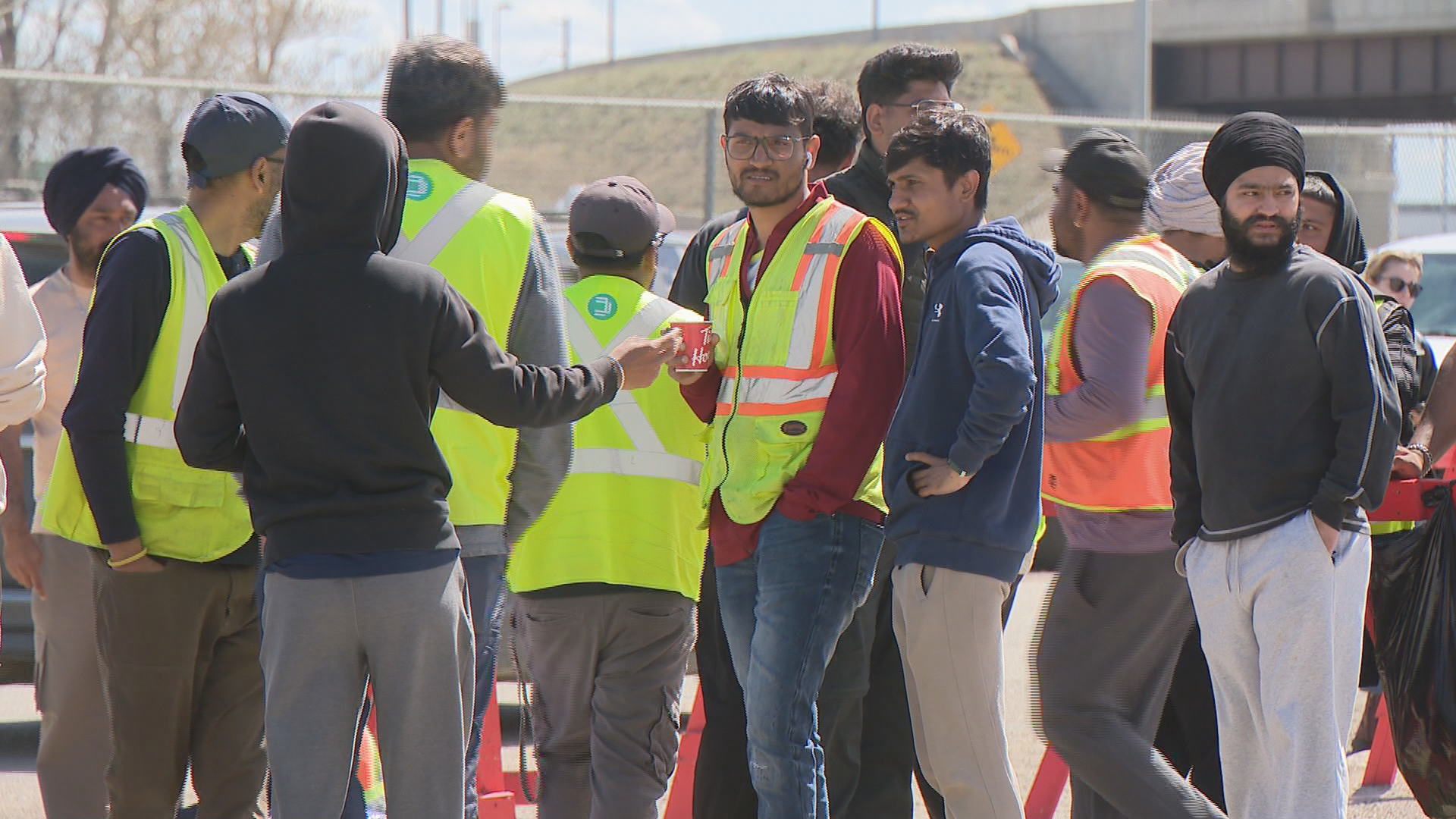
Consider a driver we will call Elias. He is a hypothetical composite of the dozens of couriers currently standing on a picket line in the biting prairie wind, but his reality is lived by thousands. Elias isn’t an employee, at least not according to the paperwork. He is a "partner." He is an independent contractor. He is a line item in a complex algorithm designed by Dragonfly, a delivery giant that promises speed above all else. If you enjoyed this post, you should look at: this related article.
But lately, the speed has stalled. The streets are quiet, not because of the snow, but because the people who keep the city’s commerce moving have decided to stop.
The Ghost in the Machine
The strike in Saskatoon didn't start with a grand political manifesto. It started with a ledger that no longer made sense. When you are a delivery driver, you aren't just selling your time. You are selling the life of your vehicle, the tread on your tires, and the literal safety of your body. For another look on this story, check out the latest update from Forbes.
For months, Dragonfly drivers have watched the gap between their earnings and their expenses narrow to a razor's edge. Imagine fueling a car that costs 15% more to fill than it did last year, while the "per-drop" rate from the mother ship remains stagnant or, in some cases, fluctuates downward based on an opaque "demand multiplier."
It is a specialized form of gambling. You log on, hoping for the high-volume shifts, only to find yourself idling in a parking lot, burning fuel just to stay warm, waiting for a $6 delivery that will take forty minutes to complete. The math is cold. It is relentless. And for the drivers in Saskatoon, it finally became unbearable.
The move to unionize isn't just about a few extra dollars per hour. It is a rebellion against the "black box" of algorithmic management. When a boss fires you, they usually have to look you in the eye. When an app deactivates you because a GPS glitch made you appear "dilatory," there is no eye to look into. There is only a support ticket that may never be answered by a human being.
The Invisible Infrastructure
We often treat delivery services as a utility, like water or electricity. You press a button, and a package appears. We have become conditioned to ignore the friction of the physical world. But that friction is exactly what the Dragonfly strikers are highlighting.
The strike has peeled back the curtain on what we might call the "Invisible Infrastructure" of the modern city. We see the vans. We see the branded vests. What we don't see are the lack of benefits, the absence of workers' compensation for "partners," and the sheer exhaustion of a ten-hour shift spent navigating a city that wasn't built for this level of courier density.
The push for a union in Saskatoon is a localized tremor that signals a much larger earthquake in the gig economy. For years, companies like Dragonfly have operated on the premise that their workforce is a fluid, replaceable resource. If Elias quits, there are ten others waiting to download the app.
Except, in Saskatoon, that logic is failing. The community is tight. The drivers talk. They have realized that their strength doesn't come from the app, but from the person in the car next to them at the red light.
The Human Cost of Efficiency
There is a specific kind of loneliness in gig work. You are surrounded by people—merchants, customers, other drivers—but you are essentially an island. You are competing against everyone else for the same high-value orders. This competition is the "feature" that tech companies use to keep costs down.
But humans aren't built for perpetual, isolated competition.
The picket lines in Saskatoon represent something more than a labor dispute; they are a reclamation of the "human" in the human resource. When drivers stand together in sub-zero temperatures, they are breaking the spell of the algorithm. They are proving that they are not just dots on a map moving toward a destination.
Critics of the unionization effort often point to the potential for rising costs. "If they unionize, shipping will get more expensive," the argument goes. This is true. But it forces us to ask a deeply uncomfortable question: If a business model only functions by offloading all risk and most costs onto its lowest-paid workers, is it actually a functional business model? Or is it just a redistribution of poverty?
The strike is a friction point. It is a moment where the digital dream of "seamless" commerce hits the reality of a human being who needs to pay rent and buy groceries in a town where the cost of living is no longer a suggestion.
The Weight of the Box
On the picket line, the signs are simple. They ask for fair pay, for transparency, for a seat at the table. These are not radical demands. They are the same demands that miners, steelworkers, and longshoremen have made for over a century. The only difference is the tools of the trade. Instead of a pickaxe, it’s a smartphone. Instead of a factory floor, it’s the entire city of Saskatoon.
The stakes are higher than a delayed parcel. If the Dragonfly drivers succeed in unionizing, it sets a precedent that could ripple across the country. It challenges the very definition of "contractor." It suggests that perhaps, just perhaps, the person delivering your shoes or your dinner is a fundamental part of the company, not just a temporary bypass in the system.
The strike continues. The app still pings, sending out requests to a shrinking pool of drivers willing to cross the line. But the response is slowing.
Last night, a light snow began to fall, dusting the windshields of the cars parked near the Dragonfly distribution center. A driver, let’s call him Elias again, stood by a small portable heater. He wasn't checking his app. He wasn't looking at an ETA. He was looking at his fellow drivers, realizing that for the first time in years, he wasn't alone in the dark.
The algorithm can calculate the fastest route from point A to point B. It can predict traffic patterns and weather delays. But it has never been able to calculate the breaking point of a human spirit. It doesn't know what happens when the "dots on the map" decide to stop moving and start talking to one another.
Saskatoon is a quiet city, but the silence on the delivery apps right now is the loudest thing in town. It is the sound of a system being forced to look at the people it tried so hard to make invisible.