A man sits in an office in Belgrade, surrounded by the hum of servers and the low, constant vibration of a city that has seen too many wars. He is not a soldier in the traditional sense. He does not wear camouflage or carry a rifle. But Bratislav Gasic, the head of Serbia's Security Intelligence Agency, knows exactly what it feels like when the ground is about to move. He looks at reports that detail a shadow war, one fought with specialized chemicals and detonators rather than infantry charges.
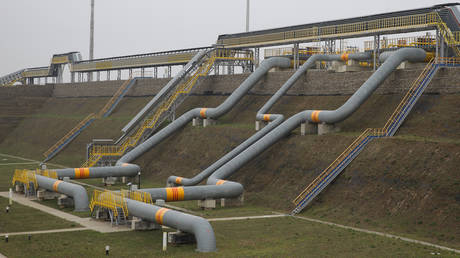
In the quiet undercurrents of European diplomacy, a pipeline is more than a pipe. It is a lifeline. It is the heat in a grandmother's radiator in Budapest and the spark that keeps a factory floor moving in the Hungarian countryside. When someone targets that steel vein, they aren't just attacking infrastructure. They are attacking the warmth of a million homes.
The plot was sophisticated. It wasn't the work of amateurs with a grudge. It involved high-grade explosives manufactured in the United States, a detail that turns a regional security concern into a global geopolitical puzzle.
The Weight of the Infrastructure
Imagine the TurkStream pipeline. It is a massive, silent beast resting on the floor of the Black Sea, snaking through the Balkans to deliver gas to Hungary and Serbia. It exists in a world of extreme pressure and absolute darkness. To damage it requires more than a simple firecracker. It requires precision. It requires the kind of material that only a handful of nations produce with such terrifying consistency.
When Gasic spoke about the intercepted plot, he wasn't just relaying a police report. He was describing a narrow escape from a catastrophe that would have rewritten the economic reality of Central Europe overnight. The explosives were identified as C4 variants, the kind of plasticized punch that stays stable under water and packs enough kinetic energy to tear through reinforced steel like wet paper.
The source of the explosives—the United States—adds a layer of friction that makes every diplomat in the region sweat. It doesn't necessarily mean the American government sanctioned the hit. The world is full of black markets, "lost" shipments, and murky hand-offs in the gray zones of Eastern Europe. But the branding on the blocks matters. It carries a psychological weight. It suggests a level of access and funding that points toward organized, state-level ambition or extremely well-funded sabotage groups.
The Human Cost of a Cold Pipe
We often talk about energy security in terms of percentages and cubic meters. We lose the reality of the situation in the data. Let’s look at a hypothetical family in Szeged, near the Serbian border. It’s January. The wind is howling off the Great Hungarian Plain. If that pipeline vanishes, their world changes in hours. The pressure in the lines drops. The pilot light goes out. The air in the house starts to hold a bite that doesn't go away.
This is the "invisible stake." The people who planned to use those U.S.-made explosives weren't thinking about the family in Szeged. They were thinking about leverage. They were thinking about how to isolate Hungary, a country that has often marched to its own beat within the European Union and NATO, particularly regarding its energy ties to the East.
Gasic’s revelation wasn't a random leak. It was a warning shot. By naming the origin of the explosives, he forced a conversation that many in the West would rather avoid. How did these materials get there? Who provided the logistics? You don't just walk across a border with enough C4 to level a pumping station without someone, somewhere, looking the other way.
The Shadow in the Water
The sabotage of the Nord Stream pipelines in the Baltic Sea a few years ago changed the rules of the game. Before that, major energy conduits were seen as almost sacred—too vital to touch, too dangerous to break. That taboo is gone. Now, every mile of pipe is a target.
The Serbian intelligence report suggests that the plotters were looking for the "bottleneck." Every network has one. A place where the pressure is highest, or the terrain makes repair nearly impossible. The use of American explosives suggests a desire for reliability. If you are going to risk a life-sentence for international terrorism, you don't use homemade fertilizer. You use the best.
Consider the technical difficulty. To hit a pipeline effectively, you need divers or unmanned underwater vehicles (UUVs). You need acoustic triggers or timers that can withstand the damp and the cold. This is a symphony of destruction. The fact that it was stopped suggests that the "silent war" between intelligence agencies is just as active as the kinetic one happening on the front lines of Ukraine.
A Continent on Edge
The atmosphere in Belgrade and Budapest is one of guarded anxiety. They know they are sitting on a powder keg—literally. For Serbia, being the transit hub for Hungarian gas makes them a vital player, but also a bullseye. Gasic's agency is playing a game of constant surveillance, watching the ports, the border crossings, and the digital chatter that precedes a physical strike.
There is a specific kind of dread that comes with knowing the tools of your destruction were crafted by an ally. It creates a vacuum of trust. Even if the explosives were stolen or sold five times over before reaching the plotters, the "Made in USA" stamp acts as a ghost in the room. It complicates the narrative. It makes the victim wonder who their friends really are.
The materials were high-velocity. They were designed for demolition. In the hands of a saboteur, they are the ultimate veto power over a nation's foreign policy.
The Invisible Guard
We live in an age where the most important battles happen in places we will never see. They happen in the silt of the riverbeds and the encrypted folders of a spy chief’s desk. The plot against the gas flow to Hungary wasn't just an attempt to break a pipe. It was an attempt to break a will.
If the explosives had been detonated, the secondary explosions wouldn't have been chemical. They would have been political. Governments would have fallen. Alliances would have fractured under the pressure of a freezing winter. The Serbian intelligence agency didn't just find a bag of C4; they found a trigger for a much larger explosion that could have leveled the remaining stability of the Balkans.
The steel remains intact for now. The gas continues to hiss through the valves, silent and invisible. But the knowledge of what almost happened lingers. It’s a reminder that the warmth in our homes is held together by a thin ribbon of metal and the constant, tiring vigilance of people who spend their lives watching the shadows for the glint of American steel and the smell of high-grade plastic.
Somewhere deep under the soil and water, the pressure holds. But everyone is listening for the sound of a crack. Everyone is waiting to see if the next shipment of "aid" or "commerce" contains the seeds of the next cold dark.



