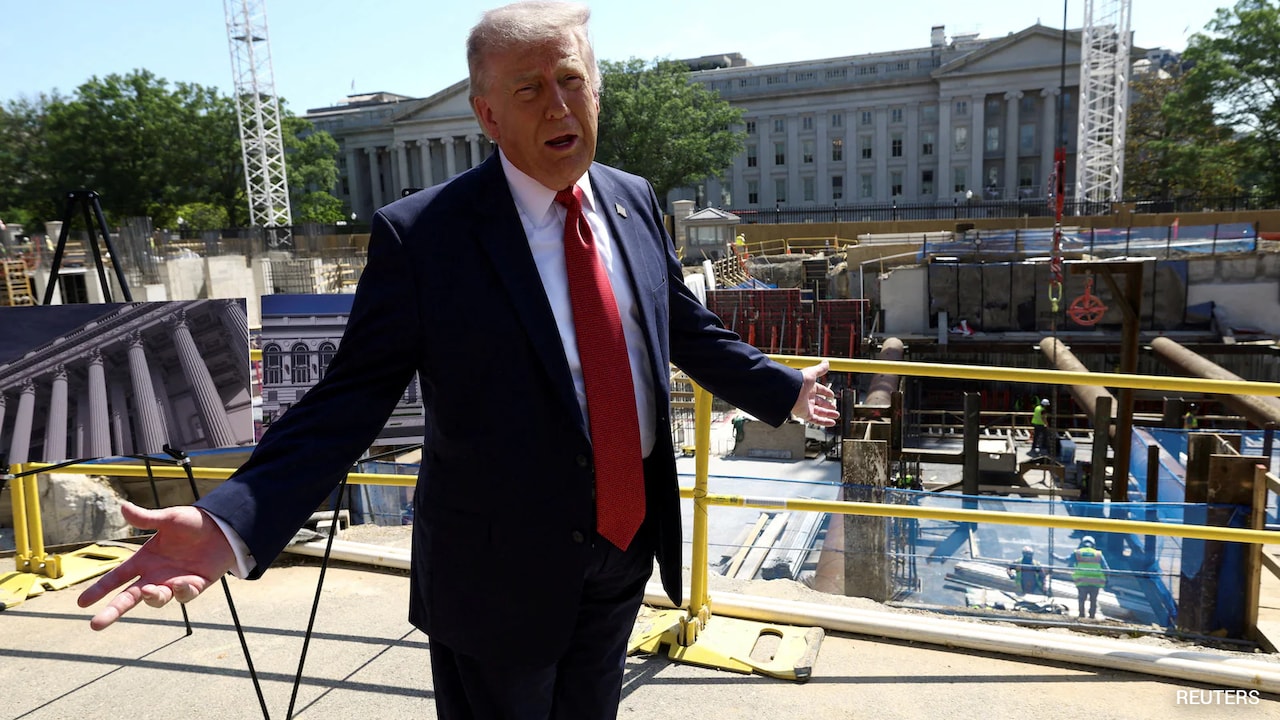
The Smell of Wet Cement and Old Stone
There is a distinct scent to power when it starts taking up physical space. It smells of diesel exhaust, fresh hydraulic fluid, and the sharp, alkaline bite of wet concrete mixing on an industrial scale.
If you stood on the South Lawn of the White House during the height of the planning, you could almost hear the quiet, persistent grinding of gears that had nothing to do with legislation or diplomacy. You could hear the future arriving, truck by heavy truck.
We have a habit of talking about government as if it were entirely made of paper. We talk about bills, amendments, executive orders, and subcommittees. We picture gray rooms filled with men and women in dark suits shuffling briefs beneath fluorescent lights. But power is physical. It requires foundations. It demands walls. And sometimes, it demands a four-hundred-million-dollar ballroom designed to seat hundreds of dignitaries under gilded chandeliers, tucked discreetly against the historic back porch of the American executive mansion.
Stop.
Consider the sheer audacity of the price tag. Four hundred million dollars. That is not just a budget line item; it is a monument.
When the news broke that a federal court had slammed the emergency brakes on this massive architectural ambition, the headlines treated it like a procedural footnote. Another injunction. Another procedural tango between the judiciary and the executive branch.
They missed the story.
The story is about what happens when the people who temporary occupy a house decide they want to rewrite its architecture forever. The story is about the invisible friction between a president's personal vision of grandeur and the heavy, immovable machinery of federal preservation law.
The House That History Built
To understand why this court intervention matters, you have to remember what the White House actually is.
It is not a blank canvas. It is a palimpsest. Every single resident from John Adams onward has scratched their own era into its plaster and painted over its trim. Lincoln held cabinet meetings in a room dominated by massive maps of the Civil War. Truman gutted the interior entirely, leaving only the exterior walls standing like a hollowed-out theatrical set while steel beams were shoved into its ancient bones.
Yet, there is an unwritten contract governing the estate. It is a shared heritage. It belongs to the public trust.
When the plans for the grand ballroom first leaked into public view, they arrived with renderings that looked like they belonged in a modern European palace or a luxury hotel in Dubai. High ceilings, classical columns, floor-to-ceiling glass looking out over the Rose Garden, and enough square footage to host state dinners that previously had to be crammed into temporary tents on the lawn.
The argument for it was simple, transactional, and superficially practical. The existing State Dining Room maxes out at around one hundred and forty guests. When foreign heads of state arrive, tents go up. Tents leak. Tents flap in the winter wind. Tents lack the gravitas of a permanent American throne room.
So the logic went: Let us build something permanent. Let us build something magnificent. Let us build a ballroom worthy of a superpower.
But history does not surrender its territory easily.
The Machinery of Oversight
Enter the National Capital Planning Commission, the Commission of Fine Arts, and a web of preservation statutes designed precisely to prevent the impulsive reshaping of national monuments.
Imagine walking through a historic district where every shingle and brick is cataloged. Now multiply that oversight by a thousand, apply it to the most famous residence in the western world, and you begin to understand the regulatory gauntlet.
The core of the legal challenge was never just about concrete or aesthetics. It was about authority. Does an administration have the unilateral right to alter the permanent footprint of the Executive Residence without deep, exhaustive, multi-layered congressional and public review?
The plaintiffs in the lawsuit argued no. They pointed to the National Environmental Policy Act and the National Historic Preservation Act. These are dry, bureaucratic names for what are essentially the shock absorbers of democracy. They are designed to slow things down. They exist precisely because impatient leaders want to build monuments in the heat of a single term, while the public must live with the consequences for centuries.
The courts agreed. At least for now.
When the federal judge issued the halt, the project froze mid-stride. The heavy machinery sat idle. The blueprints rolled up. The ambitious timeline of groundbreaking and ribbon-cutting suddenly dissolved into briefs, depositions, and oral arguments.
The Human Cost of Grandeur
Why does a ballroom matter so much?
It matters because buildings are autobiographies in stone.
When a leader commissions a structure, they are casting a vote on how they want history to remember them. They are saying: This is my scale. This is my ambition. This is how large I believe the presidency should feel.
For the workers hired to draft the plans, it was an engineering marvel. Imagine calculating the load-bearing capacity for a ceiling designed to host the world's most powerful people, ensuring the acoustics could carry a toast across the room without distortion, threading the needle between modern HVAC systems and nineteenth-century masonry.
For the preservationists, it was an existential threat. They looked at the South Lawn and saw not a blank space waiting for improvement, but a sacred composition laid out by architects who understood restraint.
Restraint is out of fashion.
We live in an era that worships scale. Everything must be bigger, faster, louder, and more monumental. If you cannot see it from a satellite, did it even happen?
Yet, the beauty of the American experiment has always been rooted in a strange, deliberate friction. Power is never allowed to run completely unmoored. There is always someone—a judge, a preservationist, a skeptical public, a pesky piece of legislation—waiting in the wings to grab the coattails and ask: By whose authority?
The Quiet After the Halt
Drive past the perimeter today, and you will not see the rising steel skeleton of a new palace. You will see the familiar, stoic white neoclassical facade standing just as it has for generations.
The silence of the construction site is telling.
It reminds us that the White House is not a playground for architectural fantasies. It is a trust. Every brick holds the weight of decisions made by people who knew they were only passing through.
The courts have spoken, halting the heavy excavators and sending the blueprints back into the legal ether. Whether the project will eventually rise from the paperwork or quietly die in committee remains to be seen.
What remains undisputed is the lesson left in the wake of the injunction.
In a democracy, the hardest thing to build is not a ballroom. It is consensus. And no matter how much money you throw at the problem, concrete cannot buy its way past the law.