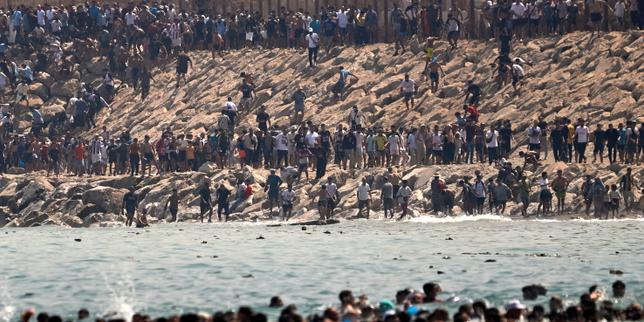
The wire is cold. It is rusted in places where the salt air of the Atlantic bites into the steel, flaking orange dust onto the concrete below. If you stand close enough, you can hear the hum of the electricity, or perhaps that is just the sound of the wind screaming down from the hills, carrying the scent of woodsmoke from a kitchen five miles away that happens to be on a entirely different continent.
Ceuta does not make sense on a map.
It is a chunk of Europe carved out and dropped squarely onto the northern belly of Africa. A scrap of Spain surrounded by mountains and sea, defended by double fences twelve meters high, studded with cameras, patrolled by men in green uniforms who look into the middle distance with tired eyes.
On Tuesday, the quiet broke.
Hundreds of people did not walk through the gates. They did not show passports stamped in Madrid or Rabat. They swam. They ran. They surged against the physical manifestations of a border that separates a euro-denominated supermarket from an economy where hope often feels like a currency in dangerously short supply.
Consider what happens next.
Statistics roll out by Wednesday morning. A dry tally. Three hundred people. Four hundred people. Minor injuries among the Guardia Civil. A temporary closure of the Tarajal crossing. The news anchors read these numbers with the practiced cadence of weather reporters tracking a distant storm. They speak of migratory pressure, of border security protocols, of geopolitical friction between two nations locked in a perpetual dance of cooperation and suspicion.
They talk about numbers. They rarely talk about the water.
The water off the coast of Fnideq is not welcoming. In the early hours, before the sun begins to bleed purple and gold over the Moroccan hills, the sea is black and heavy. It pulls at your limbs. It steals your body heat with an efficiency that takes your breath away long before you ever lay eyes on a barbed-wire entanglement.
Imagine pushing off from that shore. (Note: This hypothetical scenario is drawn from hundreds of documented testimonies gathered by humanitarian workers along the Strait of Gibraltar over the past decade.) You have a plastic bottle tucked into your waistband for buoyancy, or perhaps a cheap inner tube bought from a roadside stall. You have left behind a bedroom, a mother who is praying behind closed doors, and a future that offered nothing more than the slow erosion of potential.
You swim because staying still is a quiet death.
When you reach the fence, it looms like a cathedral of exclusion. It is mesh and razor wire, engineered to stop human beings from doing what human beings have done since the dawn of time: moving toward where the food is, where the shelter is, where the safety is.
Why Ceuta? Why this bizarre anomaly of geography?
Because it is a door. A cracked door on a fortress wall. Spain shares a land border with Morocco only here, and in Melilla, another coastal enclave a few hundred miles to the east. These two cities are magnets. They pull gravitational force from thousands of miles south, drawing young men, and sometimes families, across the Sahara, through the Rif mountains, and down to the beaches.
The security apparatus responds with predictable mechanics. Tear gas drifts over the sand. Rubber bullets crack against the morning quiet. The Spanish Ministry of the Interior issues a statement praising the swift coordination of forces. Moroccan authorities sweep the surrounding hills, rounding up those who did not make it across, loading them onto buses heading south toward the interior of the country.
Order is restored.
Except order is an illusion here.
The fence is taller this year than it was ten years ago. It has been upgraded with non-cutting mesh, anti-climbing plates, and optical sensors that can spot a heartbeat in the dark. Yet the arrivals continue. They come in waves, timed with the heavy fog that rolls in off the strait or the distraction of a holiday weekend. Every upgrade to the wall simply changes the physics of the crossing, driving people to swim around the breakwaters, risking the surf rather than the steel.
We look at these events through the lens of policy. We debate quotas, asylum laws, and border funding. We treat migration as a technical glitch in the global software, something to be patched with better code, stronger treaties, or more money funneled into neighboring states to act as wardens.
The failure lies in the metaphor.
A border is not a dam. It is a filter. And when the pressure behind a filter rises high enough, something has to give.
Down in the narrow streets of Ceuta's old town, far from the dramatic confrontations at the perimeter, life goes on with a strange, bifurcated rhythm. Shopkeepers sweep their doorsteps. Tourists from the Spanish mainland sip café con leche at outdoor tables, glancing occasionally at their phones to check the news alerts about the morning's influx. They live in Europe. They pay with euros. They catch ferries back across the strait to Algeciras as if they had never left the Iberian peninsula.
Just beyond the ridge, a few kilometers away, a teenager from sub-Saharan Africa sits in a red cross tent, wrapped in a foil thermal blanket that makes him look like an astronaut who has crash-landed on an alien planet. He is shivering. His shoes are gone, lost to the undertow. He is breathing hard, not from the swim, but from the realization that he has crossed the line, and now he exists in a legal limbo that could last for months or years.
He is inside Europe. He is outside everything.
The policy debates will rage in television studios in Madrid and Brussels. Politicians will posture. Treaties will be signed and quietly ignored. But the reality of Ceuta remains stubbornly physical. It is where two different realities grind against each other like tectonic plates, creating earthquakes that register not on seismographs, but in the tearful phone calls home and the sudden flash of green uniforms in the morning mist.
The sun climbs higher over the Mediterranean. The salt dries on the wire. Out on the horizon, a cargo ship plows steadily toward the Atlantic, carrying containers of goods that move across borders with effortless bureaucratic grace, while the human beings who made them sit behind a fence, waiting for a verdict on their lives.