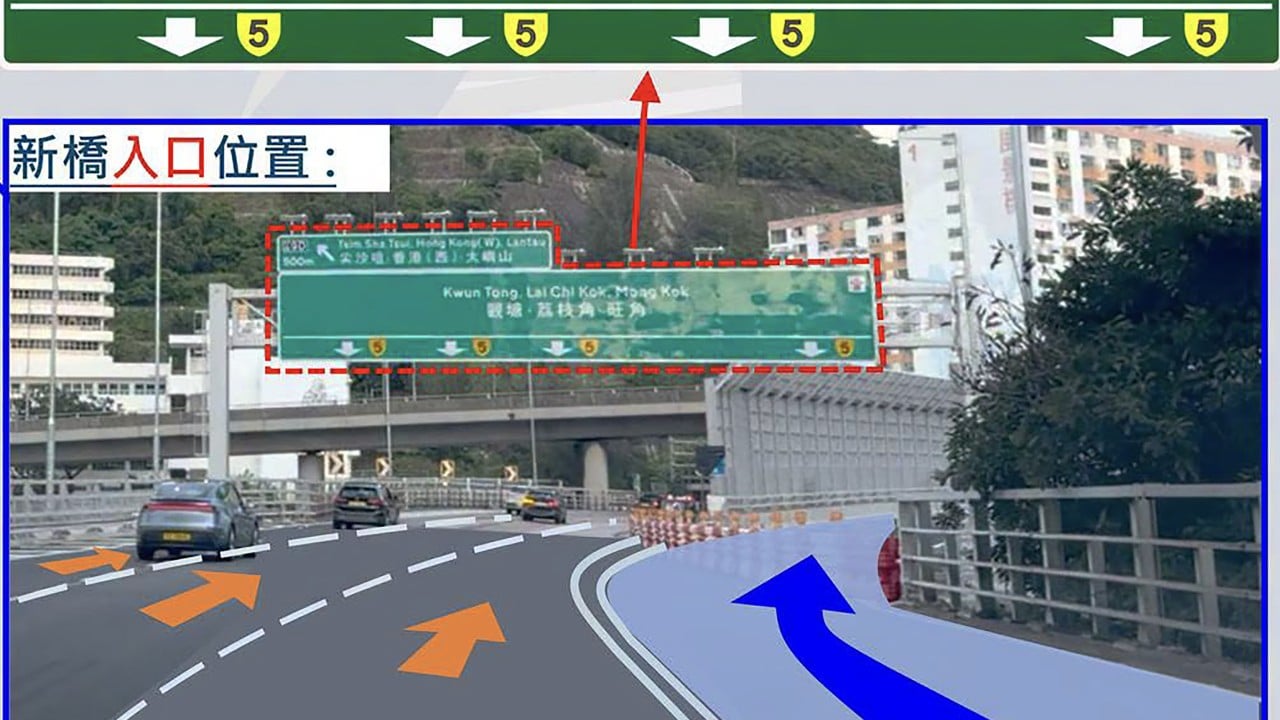
The rain had stopped, but the asphalt was still weeping.
It was 8:24 on a Tuesday morning, the precise moment when Hong Kong’s kinetic energy reaches its suffocating peak. Thousands of commuters were hurtling toward Kowloon, their minds occupied by morning meetings, overdue emails, and the ambient stress of a city that never pauses to breathe. Underneath them, the tires of a private car hummed along Tsuen Wan Road, approaching the Kwai Tsing Interchange upramp.
The driver knew this route. He had driven it for years. But the road beneath him had changed over the weekend.
Two days prior, the government opened a brand-new, single-lane flyover designed to fix a notorious bottleneck, expanding the road capacity from a chaotic "four-in, three-out" lane distribution to a streamlined "four-in, four-out" grid. On paper, it was a triumph of civil engineering. In reality, it became a psychological funnel.
As the car reached the apex of the interchange, the driver faced a split-second decision. The far-right lane—historically the fast lane for overtaking—now fed exclusively into the new flyover, locking drivers onto a trajectory toward Kwun Tong, Lai Chi Kok, and Mong Kok. If he needed Route 3 toward Tsim Sha Tsui or the airport, he was supposed to have stayed left.
He didn't know that. The realization hit him too late. A sudden, instinctual tap on the brakes. A frantic glance at the rearview mirror.
Metal met metal.
Three minutes later, while the two startled drivers were still exchanging insurance details on the narrow concrete ledge, a second wave of commuters rounded the bend. Four cars, traveling too fast and too close, slammed into one another in a chain reaction of shattered glass and crumpled fenders. Ten minutes after that, a third accident unfolded at the exact same spot. Three distinct crashes. Seven vehicles ruined. One driver clutching his neck in pain. All within a thirty-minute window on a single stretch of elevated concrete.
It was the third consecutive day the new flyover had tasted blood. Five crashes in seventy-two hours.
The Failure of Perfect Logic
When a modern city builds infrastructure, it relies on cold, mathematical certainty. The Highways Department had even commissioned an independent road safety audit before a single orange cone was moved. The auditors looked at the signs, measured the visibility arcs, and declared the setup entirely sufficient.
But an audit cannot measure human muscle memory.
Consider a hypothetical commuter named Mr. Lam. For a decade, Lam’s morning routine has been dictation by instinct. He enters the highway, moves to the fast lane, and lets his subconscious guide him through the familiar geometry of the city. He is not looking for new signs because, to his brain, the road is a solved puzzle.
When a piece of that puzzle changes overnight, the brain experiences a brief, catastrophic lag.
Psychologists call it cognitive tunnel vision. Under the stress of morning traffic, a driver's focus narrows to the bumper in front of them. They do not read directional text painted on the tarmac until they are already rolling over it. By the time Lam sees the words Kwun Tong beneath his tires, the solid white line has already locked him in. He has seconds to choose between accepting a major detour or making a dangerous, illegal lane sweep.
That micro-second of hesitation is where accidents are born.
The first victim of the flyover, on Sunday afternoon, was a taxi passenger who ended up in Princess Margaret Hospital with chest injuries after a four-vehicle pile-up. On Monday morning, another three-car crunch choked the fast lane. By Tuesday, the flyover wasn't just a road anymore; it was an unpredictable hazard that required emergency government intervention.
The Anatomy of a Fix
The official response was swift, predictable, and telling. Crew members arrived to paint larger road markings and erect temporary, highly visible traffic signs at the approach points. They did what engineering always does when logic fails: they added more noise to a noisy system.
The real problem lies in the design language of cities.
We build roads for cars, but we forget they are piloted by fragile, distracted primates. A single lane branching off a high-speed highway requires more than just legality; it requires empathy. It requires an understanding that a driver heading to Lantau or Hong Kong West cannot suddenly undo ten years of driving habits because of a fresh coat of paint applied over the weekend.
The government now claims the situation is being closely monitored. The lanes have reopened, the glass has been swept away, and the morning traffic once again flows toward Kowloon. But the tension remains.
Every driver approaching the Kwai Tsing Interchange now experiences a small, collective tightening of the grip on the steering wheel. They are watching the signs, watching each other, waiting to see who will hesitate next.
The concrete structure stands impassive against the Hong Kong skyline, a testament to efficiency on paper, and a monument to human error on the ground.

