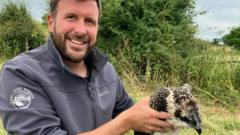
We love a good redemption arc. There is a specific kind of smugness that comes with "tricking" nature into doing what we want, then patting ourselves on the back for it. The recent headlines about Ospreys breeding in Dorset after a 200-year hiatus are dripping with this sentiment. They frame the reintroduction project at Poole Harbour as a clever human victory—a bit of smoke and mirrors with decoys and high-tech platforms that supposedly lured these raptors back to the South Coast.
The narrative is simple: humans broke it, humans fixed it, and the birds are "happy." You might also find this similar coverage interesting: The End of the Dubai Sanctuary and the Fall of the Regency Era.
It is a lie. Not because the birds aren't there—they clearly are—but because the "tricked" narrative hides the uncomfortable reality of ecological manipulation. We aren't restoring nature; we are gardening it. We are creating expensive, high-maintenance avian museums. If we want to actually talk about conservation, we need to stop romanticizing the "trickery" and start looking at the cold, hard mechanics of habitat dependency and the biological cost of human ego.
The Myth of the Clever Shortcut
The competitor's fluff piece leans heavily on the idea that translocation is a shortcut to ecological health. They talk about "translocation" as if it’s a moving service for wildlife. In reality, translocation is an admission of total failure. As highlighted in latest articles by Al Jazeera, the implications are significant.
To get Ospreys to breed in Dorset, conservationists had to physically snatch chicks from healthy populations in Scotland and "hack" them—raising them in artificial pens so they would imprint on the new location. This isn't nature taking its course. This is a desperate, labor-intensive intervention.
When we say we "tricked" them, we are masking the fact that the environment itself was, and largely remains, incapable of attracting these birds naturally. If the habitat were truly ready, the birds would have found it. Birds have wings. They are mobile. The reason they weren't in Dorset for two centuries wasn't a lack of maps; it was a lack of security, food density, and nesting sites free from human interference.
By using decoys and artificial nests, we are essentially building a luxury condo in a wasteland and wondering why the neighbors haven't moved in on their own.
The Decoy Delusion
Let’s dismantle the "decoy" strategy. The project used plastic birds to simulate a thriving colony. The logic? Ospreys are semi-colonial and prefer to nest where they see others succeeding.
On the surface, it’s a neat trick. In practice, it’s a biological trap. By using decoys to lure birds into a specific area, we are overriding their natural instinct to scout for the best possible territory based on actual environmental cues. We are forcing them to trust our plastic replicas over their own sensory data.
If those birds fail to thrive—if the local fish stocks aren't what they seem or if the disturbance from Poole Harbour’s heavy boat traffic proves too much—they have been led into a reproductive dead end. We call it "encouragement." A biologist might call it an "ecological trap."
The True Cost of Micro-Management
I have watched organizations dump six-figure sums into single-species reintroductions while the broader ecosystem rots. This is the "Pandas and Polar Bears" problem applied to the British coast.
Ospreys are charismatic. They look great on a webcam. They drive donations. But they are a top-tier predator that requires a massive, healthy caloric base. Focusing on the Osprey is like polishing the hood ornament of a car that doesn't have an engine.
While we celebrate a handful of pairs nesting on man-made poles, the actual water quality in our estuaries is a disaster. Chemical runoff, microplastics, and overfishing of key species are the real issues. But fixing a river is hard. It’s expensive. It involves fighting powerful agricultural and industrial interests.
Plucking a bird from Scotland and putting it on a pole in Dorset is easy by comparison. It’s a PR win that allows us to ignore the systemic collapse of the surrounding food web.
The Sovereignty of the Wild
The most offensive part of the "tricked" narrative is the underlying assumption that nature is a machine we can calibrate. We treat these birds like software we can install in a new hardware environment.
True conservation isn't about control; it’s about abdication. It’s about stepping back and making a space so wild and so functional that we don't need to move birds around like chess pieces.
When we intervene this heavily, we create a "dependent" population. These Dorset Ospreys rely on man-made platforms because we’ve removed the ancient, gnarled trees they would naturally use. They rely on human protection because we haven't addressed the underlying reasons they were wiped out in the first place—primarily human encroachment and persecution.
We aren't rewilding. We are ranching.
Why Your "Feel Good" Story is a Distraction
People ask, "Isn't any Osprey better than no Osprey?"
The honest, brutal answer is: Not if it buys us another decade of ecological complacency.
Every time we celebrate one of these "managed" successes, we lower the bar for what we consider a healthy environment. We start to believe that a world of artificial nests and translocated predators is a substitute for the real thing. It’s the "Disneyland-ification" of the British countryside.
Imagine a scenario where we stopped spending millions on translocation and instead focused exclusively on massive-scale habitat restoration. If we restored the wetlands, cleaned the rivers, and let the forests grow back to the water's edge, the birds would come back. They would come back because they are biological opportunists, not because we "tricked" them.
The difference is that a bird that returns on its own is part of a functioning system. A bird that is moved there by humans is a guest in a hotel we are paying for.
The Actionable Truth
If you actually care about Ospreys—or any other species—stop cheering for the "tricks." Start demanding the difficult work.
- Stop Species-Centric Thinking: A single bird species is a symptom, not the cure. If your local conservation group is obsessed with one "cool" animal while ignoring the insects and the soil, they are a PR firm, not a conservation group.
- Demand Habitat, Not Hardware: A nesting platform is a band-aid. A sprawling, protected coastal buffer zone is a cure.
- Question the "Success" Metrics: One breeding pair is not a "recovered population." It’s a fragile experiment. Don’t let them tell you the job is done until the birds are spreading into territories that weren't pre-prepared by humans.
We need to get over our god complex. Nature doesn't need our cleverness. It needs our absence. The Ospreys in Dorset aren't a sign that we are winning the fight against extinction; they are a sign of how much we have lost that we now have to play dress-up with plastic birds just to see a raptor in the sky.
Stop celebrating the trick and start mourning the necessity of it. Then, and only then, will we actually do the work required to bring the wild back for real.
The birds didn't choose Dorset. We chose it for them. And until they return on their own terms, we’re just playing house in a ruin.