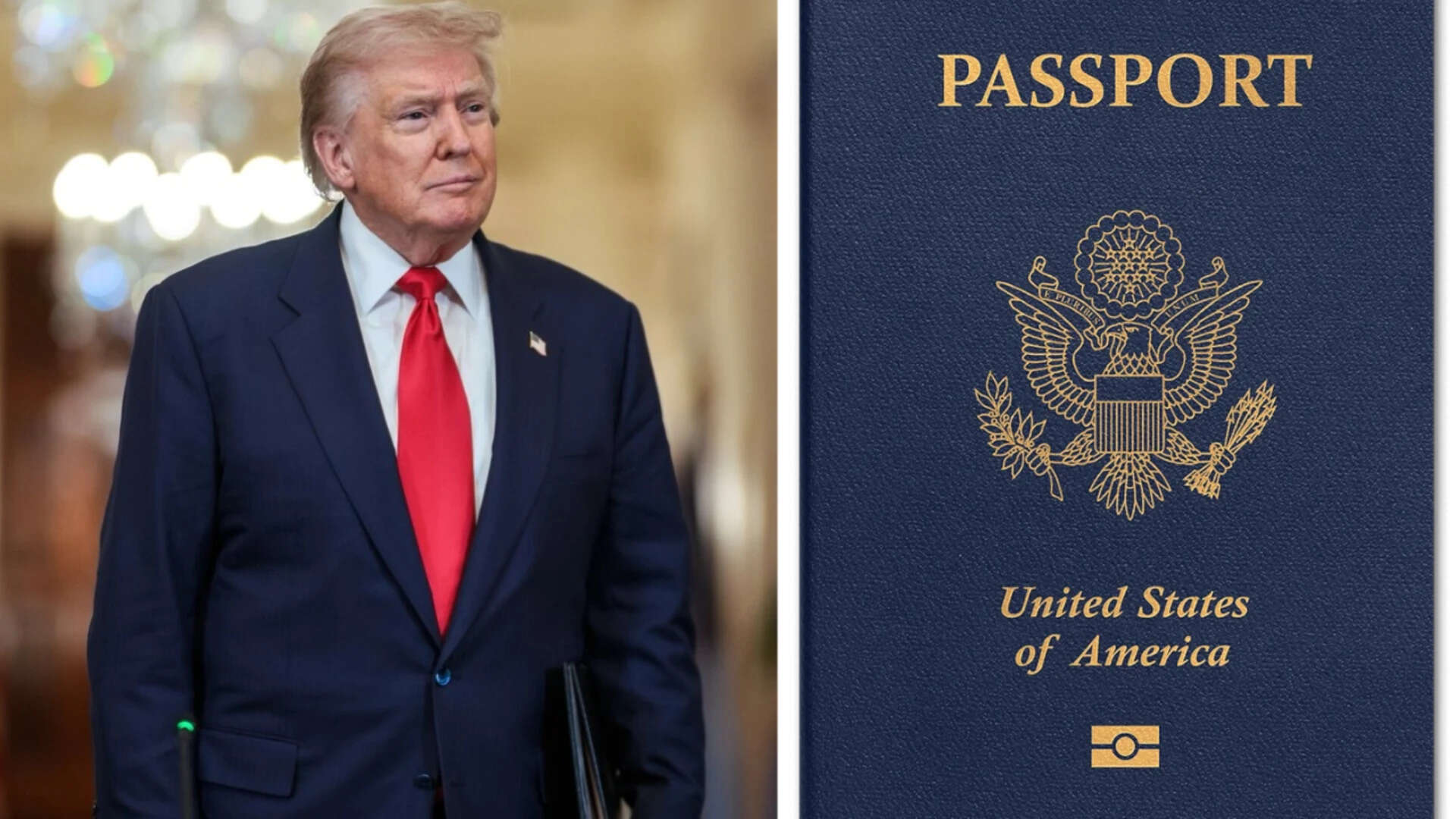
The issuance of a limited-edition U.S. passport featuring the likeness of a sitting president establishes a new precedent in the management of American sovereign identity documents. Traditionally, the U.S. passport has functioned as a neutral administrative tool, utilizing historical vignettes and dead statesmen to signal continuity rather than contemporary political alignment. The State Department’s April 2026 announcement to integrate President Donald Trump’s portrait into a commemorative edition for the nation’s 250th anniversary shifts the document from a static record of heritage to an active medium for current executive branding.
The Architecture of the Commemorative Redesign
The proposed modification is not a comprehensive overhaul of the "Series B" Next Generation Passport (NGP) infrastructure but a localized aesthetic overlay. The redesign functions through three primary mechanical changes to the document’s interior and exterior: Meanwhile, you can find related stories here: The FCC License Battle Over Jimmy Kimmel and the Threat to Broadcast Independence.
- Portrait Integration: A high-resolution second-inaugural portrait of President Trump is situated on the interior cover, overlaid on the text of the Declaration of Independence. This placement replaces the standard historical or geographic imagery typical of the NGP series.
- Signature Imprimatur: For the first time in the history of U.S. travel documents, a sitting president’s signature will be featured as a gold-leaf security element. This mirrors the recent Treasury Department initiative to include executive signatures on paper currency.
- External Symbolism Reversal: The standard cover layout—"United States of America" at the top and "Passport" at the bottom—is inverted. The back cover will feature a gold-laminate American flag with "250" encircled by thirteen stars, marking the semi-quincentennial.
Operational Logistics and Availability Constraints
The rollout of these documents is governed by strict scarcity and geographic limitations, designed to test public adoption while maintaining existing production efficiencies.
- Geographic Bottleneck: The commemorative edition is exclusively available for in-person applicants at the Washington Passport Agency.
- Opt-Out Mechanisms: Applicants utilizing online renewal platforms or regional agencies outside of the District of Columbia will continue to receive the standard NGP design. This creates a two-tier system where the commemorative document serves as a "default" only within a specific administrative radius.
- Volume Caps: Production is limited to an initial run of 25,000 to 30,000 units. Given that the U.S. issues approximately 20 million passports annually, this represents less than 0.2% of the total yearly output, classifying the item more as a numismatic-style collectible than a universal policy shift.
Security Integrity and International Compliance
A primary constraint in passport design is the maintenance of "Machine Readable Travel Document" (MRTD) standards set by the International Civil Aviation Organization (ICAO). Any alteration to the data page or the biometric chip's encoding would jeopardize the document's validity at foreign borders. To see the complete picture, we recommend the detailed analysis by TIME.
The State Department has confirmed that the customized artwork is restricted to non-data pages. The polycarbonate data page, which contains the laser-engraved personal information and the RFID chip, remains unchanged. This ensures that while the visual branding of the book is modified, the underlying security logic—including the ghost images, micro-printing, and ultraviolet features—remains compliant with global interoperability standards.
The Strategy of Institutional Branding
This move is a component of a broader executive strategy to link the current administration’s image with foundational national symbols. The logic follows a "Cumulative Branding Model" where the executive’s likeness is integrated into high-frequency touchpoints of federal authority:
- Fiscal Touchpoints: Presence on paper currency and commemorative $1 gold coins.
- Territorial Touchpoints: National Park passes featuring the president alongside George Washington.
- Cultural Touchpoints: The renaming of the Kennedy Center and the U.S. Institute of Peace to incorporate the Trump name.
The objective is to reduce the distance between the office of the presidency and the personal brand of the incumbent. By placing a portrait in a 10-year document, the administration ensures a persistent visual presence that outlasts the current electoral cycle.
Administrative Risks and Diplomatic Friction
The introduction of political portraiture into travel documents presents specific operational risks. The most significant is "Neutrality Degradation." In certain geopolitical contexts, a passport is viewed as a request for safe passage from one sovereign power to another. The presence of a polarizing figure’s image may, in rare instances, influence the discretionary behavior of border officials in hostile or highly politicized jurisdictions.
Furthermore, the domestic legal framework for passport design is broad, granting the Secretary of State significant leeway under the Passport Act of 1926. However, the use of federal funds for what could be construed as campaign-style branding may face challenges under the Hatch Act or via congressional appropriations committees.
The State Department’s tactical choice to frame this as a "limited edition" for a national anniversary provides a specific legal and commemorative shield, characterizing the move as a historical celebration rather than a permanent change to the American identity stack. Those seeking to avoid the redesign should prioritize online renewal or remote agency applications to ensure they receive the standard Series B document.