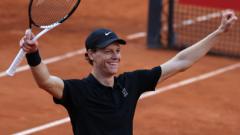
Jannik Sinner did not just win the Italian Open on Sunday. By defeating Casper Ruud 6-4, 6-4 in Rome, the 24-year-old world number one became the youngest player in history to complete the Career Golden Masters, a clean sweep of all nine ATP Masters 1000 tournaments. Only Novak Djokovic had ever accomplished this since the tier was established in 1990. Djokovic completed his set at age 31, eleven years after his first Masters trophy. Sinner did it in three years, ticking off Indian Wells, Miami, Monte Carlo, Madrid, and Rome in a relentless, five-month march through the 2026 calendar.
The traditional sports press will paint this as a triumph of raw athletic destiny or the poetic ending of Italy's 50-year wait for a home male champion at the Foro Italico. That narrative is too simple. The reality is that Sinner's sudden, total monopoly over men's tennis is the result of a cold, highly calculated structural overhaul that treats a human athlete like an elite corporate enterprise. Sinner did not just out-talent the tour. He out-engineered it.
The Industrialization of the Support Staff
For decades, tennis players functioned like nomadic family businesses. A player hired a coach, perhaps a childhood mentor, and traveled the world with a small, insular entourage. Sinner broke that model entirely. Following a high-profile split from long-time coach Riccardo Piatti in 2022, Sinner built a decentralized corporation of specialists.
Look at the bench Sinner credited immediately after stepping off the clay in Rome. He did not praise a singular guru. He thanked his physical team. By employing co-coaches Darren Cahill and Simone Vagnozzi alongside a rotating cast of specialized physiotherapists, data analysts, and biomechanical experts, Sinner insulated himself from the emotional and physical vulnerabilities that derail his peers.
This corporate structure behaves like an engineering firm solving a technical problem. When Carlos Alcaraz withdrew from Rome with a persistent wrist injury, it highlighted the fragility of the traditional high-intensity approach. Sinner, conversely, treats scheduling and recovery with mechanical precision. His team analyzes workload down to the micro-second of racquet-head acceleration, ensuring he peaks during the grueling back-to-back schedules of Masters events.
The results of this internal optimization are terrifying for the rest of the tour. Sinner is currently on a 34-match winning streak at the Masters 1000 level. He did not just sweep the clay-court trifecta of Monte Carlo, Madrid, and Rome—a feat previously achieved only by Rafael Nadal in 2010—he won the first five Masters tournaments of a single season. The predictability of his excellence has turned elite tennis into a foregone conclusion.
Technical Monotony as a Weapon
On court, Sinner's dominance looks boring because it is designed to be. Against Ruud in the Rome final, there were no theatrical baseline rallies or emotional outbursts. Ruud tried to use heavy topspin and disruptive drop shots to break the rhythm. Sinner simply stood inside the baseline and absorbed the ball early.
The mechanical shift in Sinner’s game over the past 24 months centers on his serve and tactical positioning.
- The Serve: A reconstructed, simplified motion that minimizes moving parts, leading to an astonishing 93% first-serve points won percentage in his Madrid final victory over Alexander Zverev earlier this month.
- The Return: Shifting his baseline position forward by nearly two feet compared to his 2023 metrics, taking away time from opponents and forcing them into defensive errors.
- The Target: An unyielding, repetitive assault on an opponent's weakest wing—in Ruud's case, the backhand corner—until the defensive structure collapses under sheer weight of pace.
This is not the artistic, improvisational tennis of Roger Federer or the defensive friction of classic clay-courters. It is a suffocating baseline squeeze. Sinner wins by eliminating variables. By hitting the ball with identical depth and velocity from both wings, he turns the tennis court into a high-speed laboratory where opponents eventually run out of laboratory solutions.
The Complicity of a Changing Tour
To understand how Sinner conquered all nine distinct tournament environments so rapidly, one must look at the external landscape. The ATP tour has fundamentally changed. The structural variations between court surfaces have shrunk dramatically over the last decade.
Once upon a time, winning the "Sunshine Double" of Indian Wells and Miami required adapting to two completely different environments, followed by a jarring transition to the slow, heavy red clay of Europe. Today, court privatization, uniform ball manufacturing, and organizational demands for longer baseline rallies have standardized the playing conditions. The clay in Madrid plays fast due to altitude; the hard courts in Miami can play slow and sticky.
Sinner's flat, heavy groundstrokes, which used to be a liability on slippery clay, are now perfectly suited for modern courts. Because the surfaces behave more similarly than ever before, Sinner's optimized baseline blueprint requires only minor calibration from week to week. He did not have to master three different sport disciplines to win the Golden Masters. He mastered one hyper-efficient style that the modern tour has made universally viable.
The Psychological Void Left by the Big Three
There is a final, overlooked factor in Sinner's historic run. He is operating in a psychological vacuum. For twenty years, young players failed to win big titles because they had to face Roger Federer, Rafael Nadal, and Novak Djokovic in their prime. That triumvirate did not just beat opponents physically; they defeated them in the locker room before the match even started.
Now, Federer is retired, Nadal is at the twilight of his career, and Djokovic, whom Sinner pushed to a brutal five-set defeat in the Australian Open semifinals in January, is no longer an omnipresent roadblock. The rest of the locker room is populated by a generation that looks visually intimidated by Sinner's machine-like consistency.
When Ruud spoke after the Rome final, his language was telling. He described Sinner's form as "hard to describe with words" and called it "an honour to watch you play." That is the language of a competitor who has already accepted his subordinate position in the hierarchy. When the opposition views a matchup as an exhibition rather than a fight, the psychological battle is over before the first coin toss.
Sinner insists he does not play for records, stating in Rome that he only plays for his "own story." But as the tour moves to Paris for Roland Garros next week, where Sinner can complete a Career Grand Slam, his personal story has become the defining corporate monopoly of modern sports. He has built an infrastructure designed to win every time he steps onto a court, and right now, the tennis world has no anti-trust laws to stop him.