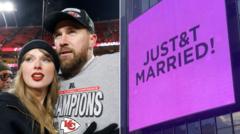
Taylor Swift and Travis Kelce are married, transforming Madison Square Garden from a sports arena into a fortress of pop-culture history on July 3, 2026. Within minutes of the ceremony concluding, giant purple marquees lit up Midtown Manhattan with the phrase "JusT&T Married!" while publicist Tree Paine issued the official confirmation. This was not a standard celebrity wedding. It was a massive, highly synchronized corporate merger of sports, music, and high fashion executed with military precision.
The scale of the event was staggering, yet the inner circle remained remarkably tight. While 1,000 guests filled the windowless arena, the couple bypassed traditional bridal parties. Instead, Swift’s brother, Austin Swift, stepped in as her man of honor, while Travis’s brother, Jason Kelce, stood as best man.
By looking past the immediate internet frenzy, the architectural planning of this event reveals how the world's most scrutinized couple completely rewrote the playbook for modern celebrity nuptials.
The Logic of a Windowless Fortress
Holding a wedding at Madison Square Garden sounds like a logistical nightmare, but for a billionaire pop star, it was a tactical masterstroke.
Celebrity weddings usually rely on remote islands, private estates in Rhode Island, or barricaded European villas to keep paparazzi at bay. These locations always possess a flaw. Long-lens cameras can shoot from boats, helicopters can fly overhead, and local security guards can be bribed.
Madison Square Garden eliminated the physical possibility of an aerial breach. It is a completely enclosed concrete bunker in the center of the most heavily policed city in America.
Security preparations began days in advance. The New York Police Department shut down four major blocks surrounding the arena, including 7th Avenue and West 31st through 33rd Streets. Guests arrived in vehicles with blacked-out windows, driving directly into a sealed white security tent built over the venue's entrance.
Inside, the couple held a strict filming notice. Guests were notified that the entire five-day window, from setup on June 29 to the main event on July 3, was fully miked and filmed. By controlling the physical space entirely, Swift and Kelce achieved absolute control over their own narrative.
The Haute Couture Coup
The biggest secret of the night was not the location, which had leaked weeks prior, but the dress. Swift walked down the aisle in a bespoke Christian Dior Haute Couture gown designed by Jonathan Anderson.
This choice sent shockwaves through the fashion industry. Anderson, who serves as the creative director for Dior, had never designed a couture wedding gown for a world-renowned celebrity before. Securing Swift as his debut bridal client is a massive corporate victory for LVMH and Dior Chief Executive Delphine Arnault, especially after rival house Chanel secured Dua Lipa’s wedding wardrobe.
Kelce matched his bride in a custom Dior tuxedo. Both wore custom-engineered footwear by Christian Louboutin, a practical necessity for Swift, who spent the last few years performing three-hour stadium sets in Louboutin heels. The bride accessorized with classic Cartier jewelry.
The choice of Dior connects Swift to a specific legacy of mid-century celebrity weddings, echoing the old-Hollywood traditions of figures like Olivia de Havilland and Rita Hayworth, who famously chose the French fashion house for their own ceremonies. The aesthetic avoided temporary internet trends, opting instead for architectural, timeless lines that will look relevant in archive photos fifty years from now.
Adam Sandler and the Counter-Intuitive Guest List
The ceremony itself was full of calculated subversions. The most surprising choice was the officiant.
Actor Adam Sandler stepped up to marry the couple. While Sandler seems like an outsider to the high-drama world of pop music, he has transitioned into a universally liked, paternal figure within Hollywood. His presence grounded an otherwise overwhelming spectacle in unexpected comedy and warmth.
The musical performance was equally deliberate. Rock icon Stevie Nicks performed for the crowd, anchoring the night in musical royalty rather than contemporary chart-toppers.
The crowd was a carefully curated mix of both worlds. The guest list blended modern indie-pop royalty like Jack Antonoff and close friends like Lena Dunham and Abigail Anderson with the elite ranks of sports media and the NFL. Key sports figures like Erin Andrews, Charissa Thompson, and Greg Olsen attended, alongside Kelce's childhood friend Aric Jones and the wives of several Kansas City Chiefs teammates.
The Twenty Six Million Dollar Shield
Preempting the inevitable public criticism regarding the excess and environmental impact of a 1,000-guest Manhattan wedding, the couple deployed a massive philanthropic shield just 24 hours before saying their vows.
Swift and Kelce announced a joint $26 million donation distributed across 20 distinct charities. The number was a clear nod to the year 2026. The funds were strategically allocated to cities tied to their respective careers and personal histories.
Food banks and children’s programs in New York, Los Angeles, Kansas City, Nashville, and Rhode Island received major windfalls. Organizations like City Harvest, Food Bank For NYC, Harvesters in Kansas City, and The Store in Nashville were among the primary recipients. They also directed $1 million specifically to the Rhode Island Community Food Bank, acknowledging the Watch Hill estate where media outlets originally assumed the wedding would take place.
This philanthropic rollout mirrors the corporate bonus structures Swift utilized during her touring years. It shifts the public conversation from the sheer extravagance of a Midtown arena takeover to a narrative of immense civic generosity.
Changing the Playbook
For decades, the standard procedure for an A-list celebrity wedding was to sell the exclusive photo rights to a major weekly magazine to control the images and cover the astronomical costs of security. Swift and Kelce completely bypassed this media structure. They do not need a magazine checkout aisle to validate their cultural reach or finance their security perimeter.
By utilizing Madison Square Garden, partnering directly with the highest tier of LVMH haute couture, and filming the event on their own terms, they treated their wedding less like a private family milestone and more like a historic cultural broadcast. The marriage marks the formal integration of two massive entertainment ecosystems, executed without a single unplanned detail leaking to the outside world until the purple marquees lit up the New York sky.