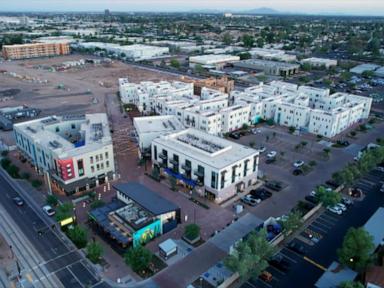
The asphalt heat of Tempe, Arizona, is an unlikely place for a revolution. For decades, the American Southwest has been the ultimate monument to the internal combustion engine—a sprawling grid of strip malls and wide-laned boulevards where surviving without a vehicle is viewed as a form of social or economic failure. Yet, in the middle of this concrete expanse sits Culdesac Tempe, a 17-acre development that has banned resident cars entirely. It is not a pedestrian mall or a temporary festival grounds. It is a permanent, high-density residential community where the lease explicitly forbids you from parking a private vehicle on-site.
This is the first "from-scratch" car-free neighborhood in the United States. While the surface-level narrative often focuses on the aesthetic appeal of European-style plazas and farmer's markets, the real story is found in the brutal efficiency of land use. By eliminating the requirement for parking garages—which can cost upwards of $30,000 to $50,000 per spot to build—Culdesac has effectively reallocated massive amounts of capital and physical space back into the living environment.
The primary query for many observers is simple: Does it actually work? Early data suggests that the demand for a walk-first lifestyle in a car-dependent state is significantly higher than developers anticipated. But the success of this model depends on a fragile ecosystem of micromobility, light rail access, and a fundamental shift in how we value every square foot of urban dirt.
The Financial Mechanics of the Missing Parking Spot
To understand why Culdesac matters, you have to look at the balance sheet. In traditional American development, "parking minimums" are the invisible hand that strangulates architectural creativity. Most cities require a specific number of parking spaces for every bedroom built. These requirements force buildings to spread out or go underground, driving up rents and creating "dead zones" of empty concrete.
Culdesac negotiated a unique agreement with the City of Tempe to waive these requirements. This was a high-stakes gamble. By stripping away the parking, the developers freed up over 50% of the land area that would have otherwise been wasted on cars. They used that reclaimed space to increase residential density and integrate commercial retail directly into the courtyard system.
The result is a neighborhood that feels significantly more intimate than a standard apartment complex. Because there are no roads cutting through the property, the "negative space" between buildings becomes a functional asset rather than a buffer. It’s a business model built on the idea that people will pay a premium for a shorter walk to their morning coffee, provided that walk doesn't involve crossing a four-lane highway.
Why Arizona and Why Now
Choosing Tempe wasn't a random dart throw. The city sits at a unique intersection of a major university (ASU), a burgeoning tech hub, and an existing light rail spine. For a car-free experiment to survive, it needs a "safety net" of external infrastructure. Culdesac residents rely heavily on the Valley Metro Rail, which connects them to Phoenix Sky Harbor International Airport and downtown Phoenix.
The timing reflects a shift in consumer appetite. The "walkability" score of a property has become a primary driver of real estate valuation for younger demographics. We are seeing a slow-motion rejection of the suburban commute. People are tired of being tethered to a $700 monthly car payment, rising insurance premiums, and the psychological toll of traffic. Culdesac offers a way out, but it comes with a trade-off that many Americans still find unthinkable: total dependence on shared transit and feet.
The Infrastructure of Convenience
A car-free life is only feasible if the friction of daily tasks is lower than the friction of driving. If getting groceries becomes a three-hour ordeal involving buses and heavy bags, the model fails. Culdesac addresses this through a hyper-local retail strategy.
The development includes an on-site grocery store, a restaurant, and a coworking space. The goal is to keep the "radius of daily life" within 1,000 feet. For everything else, the community leans on a fleet of shared electric scooters, e-bikes, and a dedicated Lyft pickup zone. There is even a partnership with car-sharing services for those rare occasions when a resident absolutely must drive to the outskirts of the valley.
However, the "last mile" problem remains a persistent ghost in the machine. While the interior of Culdesac is a tranquil, shaded oasis, the moment a resident steps off the property, they are back in the scorching reality of a car-centric desert. The heat is a physical barrier. Walking 15 minutes to a light rail station in 115-degree weather is not a lifestyle choice; it’s an endurance sport. This makes the "micro-climate" engineering of the site—using building shadows and desert-adapted greenery—essential for its survival.
The Myth of the Lifestyle Choice
Critics often dismiss these developments as niche experiments for wealthy urbanites. They argue that a car-free life is a luxury of the "laptop class" who don't have to haul tools to a job site or transport three children to different schools. There is some truth here. Culdesac, in its current form, targets a specific demographic of young professionals and retirees.
But the broader implication isn't about forcing everyone to sell their cars. It’s about legalizing the option to live without one. For most of the last century, it was actually illegal in many parts of the U.S. to build a neighborhood like this due to zoning laws. By proving that a car-free development can be profitable and popular, Culdesac is providing a template for city planners who are desperate to solve housing shortages without adding thousands of additional cars to already clogged arteries.
The Scalability Wall
The biggest threat to the "Culdesac model" isn't a lack of interest; it’s the sheer weight of existing municipal code. To replicate this elsewhere, developers have to fight a war of attrition against city councils, fire departments (who demand wide roads for truck access), and lenders who view car-free projects as high-risk anomalies.
Banks are notoriously conservative. They look at historical data to determine if a project will succeed. Since there is very little data on large-scale, car-free developments in the Sun Belt, securing financing requires a level of institutional bravery that is rare in the real estate world. Culdesac had to raise significant venture capital to get off the ground, moving it more into the category of a "tech startup" than a traditional real estate firm.
Data as the New Pavement
To manage a neighborhood without cars, you need a high degree of digital coordination. Culdesac operates almost like an operating system. Residents use an app to manage their transit credits, unlock shared bikes, and access communal spaces. This integration of software into the physical environment is what separates this project from the "New Urbanism" movements of the 1990s.
It is a data-driven approach to human movement. By tracking how residents use the light rail versus ride-sharing, the developers can tweak their offerings in real-time. If the e-bike fleet is underutilized, they can pivot. This agility is something the traditional suburban developer, locked into 30-year infrastructure plans, simply cannot match.
The Heat Island Problem
Arizona's climate is getting harsher. The urban heat island effect—where asphalt and concrete trap heat—makes Phoenix-area nights significantly warmer than they were fifty years ago. Culdesac’s lack of massive parking lots is a direct countermeasure to this.
By replacing blacktop with light-colored pavers and dense clusters of buildings that shade each other, the development can theoretically lower the ambient temperature within its borders by several degrees. This is a survival mechanism. As the Southwest continues to bake, the "car-free" lifestyle may transition from an environmentalist's dream to a thermal necessity. Shaded, walkable alleys are simply cooler than wide, sun-baked roads.
The Social Experiment
Beyond the economics, there is a profound social shift happening in these courtyards. In a car-centric suburb, your primary interaction with your neighbor is through a windshield or a garage door. At Culdesac, you are forced—or rather, invited—to interact. The "farmer's market" isn't just a place to buy kale; it’s the town square that replaces the parking lot.
This leads to a higher degree of social cohesion, but it also requires a certain type of personality. Not everyone wants to live in a "community-first" environment. The friction of seeing people every time you leave your front door is the price you pay for the convenience of the location. For some, this is the ultimate selling point. For others, it’s a reason to keep their suburban five-bedroom with the three-car garage.
Moving the Needle
The real test for Culdesac will be its five-year retention rate. Will residents grow tired of the logistical hurdles? Or will they find that the freedom from car maintenance and the "dead time" of driving outweighs the occasional inconvenience?
If this project fails, it will be used as a cautionary tale by every "status quo" developer for the next twenty years. It will be the "proof" that Americans will never give up their keys. But if it thrives, it will trigger a massive re-evaluation of urban land. We will start seeing these pods popping up in Dallas, Las Vegas, and Atlanta.
The math is simple: land is finite. We can use it to store inanimate metal boxes, or we can use it to house people. For the first time in a century, a developer has bet everything on the latter.
Look at the sheer acreage of the parking lot at your local grocery store. Imagine if those four acres were instead filled with three-story apartments, small shops, and parks. That is the future Culdesac is trying to manifest. It is a dense, high-stakes gamble that ignores the conventional wisdom of the American dream in favor of something more efficient and, arguably, more human.
The car isn't dying, but its monopoly on the American landscape is finally being challenged. The real question isn't whether you would live there, but whether your city will even allow such a place to exist. To change the way we live, we first have to change the laws that mandate our isolation. Stop looking at the farmer's market and start looking at the zoning map. That is where the real war is being won.