The canvas did not just rip. It screamed.
Anyone who has ever stood on a Cornish cliffside knows that the wind there does not merely blow; it possesses a heavy, muscular weight. It carries the unchecked momentum of three thousand miles of open Atlantic Ocean, slamming into the granite coast with the force of a physical wall. But on a Tuesday evening in early June, that wind found a new target. It set its sights on the sprawling, temporary city of white canvas erected on the hills near Wadebridge. For a deeper dive into this area, we recommend: this related article.
For more than two centuries, the Royal Cornwall Show has been the undisputed heartbeat of the county. It is not a mere exhibition. It is a annual convergence of culture, commerce, and community, a place where multi-generational farming families display their life’s work, where teenagers find their first tastes of independence, and where millions of pounds change hands over everything from massive combine harvesters to artisan cheeses. It is an event built on the assumption of permanence.
Then, the gale arrived. For broader background on this development, in-depth reporting is available on The Washington Post.
The forecast had dropped a quiet warning forty-eight hours prior, a standard low-pressure system moving in from the west. But weather in this part of the world is volatile, a shifting beast that defies computer models. By midnight, gusts were clocking over sixty miles per hour.
Imagine standing inside a structure the size of a football pitch, made entirely of tensioned fabric and metal poles, while the air outside tries to lift it into the sky. The sheer physics of a marquee during a gale are terrifying. The fabric acts as a colossal sail. Every square inch catches the wind, transferring hundreds of tons of upward force to the metal stakes driven deep into the earth. When those stakes begin to work loose, the entire structure transforms from a shelter into a lethal weapon.
By 3:00 AM, the organizers were faced with a choice that had no good outcome.
The Arithmetic of Heartbreak
To cancel a massive agricultural show is an logistical nightmare of staggering proportions. It is not like calling off a football match or postponing a concert. The infrastructure of the Royal Cornwall Show is a complex ecosystem that takes months to build and days to calibrate.
Consider the livestock. Hundreds of prize cattle, sheep, pigs, and horses were already on-site or en route in the backs of trailers winding down narrow Cornish lanes. These are not static exhibits. They are living, breathing animals that require specific feeding schedules, milking parlors, bedding, and security. They cannot simply be parked in a multi-storey car park.
Behind every animal is a human story. For a smallholder from the rugged spine of Bodmin Moor, showing a prize bull is the culmination of years of selective breeding, early mornings in freezing mud, and financial risk. The red rosette pinned to a halter can cement a farm’s reputation, driving up the value of their stock for the next decade. It is the difference between a profitable year and a precarious struggle to survive.
But the wind cared nothing for lineage.
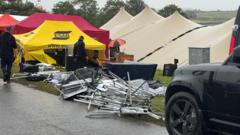
As dawn broke, the true scale of the danger became undeniable. Main marquees were flexing violently, their heavy aluminum supports groaning under the strain. Flags were torn to ribbons. Lightweight trade stands had already been overturned, their contents scattered across the muddy thoroughfares. The decision was made before the gates could open to the public.
Safety won. The show was cancelled.
The announcement went out over the radio waves and digital feeds, hitting the county like a sudden bereavement. For the first time in memory outside of global crises or disease outbreaks like foot-and-mouth, the great gates stayed shut.
The Ripple in the Local Economy
The immediate reaction to a cancellation is often visual—the empty walkways, the flapping canvas, the flashing blue lights of security teams redirecting traffic. But the real crisis ripples outward, far beyond the perimeter fences of the showgrounds, into the quiet corners of the regional economy.
Cornwall relies on the summer influx, but its agricultural backbone relies on the Royal Cornwall Show. For three days, this patch of land becomes the highest-grossing marketplace in the southwest.
Think of the independent food producers. A small-scale cheesemaker or an artisan cider brewer spends months building up inventory specifically for this weekend. They ferment, age, bottle, and pack thousands of units of stock. They hire extra staff. They pay hefty fees for their pitch inside the food hall. When the show vanishes overnight, that stock doesn’t just sit there; it represents frozen capital, and for perishable goods, it represents a ticking clock toward a total write-off.
The financial hit is a domino effect. The local hotels that were booked solid for a thirty-mile radius suddenly face a wave of cancellations. The marquee hire companies, the security firms, the catering staff, the local petrol stations—everyone loses a vital piece of their yearly income.
Yet, walking through the abandoned showground on that canceled morning, the mood among the exhibitors was not one of anger. It was a quiet, resilient resignation.
The Unspoken Bond of the Soil
There is a distinct stoicism ingrained in the people who work the land. They are accustomed to the reality that nature always holds the highest cards. A late frost can destroy an apple crop; a prolonged drought can burn a pasture to dust; a June gale can rip down a multi-million-pound event.
Watching the farmers load their livestock back into trailers in the driving rain was a lesson in quiet dignity. There were no shouting matches, no frantic arguments with officials. Instead, there was a mutual understanding. Neighbors helped neighbors back their rigs into position through the churning mud. Strangers offered a hand to secure a nervous heifer or tie down a shifting load.
The event was gone, but the community that created it remained entirely intact.
The true cost of the cancellation cannot be measured solely in lost revenue or ruined tents. The real loss was the collective pause—the annual moment where a scattered, often isolated rural population comes together to look each other in the eye, shake hands, and celebrate the shared trial of making a living from the earth.
Later that afternoon, as the wind continued to howl across the empty lanes of Wadebridge, a lone tractor crawled across the hillside, pulling a trailer laden with unused straw bales back toward a nearby farm. The grand banners advertising the show beat a frantic, rhythmic tattoo against the railings, sounding for all the world like a slow, steady drumbeat marking time until next year.