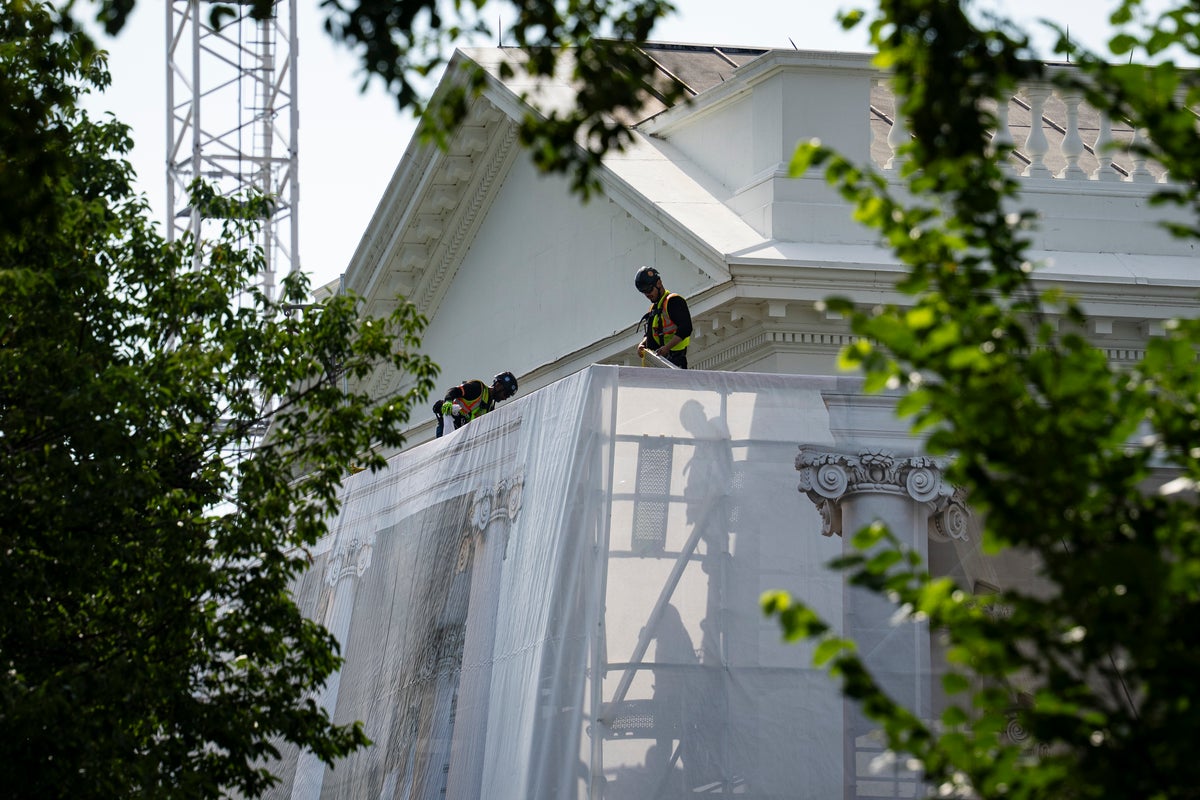
The white paint on the North Portico columns is always thicker than you think. Decades of layers, baked by the humid Potomac summers and cracked by freezing winters, cling to the sandstone like old skin. To the casual tourist standing on Pennsylvania Avenue, the scaffolding that went up around the White House’s iconic entrance looked like standard bureaucratic upkeep. A bit of scraping, a fresh coat of white, a standard government maintenance contract.
But buildings, especially those built by historical hands and occupied by modern anxieties, rarely tell their true stories on the surface.
If you stood near the iron gates during those months of construction, you heard the rhythmic, heavy thud of pneumatic drills and the low rumble of machinery that felt far too intense for simple masonry repair. This was not a mere facelift. Under the guise of fixing historic columns, workers were fundamentally altering the physical relationship between the American presidency and the public.
The front door of the nation was being reinforced against a world that felt increasingly volatile.
The Weight of the Paint
To understand the stakes of a construction project at 1600 Pennsylvania Avenue, you have to look past the political theater and focus on the stone itself. Built largely from Aquia Creek sandstone, the mansion has always been surprisingly fragile. It chips. It absorbs moisture. It requires constant, obsessive care to keep looking like the pristine symbol printed on the back of the twenty-dollar bill.
Consider the perspective of a stone carver working on those columns. Let us call him James, a composite of the dozens of highly specialized tradespeople who sign strict non-disclosure agreements before they are allowed to touch the building. James does not care about the daily press briefings or the cable news outrage. His focus is on the grain of the stone, the legacy of the Scottish masons who first shaped these blocks in the 1790s, and the unsettling reality of what lies beneath the surface.
When you scrape away two centuries of paint, you find the scars of history. You find the scorch marks left by the British in 1814, preserved like charcoal drawings under the protective layers. But during this specific renovation, the workers were not just looking backward. They were preparing for the future.
The columns were indeed cracking, suffering from structural decay caused by water intrusion and the sheer weight of the portico. But the work order went far deeper than stone stabilization. The project quietly incorporated sophisticated defensive measures, transforming a porous historic landmark into a hardened command center.
What the Tourists Didn't See
For generations, the White House was remarkably accessible. In the nineteenth century, citizens could literally walk up to the front door, turn the knob, and ask to see the president. Abraham Lincoln famously complained about the crush of office-seekers filling the hallways. Even through the mid-twentieth century, the public could get close enough to hear the clinking of dinner glasses during state events.
That era is entirely gone. The modern renovation of the North Portico represents the latest, most permanent stage of an ongoing retreat from public accessibility.
Behind the plywood barriers, crews were installing heavy structural reinforcements beneath the driveway. The goal was simple but grim: to ensure that the portico could withstand a high-impact vehicular attack. The beautiful, sweeping carriage path that has welcomed kings, queens, and foreign dignitaries was systematically dug up and rebuilt with reinforced steel and concrete sub-structures.
At the same time, the glass in the historic doors and windows surrounding the entryway was replaced. The new panes look identical to the old ones, complete with the slight imperfections that mimic historic hand-blown glass. But these panes are engineered to withstand ballistic impacts and explosive blast waves.
The light still shines through them, but the outside world is kept at a permanent, heavily engineered distance.
The Architecture of Fear
Every security decision is a balance between safety and symbolism. When you build a fortress, you signal strength, but you also signal fear. If you build high walls, you tell the world that you are afraid of what lies on the other side.
The challenge of modern White House renovations is to build a fortress that still looks like a home.
The security upgrades beneath the North Portico were designed to be invisible. The sensors, the reinforced entry points, the blast-resistant materials—all of it is wrapped in the familiar, comforting language of neoclassical architecture. The ionic columns still soar. The lantern still hangs from the ceiling of the portico, casting a warm, welcoming glow across the driveway at night.
But the warmth is an illusion of engineering. The lantern itself, while historically accurate in appearance, is wired into a sophisticated security grid. Every camera is hidden. Every sensor is color-matched to the trim.
We want our leaders to be safe, yet we want our institutions to remain open. When the physical space of democracy is hardened to the point of near-impenetrability, something subtle but vital is lost. The building ceases to be the "People's House" and becomes, instead, a monument to administrative isolation.
A Fortress in Plain Sight
The work on the front door was eventually completed. The scaffolding came down, the plywood was carted away, and the smell of fresh paint faded into the autumn air. To the average passerby, the White House looked exactly the same as it had for decades. The columns were white, the glass was clear, and the lawn was green.
But the building is different now. It is heavier, stronger, and more closed off than it has ever been in its long history.
The true cost of these security improvements is not measured in the millions of federal dollars spent on specialized concrete and ballistic glass. It is measured in the silent, steady erosion of the idea that the government belongs to the governed. Every reinforced barrier is a physical manifestation of a growing divide, a tangible sign that the space between the street and the oval office is wider than it has ever been.
As the sun sets over Lafayette Park, casting long shadows across the North Lawn, the lights inside the portico flicker on. They illuminate a door that is no longer just a door, but a highly engineered barrier. The people still stand at the fence, looking in through the iron bars, catching a glimpse of a house that is preserved in perfect stone, but locked away from the world it was built to serve.


