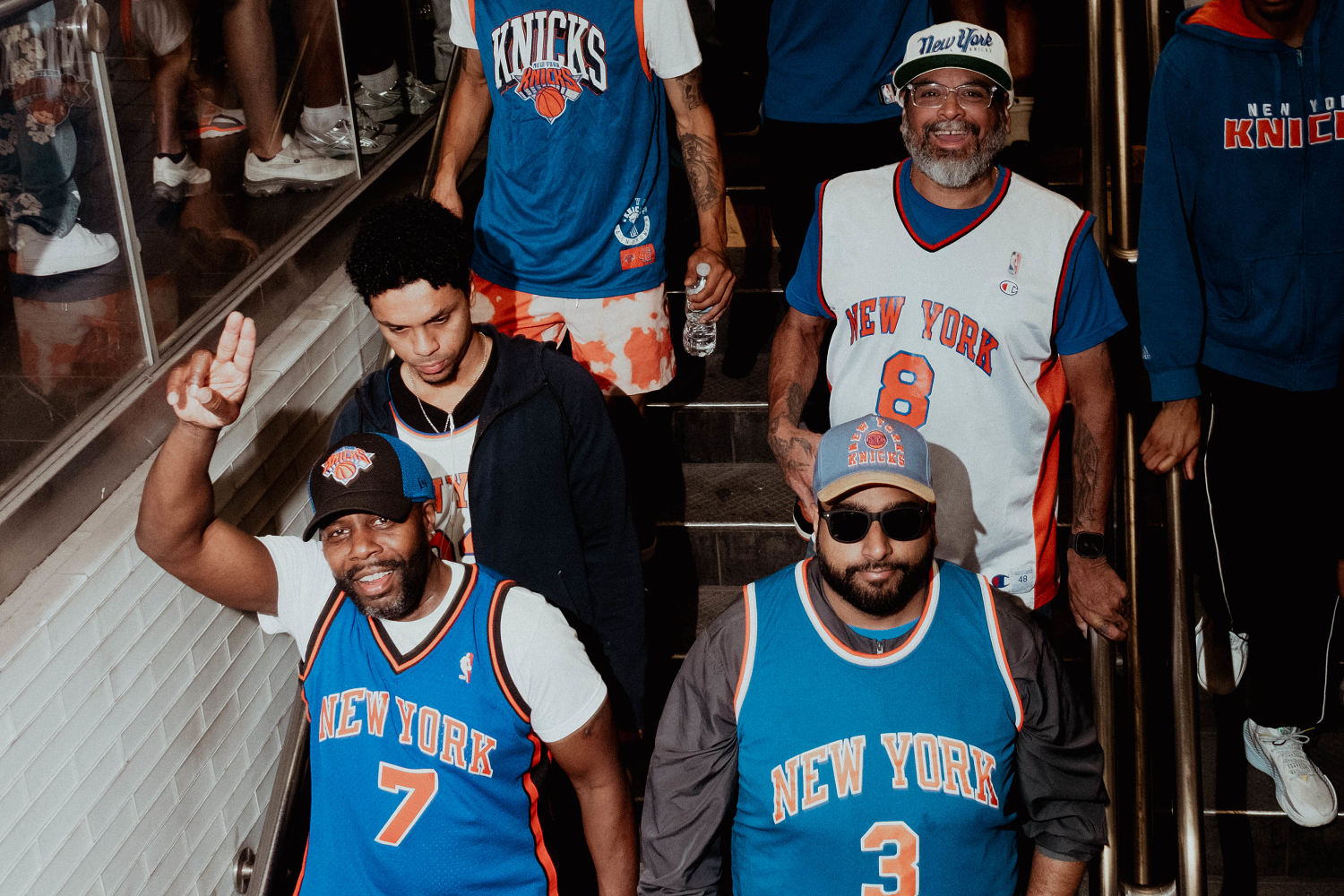
The metallic screech of the 4 train usually drowns out everything else at 161st Street. But not today. Today, the sound was buried under a low, vibrating hum that started somewhere in the soles of your feet before it ever reached your ears.
If you have lived in this city long enough, you learn to read its architecture like a thermometer. You know the exact shade of grey the sky turns before a February blizzard. You know the specific, heavy humidity that traps the scent of roasted nuts and hot asphalt in July. And you know the precise look of a New York sports fan who has spent decades waiting for a shoe that never drops.
For fifty-three years, that shoe hung suspended in mid-air.
Generation after generation grew up on a steady diet of black-and-white highlights from 1973. They listened to their grandfathers talk about Walt Frazier’s style or Willis Reed limping out of the tunnel like a mythological hero. But nostalgia is a cruel currency. It buys you nothing in the present. For over half a century, being a Knicks fan wasn’t about celebrating victories; it was an exercise in collective endurance. It was a shared contract of suffering, passed down from parents to children like a heavy, dented inheritance.
Then came the parade.
The Geography of Relief
Manhattan does not easily yield its grid to celebration. It is a city designed for forward motion, for briefcases cutting through crowds, for aggressive briskness. To stop the traffic on Broadway is to stop the blood flow of the metropolis itself.
Yet, by 9:00 AM, the canyon of heroes was already choked with orange and blue.
Consider a hypothetical fan named Marcus. Marcus is forty-two. He was born nine years after the last championship banner was raised to the rafters of Madison Square Garden. His entire relationship with basketball has been defined by the near-misses of the nineties, the disastrous mismanagement of the two-thousands, and the quiet, crushing realization that maybe greatness was something that only happened to other cities. Marcus brought his teenage daughter, Maya, to the barricades near City Hall.
"I wanted her to see it," Marcus said, his voice already raspy from shouting. "I wanted her to know that the waiting actually ends."
That is the hidden stake of sports that outsiders rarely understand. It is never just about a ball going through a hoop. It is about validation. It is about proof that loyalty—even the stubborn, illogical, borderline-foolish loyalty required to back a struggling franchise for decades—is eventually rewarded.
The crowd was a cross-section of the five boroughs. Wall Street executives in tailored suits stood shoulder-to-shoulder with construction workers from Queens and high school kids who had skipped fifth-period algebra to be there. In a city famously divided by income, neighborhood, and background, the championship acted as a grand equalizer. For one afternoon, everyone possessed the exact same history.
The Sound of Half a Century Releasing
When the open-top buses finally rolled down the avenue, the noise didn’t sound like cheering. It sounded like an exhale.
It was the release of five decades of pent-up frustration. Every bad trade, every draft lottery disappointment, every agonizing playoff exit from yesteryear was washed away in a blizzard of shredded paper. The confetti didn't just fall; it swirled in violent eddies created by the updrafts between the skyscrapers, creating a faux snowstorm in the middle of the celebratory warmth.
The players on the buses looked almost overwhelmed by the scale of it. These were professional athletes, men used to roaring arenas and intense scrutiny. But the Garden holds roughly nineteen-thousand people. The streets of Manhattan hold millions. To see that sea of humanity stretching out as far as the eye could see, all of them wearing your jersey, all of them screaming your name, is a different kind of pressure entirely.
One veteran player stood near the front of the lead float, shaking his head. He didn't dance. He didn't spray champagne immediately. He just stared at the crowd, absorbing the collective emotion of a fan base that had adopted him not just as a talented employee, but as a savior.
The relationship between New York and its basketball team is uniquely intimate. The team plays in the literal heart of the city, sitting directly on top of Penn Station. You cannot separate the subways from the stadium. The energy of the streets bleeds directly up through the hardwood of the court. When the team loses, the commute home feels heavier. When they win, the entire city walks a little faster.
The Anatomy of the Wait
To truly appreciate the chaos of the parade, you have to understand the sheer weight of the drought.
Statistically speaking, the odds of a single franchise going over five decades without a title in a league of thirty teams are brutally high. It requires a perfect storm of bad luck, poor management, and existential hexes. Entire lifetimes were lived entirely within the gap between championships. Children were born, grew up, had their own kids, and grew old without ever seeing a trophy return to Eighth Avenue.
Because of this, the celebration carried a distinct note of reverence alongside the rowdiness.
People carried framed photographs of deceased relatives. They held them high above their heads, facing the floats, as if ensuring their ancestors wouldn't miss the moment. It was a silent acknowledgment that this day belonged to the dead as much as the living. It was a secular ritual of remembrance.
"My dad passed away three years ago," a woman named Elena explained, holding a fading Polaroid of a man in an oversized Patrick Ewing jersey. "He swore he’d live to see them win it all again. He didn't make it. So I'm holding him up today. He’s here."
This is the emotional core that standard news reports miss when they focus solely on attendance numbers or traffic delays. A championship parade is a giant, loud, beer-soaked memorial service for all the years spent in the wilderness. It is the closing of a chapter.
What Happens When the Smoke Clears
By late afternoon, the buses had reached their destination, the speeches had been delivered, and the players had retreated to private parties far away from the pavement.
The crowd began to fracture. The sea of orange and blue slowly separated back into individual commuters, heading toward the subways and the ferries, returning to the reality of their ordinary lives. The magic trick was over. The gridlock loosened, and the regular sounds of Manhattan—the angry honking, the sirens, the construction drills—began to reclaim their territory.
But something had fundamentally shifted.
The heavy, generational anxiety that had hung over the fan base for fifty-three years was gone. It had been replaced by a quiet, immovable fact. No matter what happened next season, no matter how many injuries or bad contract decisions lay in the future, they had this day. The debt had been paid in full.
Walking down Broadway toward the subway, the ground was thick with discarded paper. Millions of white and blue strips coated the asphalt like a blanket. If you stepped on them, they didn't make a sound. But if you looked up at the tops of the buildings, where the wind was still catching the stray pieces of confetti and sending them dancing into the late sun, you could still feel it.
A man in a scuffed leather jacket stopped near a subway grate. He looked down at the paper-covered street, took a deep breath of the exhaust-tinted air, and smiled. He didn't say a word. He just adjusted his blue cap, stepped down into the darkness of the station, and let the city take him home.