Finding a grave for a loved one shouldn't take years. Yet in Gaza, thousands of families wait months or even years just to recover a body from the ruins.
The math of modern urban warfare is brutal. When multi-story residential blocks collapse into pancake layers of concrete and twisted iron, they become hidden tombs.
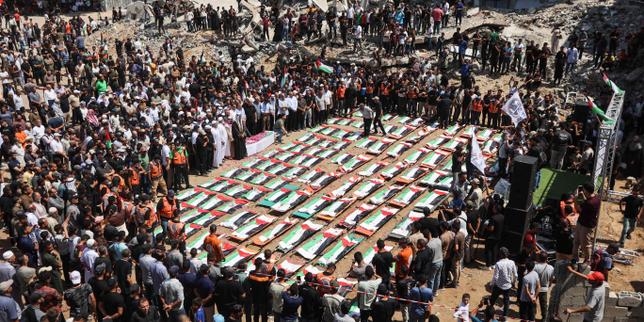
Recently, civil defense teams pulled 112 bodies from a single flattened neighborhood in Gaza City. These victims belonged to families like the Abu Sharia and Al-Hassaina groups. They died together on November 22, 2023, during one of the conflict's most punishing aerial bombardments. Their mass funeral stands as one of the largest collective burials in modern Palestinian history.
Why Recovering Bodies Takes So Long
You cannot clear tons of pulverized concrete with bare hands. Local rescue units operate with a heartbreaking lack of basic equipment. Heavy excavators are rare. Fuel is scarce. Parts for broken machinery basically don't exist under a tight blockade.
When international bodies like the International Committee of the Red Cross manage to supply a couple of operational bulldozers, the progress is painfully slow. Workers spend weeks sifting through dust. They use shovels, pickaxes, and sometimes kitchen utensils to avoid destroying remains.
Mohammed Al-Moughayyir, who directs operations for the Gaza Civil Defense, noted that recovery teams faced horrific conditions. In many instances, skeletal remains stayed intact only because clothing held them together.
Out of the 112 individuals buried in this specific ceremony, 44 were children under the age of sixteen. Thirty-seven were women. Entire family lines vanished from civil registries in a single second.
The Psychological Toll of Unburied Dead
Grief requires closure. Closure requires a physical site. When a body remains missing beneath miles of rubble, mourning freezes in time.
Ahmed Abu Sharia lost multiple relatives in the November 2023 strikes. Standing over the rows of draped coffins, he voiced what thousands of survivors feel. People want to cry over real graves, not abstract spaces. They want to bury their children properly.
The tragedy extends far beyond this single site in the Al-Sabra neighborhood. Civil defense estimates suggest that over 7,000 to 8,000 bodies remain trapped under collapsed buildings across the enclave. Every rainstorm shifts the debris, making recovery even harder. Every summer heatwave accelerates decomposition, turning extraction into a race against time and biology.
The Logistics of Catastrophe
Why won't outside forces step in to speed up recovery? Security restrictions and political deadlock freeze humanitarian logistics. Heavy engineering teams need clearance, coordination, and protection. None of these elements are guaranteed in an active combat zone.
Local authorities report that rescue teams have spent up to 136 continuous hours working on single recovery sites just to pull out a fraction of the dead.
Without a stable ceasefire and open borders for heavy recovery gear, thousands of families will never find peace. The war's final chapter isn't written when the bombs stop falling. It gets written years later, one shovel of dirt at a time.
Mass Funeral Held For 112 Bodies Recovered In Gaza After Almost 3 Years
This video provides on-the-ground footage and reporting of the mass funeral services held for bodies recovered from the rubble in Gaza.
http://googleusercontent.com/youtube_content/1


