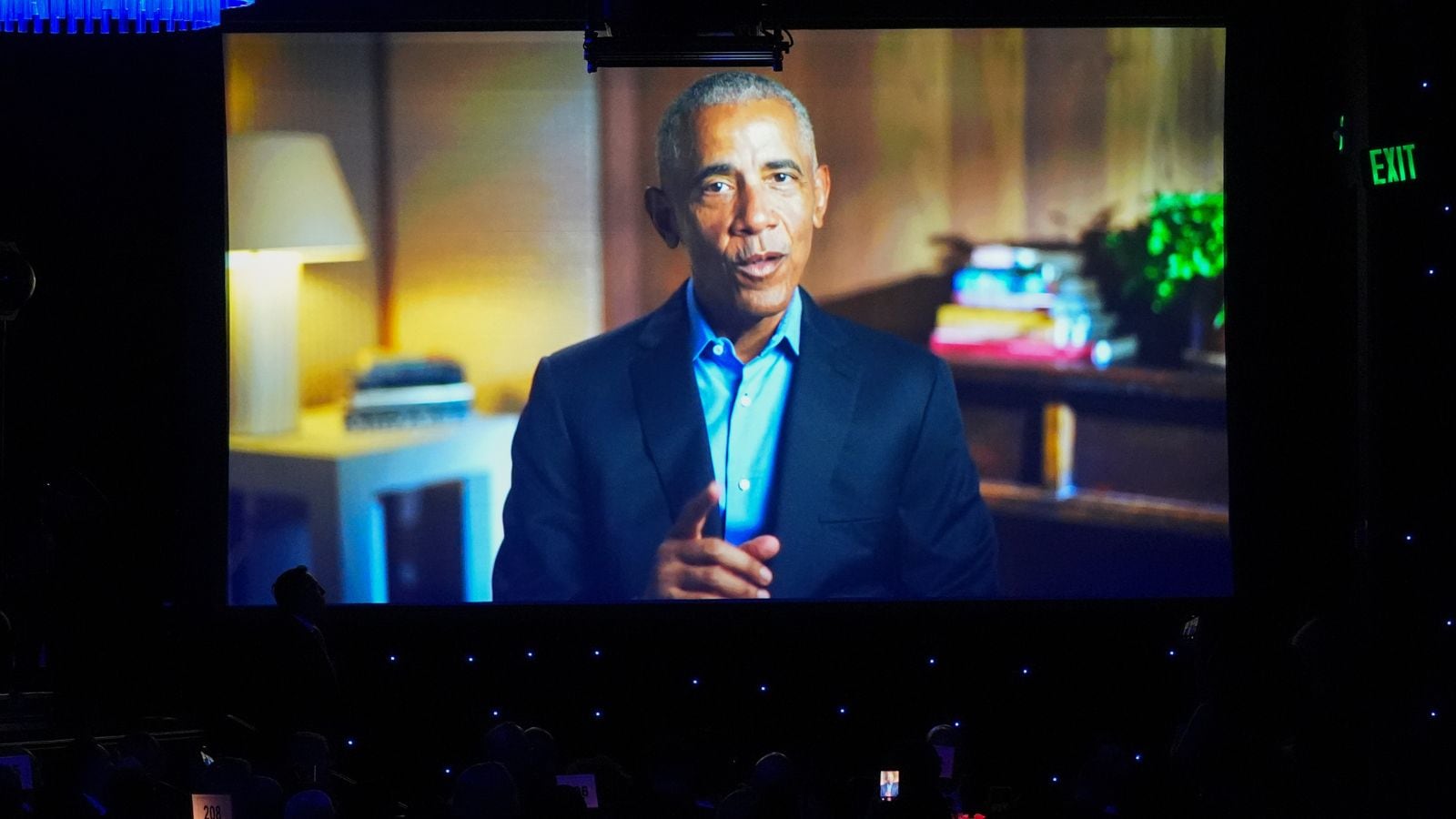
The silence of a former president is a heavy thing. It isn’t just an absence of noise; it’s a deliberate, pressurized choice. For years, Barack Obama operated under the unwritten code of the American presidency—a quiet understanding that those who have held the keys to the Resolute Desk should step back, let the gears of democracy grind, and allow their successors the space to succeed or fail on their own merits.
But every code has a breaking point. If you found value in this article, you might want to look at: this related article.
When a video surfaced of Donald Trump using language that stripped away the thin veneer of political discourse to reveal something much older and uglier, that pressurized silence finally shattered. It wasn’t just about a "racist" video. It was about the slow, agonizing evaporation of shame in the public square.
We used to have red lines. Not the geopolitical kind drawn in the sand of distant deserts, but the invisible ones that dictated how we spoke to one another in the light of day. Shame was the guardian of those lines. It was the internal wince that kept a person from saying the unthinkable. Now, that wince is gone. For another look on this development, check out the latest update from NBC News.
The Ghost in the Machine
Consider a man standing in a grocery store line in a small town in Ohio. Let’s call him Elias. Elias has lived in this town for sixty years. He remembers a time when a public official caught in a blatant lie or a slur would be forced into a stuttering apology and a swift resignation. Not because the law demanded it, but because the collective weight of the community’s disapproval made it impossible to stay.
Shame was a social utility. It functioned like a structural beam in a house; you didn’t notice it until it started to rot.
Obama’s intervention wasn’t merely a political jab. It was an autopsy of that beam. When he spoke out against the viral footage, his voice carried the exhaustion of a man watching the very concept of "public decency" become a punchline. He wasn't just defending a policy or a party; he was defending the idea that there are some things you simply do not say if you wish to lead a diverse, sprawling, and fragile nation.
The numbers back up the feeling that the floor has dropped out from under us. According to data from the FBI’s Uniform Crime Reporting Program, reported hate crimes in the United States saw a significant surge during the mid-to-late 2010s, with a 17% increase in 2017 alone. In 2022, the numbers reached their highest point since the government began tracking such data in the early 1990s, with over 11,000 reported incidents. Statistics are just the math of our misery. They tell us that when the person at the top removes the muzzle, the pack follows suit.
The Anatomy of the Viral Moment
The video in question didn’t just happen. It was a symptom of a culture that has begun to value "authenticity" over "integrity." In this new era, being "unfiltered" is treated as a virtue, even if the filter being removed was the only thing stopping a person from dumping raw sewage into the drinking water.
Donald Trump’s rhetorical style has always relied on the destruction of the taboo. By saying the things that were previously unspeakable, he signaled to a specific segment of the population that the "old rules" no longer applied. This creates a feedback loop. A politician says something incendiary; it goes viral; the outrage fuels the base; the base demands more; the politician obliges.
Obama’s defense of decency is an attempt to interrupt that loop. He pointed out that when we lose the ability to feel shame, we lose the ability to self-correct. A society without shame is a society without a brakes. It just accelerates until it hits a wall.
The Invisible Stakes
Why does it matter if a former president scolds a current candidate for a video? Because the presidency is the nation's most visible moral compass. When that compass starts spinning wildly, everyone loses their sense of direction.
Think about a classroom. A teacher sits at the front. If the teacher allows one student to mock another’s race or background without consequence, the entire climate of the room shifts. The students who were targets feel a new, sharp edge of fear. The students who were bystanders learn that cruelty is a viable path to power. The bully learns that the "red line" was actually a suggestion.
The United States is that classroom, and we have been sitting in a very loud, very tense lesson for a long time.
Obama’s "powerful defense" wasn’t a lecture on policy. It was a reminder that the words we use create the world we live in. If we normalize the language of the video—language that historical patterns show precedes systemic exclusion and violence—we aren't just being "politically incorrect." We are dismantling the social contract.
The Mirror and the Mask
There is a particular kind of discomfort that comes with watching a video like the one Trump released. It’s the discomfort of recognition. We recognize the language because it is the language of our ancestors' failures. It is the language of the eras we claimed we had moved past.
When Obama breaks his silence, he is holding up a mirror. He is asking if this is really who we want to be when the cameras are off and the masks are down.
The defense of public decency is often mocked as "elitist" or "out of touch." Critics argue that people care about the price of gas and the cost of eggs, not whether a politician uses a slur in a video. This is a false choice. The price of gas matters for your wallet, but the death of decency matters for your soul. It matters for the way your children view their neighbors. It matters for whether Elias in Ohio feels safe walking down his street or whether he starts looking at the people in the grocery store line with suspicion.
The Resonance of the Breaking Point
We are living through a grand experiment: Can a democracy survive the total loss of a shared moral vocabulary?
The facts of the matter are documented. The statements were made. The video exists. The reaction from the former president is on the record. But the story doesn't end with the news cycle. It continues in the way we react to it.
If we watch the video and shrug, the line moves again. If we hear Obama’s plea and dismiss it as partisan noise, the rot in the beam deepens.
The real power of Obama’s intervention wasn't in the specific words he used to condemn Trump. It was in the gravity of his presence. It was the reminder that some things are so fundamentally wrong that they require the breaking of a years-long, hard-earned silence.
The "lost shame" he spoke of isn't just Trump's. It's ours. It belongs to anyone who has grown comfortable with the uncomfortable. It belongs to a culture that treats the degradation of human dignity as "content" to be consumed and debated rather than a fire to be extinguished.
We are standing on a bridge that was built by people who believed in the necessity of restraint. They weren't perfect—far from it—but they understood that without a common standard of behavior, the bridge would collapse under the weight of our collective grievances.
The silence has been broken. The warning has been issued. The only question left is whether we are still capable of feeling the sting of the truth, or if we have become so numb that we will simply watch the bridge fall, recording it on our phones as we go down.
The wind is picking up, and the beams are creaking.
Listen.